
 Afrika
 Asia
Asia Yuropa
 Amerika Borwa
 Australia le Oceania
 Antarctica
 Lewatle la Pacific
 Lewatle la Atlantic
 Lewatle la India
 Lewatle la Arctic
 Lewatle la Mediterranean
 Lewatle le Lefubedu
 Lewatle la Caribbean
 Lewatle la Coral
 Lewatle la China Borwa
 Lewatle la Philippine
 Lewatle la Andaman
 Lewatle la Leboya
 Lewatle la Timor le Arafura
 Kgwohlo ya Bengal
 Kgwohlo ya California
Spotted eagle ray
 Ho hlaba
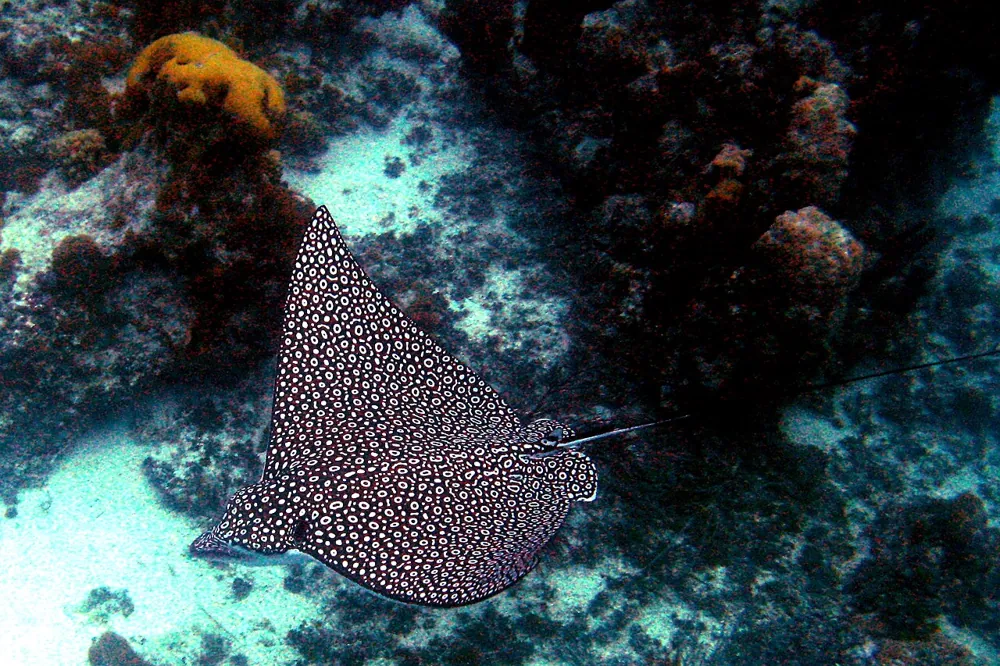
The spotted eagle ray is a flat, disc-shaped fish with dark blue or black skin covered in white spots and a snout shaped like a duck's bill. It lives in warm coastal waters, often near coral reefs and bays. It is known for leaping out of the water, sometimes onto boats.1
 Ho e tseba jwang
Matla a chefo
Chefo e tswa ka lemao le hlabang.
E kotsi hakae ho batho?
Kotsi ho batho: E bohlokoE ka utlwisa bohloko haholo, empa hoo e batlang e le kamehla ha e kotsi haholo.Spotted eagle rays are shy and generally avoid human contact, so they do not pose a significant threat to people. There have been several reports of them leaping onto boats and landing on people. In one incident in the Florida Keys, a woman died.1
E etsang ha e tshohile?
When threatened, it can leap out of the water, and it avoids human contact.1
 Haeba e hlaba
- Kenya leqeba metsing a tjhesang, a tjhesang hoo motho a ka a mamellang ntle le ho tjha (a leke ka letsoho la hao pele), metsotso e 30 ho isa ho e 90. Fumana thuso ya bongaka, haholoholo bakeng sa di-stonefish le di-stingray.
Kamehla letsetsa nomoro ya tshohanyetso pele (112, 000, 911). Ena ke tataiso e akaretsang ya thuso ya pele, hase keletso ya bongaka. Metheo ya thuso ya pele
 Dula o bolokehile
- O se ke wa ama, wa tshwara kapa wa tena phoofolo ya naheng, leha e le e nyenyane, le leha e shebahala e robetse kapa e shwele.
- E fe sebaka. Ha o kopana le yona, dula o kgutsitse, kgutlela morao butle mme o e tlohele e tsamaye ka tsela ya yona.
- Haeba e nngwe e o hlaba: dula o kgutsitse, o se ke wa sisinyeha, letsetsa nomoro ya tshohanyetso (112, 000, 911) kapa o ye sepetlele kapele. Hopola hore e ne e shebahala jwang, foto e a thusa.
Ha e o batle. E sebedisa chefo ya yona ho tshwara dijo kapa ho itshireletsa, mme e kgetha ho ipata. Ho eketsehileng ka ho dula o bolokehile
Hokae lefatsheng?
E kgolo hakae?
E telele hakae?
E boima hakae?
 e telele jwaloka dintja tse 5 ho tloha nkong ho isa mohatleng
 e telele jwaloka dibanana tse 28 tse latellanang
 e ka sesa bolelele ba letangwane le leholo la ho sesa (50 m) ka metsotswana e 6
Spotted eagle ray e kgolo hakae ha e bapiswa le WENA?
Ke dipalo feela ka hara sebatli sa hao. Ha ho letho le bolokwang kapa le romelwang kae kapa kae.
E potlaka hakae?


Dintlha
The largest spotted eagle rays have a wingspan of up to 3 metres and can weigh 230 kilograms.1
When digging for food, a cloud of sand surrounds the ray and sand is blown out through its gills.1
Sharks such as the tiger shark, bull shark and great hammerhead hunt spotted eagle rays. Sharks have also been seen following females during birth to eat the newborn pups.1
Spotted eagle rays are most often seen alone, but they sometimes swim in groups of 6 or more.1
The Great Barrier Reef protects this ray, and in Florida it is illegal to fish for, land, buy or trade it.1
Newborn pups have discs measuring 17 to 35 centimetres across, and they mature in 4 to 6 years.1
Ho senya ditshomo
Tshomo: Spotted eagle rays are a major danger to people.
Nnete: They are shy and generally avoid human contact, so they do not pose a significant threat to humans. Leaping onto boats is rare but has caused harm.1
Bakeng sa ditsebi tsa chefo
- Lebitso la saense
- Aetobatus narinari
- Sehlopha
- Ditlhapi tse nang le chefo
- Lelapa
- Aetobatidae2
- Tatelano
- Myliobatiformes
- Dikontinente
- Lewatle la Atlantic, Lewatle la Pacific, Lewatle la India, Lewatle la Caribbean, Kgwohlo ya Mexico, Lewatle le Lefubedu, Lewatle la Timor le Arafura, Kgwohlo ya Bengal, Kgwohlo ya California, Mawatle
- Masea
- They give birth to live young. The eggs hatch inside the mother after a gestation period of one year, and she gives birth to a maximum of four pups.1
- Boemo ba yona naheng
- Near Threatened1
- Kotsi ho batho
- 2 / 5: E bohloko3
Moo dintlha di tswang teng
- Spotted eagle ray (Wikipedia (CC BY-SA 4.0))
- Aetobatus narinari (iNaturalist): mabitso le tlhophiso.
- Venom Wiki: boemo ba kotsi, boholo bo tlwaelehileng le kakanyo ya lebelo ke tsa rona. Bona kamoo re di balang ka teng: Kamoo re lekanyang kotsi ka teng.
Taba e nngwe le e nngwe leqepheng lena e na le nomoro e bontshang mohlodi wa yona. Haeba re entse phoso, re kopa tshwarelo, re barati ba diphoofolo, hase makasine wa saense. Re bolelle ho [email protected] mme re tla e lokisa.
 Phepheng e lapile! Venom Wiki ke projeke ya motho a le mong: ke mahala, ha e na dipapatso ebile ha e na di-tracker. Thuso e nyenyane ya tjhelete e e boloka e ntse e le inthaneteng.Fepa phepheng
Tse ding tsa sehlopha se le seng: Ditlhapi tse nang le chefo
 Reef stonefishDitlhapi tse nang le chefoE ka bolayaO se ke wa ama
 Red lionfishDitlhapi tse nang le chefoE hloka ngakaO se ke wa ama
 Estuarine stonefishDitlhapi tse nang le chefoE ka bolayaO se ke wa ama
 Short-tail stingrayDitlhapi tse nang le chefoE ka bolaya
 Striped eel catfishDitlhapi tse nang le chefoE ka bolayaO se ke wa ama
 Bluespotted ribbontail rayDitlhapi tse nang le chefoE hloka ngaka
E boetse e phela: Lewatle la Atlantic
 Hawksbill sea turtleDiphoofolo tse ding tse chefangE ka bolaya
 Portuguese man o' warDi-jellyfish le diphoofolo tsa lewatle tse hlabangE hloka ngakaO se ke wa ama
 Blue sea dragonDikgofu tsa cone le di-octopusE utlwisa bohloko feela
 Greenland sharkDiphoofolo tse ding tse chefangE utlwisa bohloko feela
 Lion's mane jellyfishDi-jellyfish le diphoofolo tsa lewatle tse hlabangE utlwisa bohloko feelaO se ke wa ama
 Common octopusDikgofu tsa cone le di-octopusHa e na kotsi