
 Afrika
 Asia
Asia Yuropa
 Amerika Borwa
 Australia le Oceania
 Antarctica
 Lewatle la Pacific
 Lewatle la Atlantic
 Lewatle la India
 Lewatle la Arctic
 Lewatle la Mediterranean
 Lewatle le Lefubedu
 Lewatle la Caribbean
 Lewatle la Coral
 Lewatle la China Borwa
 Lewatle la Philippine
 Lewatle la Andaman
 Lewatle la Leboya
 Lewatle la Timor le Arafura
 Kgwohlo ya Bengal
 Kgwohlo ya California
Variable bush viper
 Ho loma
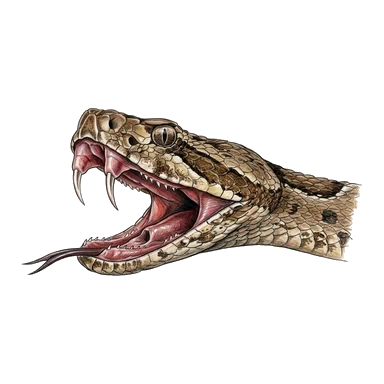
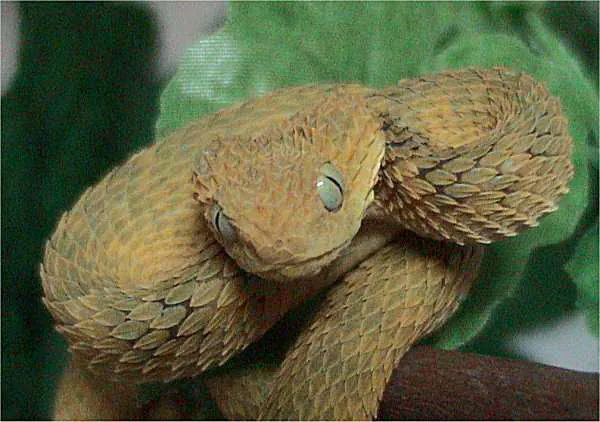
The variable bush viper is a venomous snake that lives in the rainforests of west and central Africa. It is a tree-dwelling viper that blends in well with the leaves of the bushes it hunts in. Its bite can cause serious harm, so it is important to recognise it.1
 Ho e tseba jwang
- Usually green, but the colour varies from sage or light green to dark green, bluish, olive or dark olive brown.1
- Rare individuals may be yellow, reddish or slate grey.1
- Light-coloured crossbands or chevrons (V-shaped marks) run along the body, usually 30 or more.1
- The tail has a clear ivory white tip.1
Matla a chefo
Chefo e tswa ka meno a yona a chefo (fangs) kapa ka meno a mang ha e loma.
Chefo ya yona (eo e e kenyang ka ho loma kapa ho hlaba) e etsang?
It has hemotoxic venom, which affects the blood. It is injected through two hollow fangs at the front of the mouth. Bites have caused at least one case of severe haematological (blood) complications. The venom is used to make prey defenceless.1
E kotsi hakae ho batho?
Kotsi ho batho: E tebilengHo longwa ho hloka ngaka. Lefu le etsahala ka seoelo haholo.Bites have caused at least one case of severe blood complications and two deaths. No specific antivenom is made for this genus, though antivenom for the genus Echis has been shown to be partly effective against its venom.1
 Ditaba tse monate: dingaka di na le moriana (antivenom) kapa kalafo bakeng sa sena.1
 Haeba e loma
- Boloka motho a sa sisinyehe ebile a kgutsitse, boloka setho se lomilweng se lekana le bophahamo ba pelo, tlosa mesale le dintho tse tiileng, mme o mo ise sepetlele kapele.
Kamehla letsetsa nomoro ya tshohanyetso pele (112, 000, 911). Ena ke tataiso e akaretsang ya thuso ya pele, hase keletso ya bongaka. Metheo ya thuso ya pele
 Dula o bolokehile
- O se ke wa ama, wa tshwara kapa wa tena phoofolo ya naheng, leha e le e nyenyane, le leha e shebahala e robetse kapa e shwele.
- E fe sebaka. Ha o kopana le yona, dula o kgutsitse, kgutlela morao butle mme o e tlohele e tsamaye ka tsela ya yona.
- Haeba e nngwe e o loma: dula o kgutsitse, o se ke wa sisinyeha, letsetsa nomoro ya tshohanyetso (112, 000, 911) kapa o ye sepetlele kapele. Hopola hore e ne e shebahala jwang, foto e a thusa.
Ha e o batle. E sebedisa chefo ya yona ho tshwara dijo kapa ho itshireletsa, mme e kgetha ho ipata. Ho eketsehileng ka ho dula o bolokehile
Hokae lefatsheng?
E kgolo hakae?
E telele hakae?
 e telele jwaloka dibanana tse 4 tse latellanang
 e ka matha metara e 100 ka metsotswana e 110 (motho ya potlakang ka ho fetisisa o hloka 9,6)
Variable bush viper e kgolo hakae ha e bapiswa le WENA?
Ke dipalo feela ka hara sebatli sa hao. Ha ho letho le bolokwang kapa le romelwang kae kapa kae.
E potlaka hakae?


Dintlha
Newborn snakes are already venomous and fully independent, so their mother leaves them as soon as they are born.1
Young snakes have a dark olive colour with wavy bars. Their adult colours develop within 3 to 4 months.1
Breeding in captivity needs very high humidity.1
Captive keepers and breeders often call it simply a "Squam".1
It is the most widely distributed species in its genus, Atheris.1
Bakeng sa ditsebi tsa chefo
- Lebitso la saense
- Atheris squamigera
- Sehlopha
- Di-viper le di-adder
- Lelapa
- Viperidae2
- Tatelano
- Squamata
- Dikontinente
- Afrika
- Masea
- It gives birth to live young. A single litter can have up to 19 young, though the average is 7 to 9. The young are venomous at birth and are left by their mother straight away.1
- Kotsi ho batho
- 3 / 5: E tebileng3
Moo dintlha di tswang teng
- Atheris squamigera (Wikipedia (CC BY-SA 4.0))
- Atheris squamigera (iNaturalist): mabitso le tlhophiso.
- Venom Wiki: boemo ba kotsi, boholo bo tlwaelehileng le kakanyo ya lebelo ke tsa rona. Bona kamoo re di balang ka teng: Kamoo re lekanyang kotsi ka teng.
Taba e nngwe le e nngwe leqepheng lena e na le nomoro e bontshang mohlodi wa yona. Haeba re entse phoso, re kopa tshwarelo, re barati ba diphoofolo, hase makasine wa saense. Re bolelle ho [email protected] mme re tla e lokisa.
 Phepheng e lapile! Venom Wiki ke projeke ya motho a le mong: ke mahala, ha e na dipapatso ebile ha e na di-tracker. Thuso e nyenyane ya tjhelete e e boloka e ntse e le inthaneteng.Fepa phepheng
Tse ding tsa sehlopha se le seng: Di-viper le di-adder
 Puff adderDi-viper le di-adderE a bolaya
 Gaboon viperDi-viper le di-adderE ka bolaya
 Northeast African carpet viperDi-viper le di-adderE a bolaya
 West African carpet viperDi-viper le di-adderE a bolaya
 Rhinoceros viperDi-viper le di-adderE ka bolaya
 West African Gaboon viperDi-viper le di-adderE ka bolaya
 Black mamba
 Deathstalker
 Egyptian cobra
 Boomslang
 Fat-tailed scorpion
 Western honey bee