
 Afrika
 Asia
Asia Yuropa
 Amerika Borwa
 Australia le Oceania
 Antarctica
 Lewatle la Pacific
 Lewatle la Atlantic
 Lewatle la India
 Lewatle la Arctic
 Lewatle la Mediterranean
 Lewatle le Lefubedu
 Lewatle la Caribbean
 Lewatle la Coral
 Lewatle la China Borwa
 Lewatle la Philippine
 Lewatle la Andaman
 Lewatle la Leboya
 Lewatle la Timor le Arafura
 Kgwohlo ya Bengal
 Kgwohlo ya California
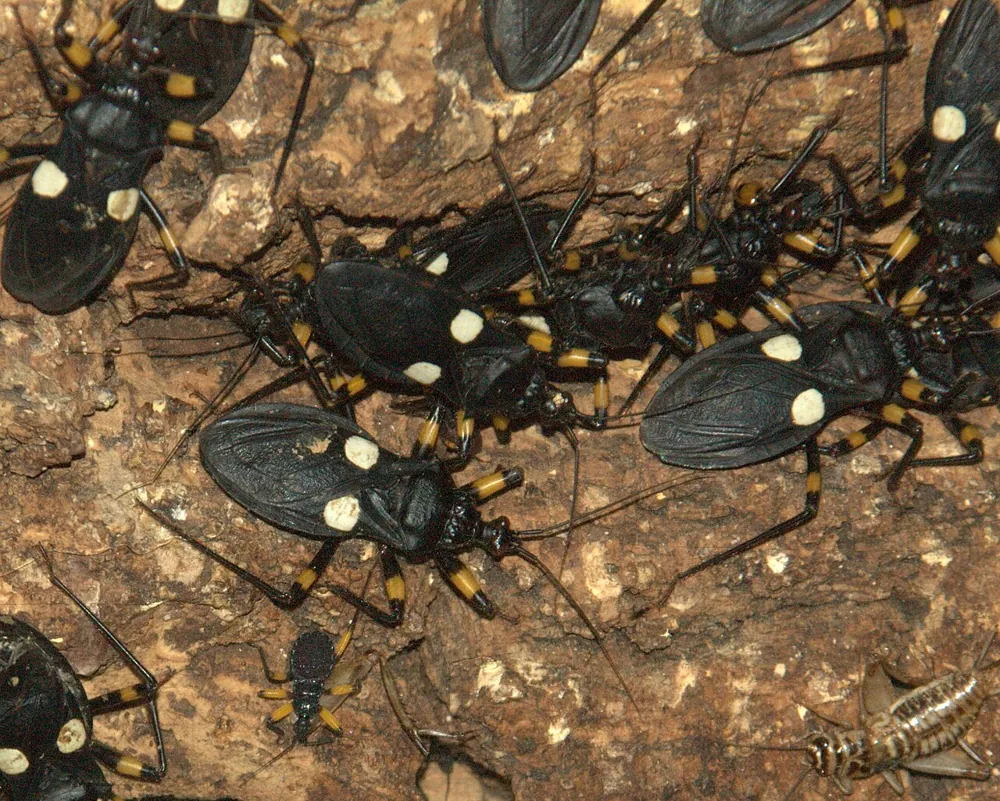
White-spotted assassin bug
 Ho loma
The white-spotted assassin bug is a venomous true bug from tropical Africa. It hunts insects and other small creatures, and it can give a bite that is more painful than a bee sting. It lives in damp tropical forests, often in hollow tree stumps and rotting logs.1



 Ho e tseba jwang
Matla a chefo
Chefo e tswa ka meno a yona a chefo (fangs) kapa ka meno a mang ha e loma.
Chefo ya yona (eo e e kenyang ka ho loma kapa ho hlaba) e etsang?
Its saliva is injected into prey, where it turns the prey's tissues to liquid so the bug can drink them. It can also spit venom, which can cause temporary blindness in humans.1
E kotsi hakae ho batho?
Kotsi ho batho: E bohlokoE ka utlwisa bohloko haholo, empa hoo e batlang e le kamehla ha e kotsi haholo.If disturbed, it can deliver a defensive bite that is more painful than a bee sting. Its spitting venom can cause temporary blindness.1
E etsang ha e tshohile?
When disturbed, it may bite, or spit venom.1
 Haeba e loma
- Bakeng sa boya bo hlabang ba diboko: bo tlose ka theipi e kgomarelang, ebe o hlatswa letlalo. O se ke wa hohla.
- Bakeng sa ho longwa: hlatswa mme o pholise. Fumana thuso ya bongaka haeba motho a ikutlwa a kula kapa a tswa madi habonolo.
Kamehla letsetsa nomoro ya tshohanyetso pele (112, 000, 911). Ena ke tataiso e akaretsang ya thuso ya pele, hase keletso ya bongaka. Metheo ya thuso ya pele
 Dula o bolokehile
- O se ke wa ama, wa tshwara kapa wa tena phoofolo ya naheng, leha e le e nyenyane, le leha e shebahala e robetse kapa e shwele.
- E fe sebaka. Ha o kopana le yona, dula o kgutsitse, kgutlela morao butle mme o e tlohele e tsamaye ka tsela ya yona.
- Haeba e nngwe e o loma: dula o kgutsitse, o se ke wa sisinyeha, letsetsa nomoro ya tshohanyetso (112, 000, 911) kapa o ye sepetlele kapele. Hopola hore e ne e shebahala jwang, foto e a thusa.
Ha e o batle. E sebedisa chefo ya yona ho tshwara dijo kapa ho itshireletsa, mme e kgetha ho ipata. Ho eketsehileng ka ho dula o bolokehile
Hokae lefatsheng?
E kgolo hakae?
E telele hakae?
 e telele jwaloka klipi ya pampiri
White-spotted assassin bug e kgolo hakae ha e bapiswa le WENA?
Ke dipalo feela ka hara sebatli sa hao. Ha ho letho le bolokwang kapa le romelwang kae kapa kae.
E potlaka hakae?


Dintlha
Ho senya ditshomo
Tshomo: Females can breed without mating, through parthenogenesis.
Nnete: This was once thought to be true but has recently been shown not to be. Unmated females lay eggs, but the eggs are infertile.1
Bakeng sa ditsebi tsa chefo
- Lebitso la saense
- Platymeris biguttatus
- Sehlopha
- Diboko le dikokoanyana
- Lelapa
- Reduviidae2
- Tatelano
- Hemiptera
- Dikontinente
- Afrika
- Masea
- Unmated females lay eggs, but these eggs are infertile. Hatchlings are called nymphs, and they look like small adults.1
- Nako ya bophelo
- e ka bang dilemo tse 21
- Kotsi ho batho
- 2 / 5: E bohloko3
Moo dintlha di tswang teng
- Platymeris biguttatus (Wikipedia (CC BY-SA 4.0))
- Platymeris biguttatus (iNaturalist): mabitso le tlhophiso.
- Venom Wiki: boemo ba kotsi, boholo bo tlwaelehileng le kakanyo ya lebelo ke tsa rona. Bona kamoo re di balang ka teng: Kamoo re lekanyang kotsi ka teng.
Taba e nngwe le e nngwe leqepheng lena e na le nomoro e bontshang mohlodi wa yona. Haeba re entse phoso, re kopa tshwarelo, re barati ba diphoofolo, hase makasine wa saense. Re bolelle ho [email protected] mme re tla e lokisa.
 Phepheng e lapile! Venom Wiki ke projeke ya motho a le mong: ke mahala, ha e na dipapatso ebile ha e na di-tracker. Thuso e nyenyane ya tjhelete e e boloka e ntse e le inthaneteng.Fepa phepheng
Tse ding tsa sehlopha se le seng: Diboko le dikokoanyana
 Pine processionaryDiboko le dikokoanyanaE utlwisa bohloko feelaO se ke wa ama
 Red-spotted assassin bugDiboko le dikokoanyanaE utlwisa bohloko feela
 Giant silkworm moth caterpillarDiboko le dikokoanyanaE ka bolayaO se ke wa ama
 Vinchuca kissing bugDiboko le dikokoanyanaE hloka ngaka
 Giant water bugDiboko le dikokoanyanaE utlwisa bohloko feela
 Oak processionaryDiboko le dikokoanyanaE utlwisa bohloko feelaO se ke wa ama
 Black mamba
 Deathstalker
 Egyptian cobra
 Puff adder
 Boomslang
 Fat-tailed scorpion