
 Afrika
 Asia
Asia Yuropa
 Amerika Borwa
 Australia le Oceania
 Antarctica
 Lewatle la Pacific
 Lewatle la Atlantic
 Lewatle la India
 Lewatle la Arctic
 Lewatle la Mediterranean
 Lewatle le Lefubedu
 Lewatle la Caribbean
 Lewatle la Coral
 Lewatle la China Borwa
 Lewatle la Philippine
 Lewatle la Andaman
 Lewatle la Leboya
 Lewatle la Timor le Arafura
 Kgwohlo ya Bengal
 Kgwohlo ya California
Yellow garden spider
 Ho loma
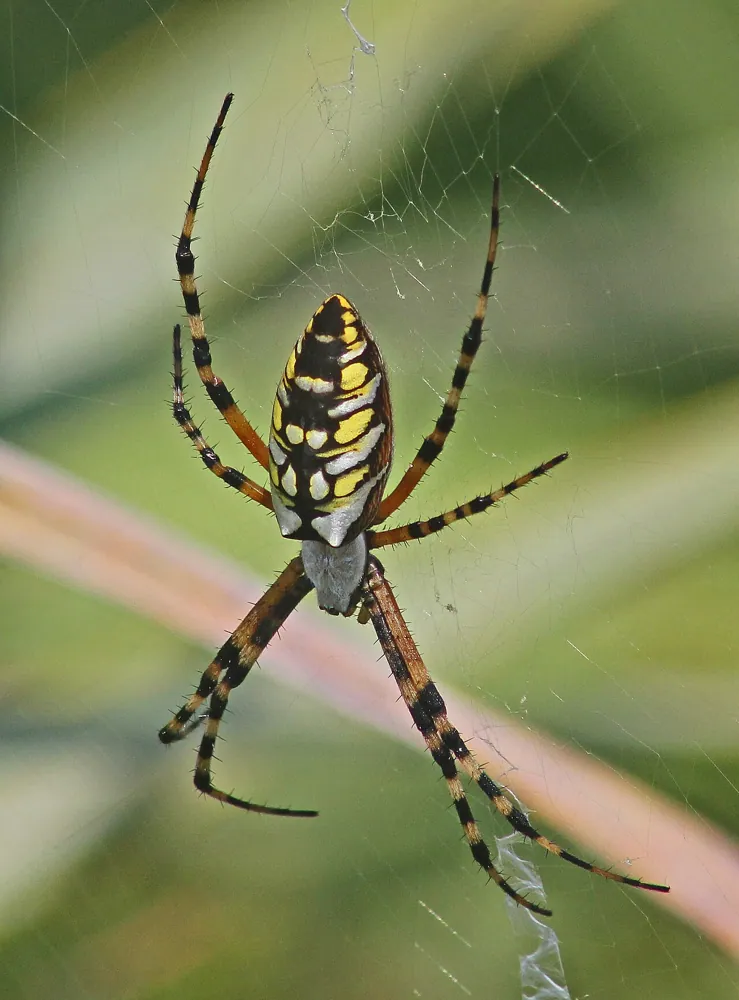
The yellow garden spider is a large, colourful spider with yellow and black markings on its abdomen. It builds big round webs in sunny fields, gardens and along the eaves of houses in North America, Mexico and Central America. It bites only if disturbed or handled, and its bite is comparable to a bee sting.1


 Ho e tseba jwang
- Yellow and black markings on the abdomen (the rear part of the body).1
- A mostly white front body section (cephalothorax).1
- A large, circular web up to 60 cm across, with a dense zigzag of silk in the centre.1
- The female sits in the centre of the web, usually facing straight down.1
- Females measure 19–28 mm in body length, while males are much smaller at 5–9 mm.1
Matla a chefo
Chefo e tswa ka meno a yona a chefo (fangs) kapa ka meno a mang ha e loma.
Chefo ya yona (eo e e kenyang ka ho loma kapa ho hlaba) e etsang?
The venom contains polyamine toxins, including one called argiotoxin ArgTX-636, which are being studied for possible medical uses. For most people the venom is harmless, and a bite causes redness and swelling, similar to a bee sting. It is harmless to people who are not allergic.1
E kotsi hakae ho batho?
Kotsi ho batho: E bobebeJwaloka ho hlajwa ke notshi kapa ho fetang moo. Ha e na kotsi ho batho.These spiders are not aggressive and only bite if grabbed or disturbed. For a healthy adult, a bite is not considered an issue. People who are very young, elderly, or have weakened immune systems should take the same care they would around a beehive or hornet nest.1
E etsang ha e tshohile?
If disturbed by a possible predator, the female may drop from her web and hide on the ground nearby, and she can shake the web vigorously while staying attached in the centre.1
 Haeba e loma
- Hlatswa moo e lomileng teng mme o bee pakete ya leqhwa hodima teng bakeng sa bohloko. Fumana thuso ya bongaka haeba bohloko bo le matla, bo phatlalla kapa motho a ikutlwa a kula.
Kamehla letsetsa nomoro ya tshohanyetso pele (112, 000, 911). Ena ke tataiso e akaretsang ya thuso ya pele, hase keletso ya bongaka. Metheo ya thuso ya pele
 Dula o bolokehile
- O se ke wa ama, wa tshwara kapa wa tena phoofolo ya naheng, leha e le e nyenyane, le leha e shebahala e robetse kapa e shwele.
- E fe sebaka. Ha o kopana le yona, dula o kgutsitse, kgutlela morao butle mme o e tlohele e tsamaye ka tsela ya yona.
- Haeba e nngwe e o loma: dula o kgutsitse, o se ke wa sisinyeha, letsetsa nomoro ya tshohanyetso (112, 000, 911) kapa o ye sepetlele kapele. Hopola hore e ne e shebahala jwang, foto e a thusa.
Ha e o batle. E sebedisa chefo ya yona ho tshwara dijo kapa ho itshireletsa, mme e kgetha ho ipata. Ho eketsehileng ka ho dula o bolokehile
Hokae lefatsheng?
E kgolo hakae?
E telele hakae?
 e telele jwaloka klipi ya pampiri
 e ka matha metara e 100 ka metsotswana e 280 (motho ya potlakang ka ho fetisisa o hloka 9,6)
Yellow garden spider e kgolo hakae ha e bapiswa le WENA?
Ke dipalo feela ka hara sebatli sa hao. Ha ho letho le bolokwang kapa le romelwang kae kapa kae.
E potlaka hakae?


Dintlha
The female can shake her web vigorously to make it harder for wasps and birds to target her, and to fully tangle an insect before it cuts itself free.1
After mating, the male often dies and is sometimes eaten by the female, as he inserts his second palpal bulb.1
The zigzag silk in the web, called a stabilimentum, may camouflage the spider, attract prey, or warn birds away, but its purpose is still disputed.1
In a case observed in Georgia, a European hornet cut free prey caught in a yellow garden spider's web, and the spider did not fight it, probably because it dropped from the web and hid.1
Ho senya ditshomo
Tshomo: Yellow garden spiders are dangerous and their bite can seriously harm a healthy adult.
Nnete: The venom is harmless to people who are not allergic. A bite is comparable to a bumblebee sting and is not considered an issue for healthy adults.1
Bakeng sa ditsebi tsa chefo
- Lebitso la saense
- Argiope aurantia
- Sehlopha
- Dikgo
- Lelapa
- Araneidae2
- Tatelano
- Araneae
- Dikontinente
- Amerika Leboya
- Masea
- Each female produces one to four egg sacs, each holding perhaps over a thousand eggs, and in spring the tiny spiderlings emerge and some are carried away on silk strands by the breeze.1
- Kotsi ho batho
- 1 / 5: E bobebe3
Moo dintlha di tswang teng
- Argiope aurantia (Wikipedia (CC BY-SA 4.0))
- Argiope aurantia (iNaturalist): mabitso le tlhophiso.
- Venom Wiki: boemo ba kotsi, boholo bo tlwaelehileng le kakanyo ya lebelo ke tsa rona. Bona kamoo re di balang ka teng: Kamoo re lekanyang kotsi ka teng.
Taba e nngwe le e nngwe leqepheng lena e na le nomoro e bontshang mohlodi wa yona. Haeba re entse phoso, re kopa tshwarelo, re barati ba diphoofolo, hase makasine wa saense. Re bolelle ho [email protected] mme re tla e lokisa.
 Phepheng e lapile! Venom Wiki ke projeke ya motho a le mong: ke mahala, ha e na dipapatso ebile ha e na di-tracker. Thuso e nyenyane ya tjhelete e e boloka e ntse e le inthaneteng.Fepa phepheng
 Brown recluse
 Southern black widow
 Northern black widow
 Western black widow
 Bold jumping spider
 Golden silk orb-weaver
 Terciopelo
 Eastern coral snake
 Eastern diamondback rattlesnake
 Eyelash viper
 Timber rattlesnake
 Western diamondback rattlesnake