
 Aforika
 Asia
Asia Yuropa
 Amerika Borwa
 Australia le Oceania
 Antarctica
 Lewatle la Pacific
 Lewatle la Atlantic
 Lewatle la India
 Lewatle la Arctic
 Lewatle la Mediterranean
 Lewatle le Lehibidu
 Lewatle la Caribbean
 Lewatle la Coral
 Lewatle la China Borwa
 Lewatle la Philippines
 Lewatle la Andaman
 Lewatle la Bokone
 Lewatle la Timor le la Arafura
 Kou ya Bengal
 Gulf ya California
Brazilian brown scorpion
 Go tlhaba
The Brazilian brown scorpion is a venomous scorpion found in South America. It lives mostly in Brazil, Argentina and Paraguay, and is very common in farming areas. It matters because it is one of the scorpions most often linked to stings in rural places.1


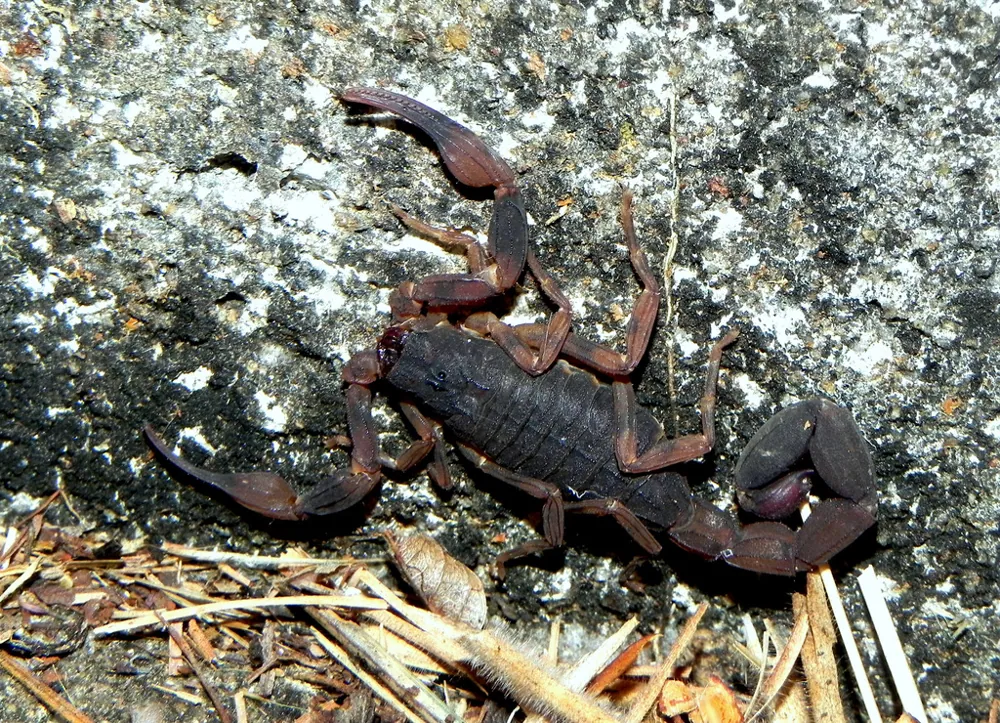
 Tsela ya go e lemoga
Maatla a botlhole
Botlhole bo tswa ka lemao le le tlhabang.
Botlhole jo e bo tsenyang bo dira eng?
Its venom is neurotoxic, meaning it attacks the nerves. Symptoms include severe pain, swelling, sweating, lethargy, fast heart rate, pulmonary (lung) oedema, difficulty breathing, pancreatitis, nausea, vomiting and changes in blood pressure. The venom's LD50 is 0.5 mg/kg, a measure of how toxic it is to test animals.1
E kotsi go le kae go batho?
Kotsi go batho: E masisiGo tlhabiwa ke yone go tlhoka ngaka. Go swa go seoka thata.It is the main cause of scorpion sting cases in rural areas and is often ranked the second most toxic of its kind, behind only T. serrulatus.1
E dira eng fa e tshogile?
It is not aggressive and avoids humans, but if threatened it will defend itself with its sting.1
 Fa e tlhaba
- Tsidifatsa fa go tlhabilweng ka pakana ya aese mme o dire gore motho a nne a sa tshikinyege. Batla thuso ya bongaka ka bonako, bogolo jang go bana: diphepheng dingwe di bolaya bana.
Ka gale leletsa nomoro ya gago ya tshoganyetso pele (112, 000, 911). Se ke kaelo e e akaretsang ya thuso ya ntlha, ga se kgakololo ya bongaka. Motheo wa thuso ya ntlha
 Nna o babalesegile
- O se ka wa ama, wa tshwara kgotsa wa tshwenya phologolo ya naga, le fa e le e nnye, le fa e lebega e robetse kgotsa e sule.
- E fe sebaka. Fa o kopana le yone, ritibala, boela morago ka bonya mme o e tlogele e tsamaye ka tsela ya yone.
- Fa e nngwe e go tlhaba: ritibala, o se ka wa tshikinyega, leletsa nomoro ya gago ya tshoganyetso (112, 000, 911) kgotsa o ye bookelong ka bonako. Gopola gore e ne e lebega jang, setshwantsho se a thusa.
Ga e go batle. E dirisa botlhole jwa yone go tshwara dijo kgotsa go itshireletsa, mme e rata go iphitlha go feta. Go le gontsi ka go nna o babalesegile
Kae mo lefatsheng?
E kgolo go le kae?
E telele go le kae?
 boleele jo bo lekanang le diboloko tsa go aga tsa ditshamekisi di le 2 mo moleng
 e ka taboga dimetara di le 100 ka metsotswana e le 260 (motho yo o bonako go gaisa o tlhoka 9,6)
Brazilian brown scorpion e kgolo go le kae fa e bapisiwa le WENA?
Ke dipalo fela mo sefetleng sa gago (browser). Ga go sepe se se bolokwang kgotsa se se romelwang gope.
E bonako go le kae?


Dintlha
It is often called the second most toxic scorpion of its kind, after T. serrulatus.1
Females can give birth to as many as 25 young in one litter.1
It is common in farmland, which is why it causes many stings in rural areas.1
The most common toxin in its venom is Tb1, which makes up about 10% of the soluble venom.1
Ya baitseanape ba botlhole
- Leina la saense
- Tityus bahiensis
- Setlhopha
- Diphepheng
- Lelapa
- Buthidae2
- Lekoko
- Scorpiones
- Dikontinente
- Amerika Borwa
- Masea
- Mating can happen at any time of year but usually from November to April. Gestation lasts 2 to 12 months, and the female gives birth to between 2 and 25 young.1
- Kotsi go batho
- 3 / 5: E masisi3
Kwa dintlha di tswang teng
- Tityus bahiensis (Wikipedia (CC BY-SA 4.0))
- Tityus bahiensis (iNaturalist): maina le thulaganyo ya mefuta.
- Venom Wiki: seelo sa kotsi, bogolo jo bo tlwaelegileng le kakanyo ya lebelo ke tsa rona. Bona kafa re di balang ka teng: Kafa re lekanyang kotsi ka teng.
Ntlha nngwe le nngwe mo tsebeng e e na le nomoro e e supang motswedi wa yone. Fa re dirile phoso, maitshwarelo, re barati ba diphologolo, e seng kgatiso ya saense. Re bolelele kwa [email protected] mme re tla e baakanya.
 Phepheng e tshwerwe ke tlala! Venom Wiki ke porojeke ya motho a le mongwe: ke mahala, ga e na dipapatso le ditraka. Mpho e nnye e thusa go e tshegetsa mo inthaneteng.Fepa phepheng
Tse dingwe tsa setlhopha se se tshwanang: Diphepheng
 Brazilian yellow scorpion
 Amazonian black scorpion
 Caracas scorpion
 Panamanian black scorpion
 Zulia scorpion
 Amazon forest scorpion
E tshela gape kwa: Amerika Borwa
 Golden poison frogDigwagwa tsa botlhole, digwagwa tse dingwe le dinewtE a bolayaO se ka wa ama
 TerciopeloDivaepara tsa mesima (pit vipers)E a bolaya
 Brazilian wandering spiderDigokgoE ka bolaya
 Eyelash viperDivaepara tsa mesima (pit vipers)E ka bolaya
 Golden lanceheadDivaepara tsa mesima (pit vipers)E ka bolaya
 South American bushmasterDivaepara tsa mesima (pit vipers)E ka bolaya