
 Aforika
 Asia
Asia Yuropa
 Amerika Borwa
 Australia le Oceania
 Antarctica
 Lewatle la Pacific
 Lewatle la Atlantic
 Lewatle la India
 Lewatle la Arctic
 Lewatle la Mediterranean
 Lewatle le Lehibidu
 Lewatle la Caribbean
 Lewatle la Coral
 Lewatle la China Borwa
 Lewatle la Philippines
 Lewatle la Andaman
 Lewatle la Bokone
 Lewatle la Timor le la Arafura
 Kou ya Bengal
 Gulf ya California
European beewolf
 Go tlhaba
The European beewolf is a solitary wasp, not a bee. It lives across Europe, North Africa and parts of Africa. The female hunts honey bees to feed her young, which is why it is named after them.1


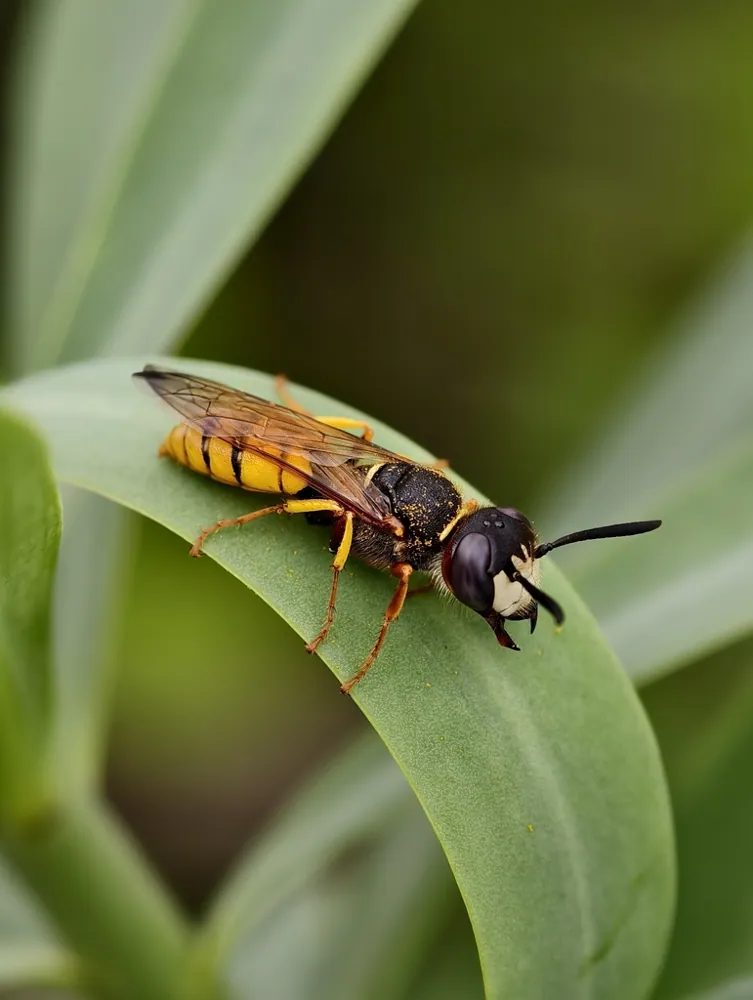
 Tsela ya go e lemoga
Maatla a botlhole
Botlhole bo tswa ka lemao le le tlhabang.
Botlhole jo e bo tsenyang bo dira eng?
The female stings its bee prey to paralyse them, so they stay alive but cannot move. The paralysed bees are stored in the nest as food for the larvae.1
E kotsi go le kae go batho?
Kotsi go batho: Kotsi e nnyeJaaka go tlhabiwa ke notshe kgotsa go le kwa tlase. Ga e na kotsi go batho. Fa e tlhaba
- Ntsha lemao la notshe ka go le kgwaratla, mme o tsidifatse lefelo leo.
- Fa motho a hema ka bothata, sefatlhego kgotsa mometso o ruruga, kgotsa a ikutlwa a tla idibala, ke tshoganyetso ya aletshi: leletsa nomoro ya gago ya tshoganyetso mme o dirise pene ya gagwe ya adrenaline fa a na le yone.
Ka gale leletsa nomoro ya gago ya tshoganyetso pele (112, 000, 911). Se ke kaelo e e akaretsang ya thuso ya ntlha, ga se kgakololo ya bongaka. Motheo wa thuso ya ntlha
 Nna o babalesegile
- O se ka wa ama, wa tshwara kgotsa wa tshwenya phologolo ya naga, le fa e le e nnye, le fa e lebega e robetse kgotsa e sule.
- E fe sebaka. Fa o kopana le yone, ritibala, boela morago ka bonya mme o e tlogele e tsamaye ka tsela ya yone.
- Fa e nngwe e go tlhaba: ritibala, o se ka wa tshikinyega, leletsa nomoro ya gago ya tshoganyetso (112, 000, 911) kgotsa o ye bookelong ka bonako. Gopola gore e ne e lebega jang, setshwantsho se a thusa.
Ga e go batle. E dirisa botlhole jwa yone go tshwara dijo kgotsa go itshireletsa, mme e rata go iphitlha go feta. Go le gontsi ka go nna o babalesegile
Kae mo lefatsheng?
E kgolo go le kae?
E telele go le kae?
 khutshwane go feta monwana wa gago o monnye
 e ka fofa go kgabaganya lebala lotlhe la kgwele ya dinao ka metsotswana e le 15
European beewolf e kgolo go le kae fa e bapisiwa le WENA?
Ke dipalo fela mo sefetleng sa gago (browser). Ga go sepe se se bolokwang kgotsa se se romelwang gope.
E bonako go le kae?


Dintlha
Females protect their young from mould by applying a secretion to the bees, and the egg releases nitric oxide that kills growing fungi.1
Females also secrete a substance containing Streptomyces bacteria, which protect the larva's cocoon from fungal infection.1
The female hunts honey bees, and the species is apparently the only one in its genus that specialises in western honey bees.1
Nests can form large groups, with as many as 15,000 burrows in one aggregation.1
Niko Tinbergen's experiments showed that the wasp identifies its nest by sight.1
In Britain it was once considered one of the great rarities among stinging wasps, but its range has expanded northwards as summers have grown warmer.1
Ya baitseanape ba botlhole
- Leina la saense
- Philanthus triangulum
- Setlhopha
- Dinotshe, diwasepe le dihonete
- Lelapa
- Crabronidae2
- Lekoko
- Hymenoptera
- Dikontinente
- Yuropa, Aforika
- Masea
- The female lays an egg in an underground brood cell with several paralysed bees as food for the larva, and in cooler regions the larva overwinters.1
- Seemo sa yone kwa nageng
- RDB2 (vulnerable) in Britain, though this may be revised because its range and numbers have increased1
- Kotsi go batho
- 1 / 5: Kotsi e nnye3
Kwa dintlha di tswang teng
- European beewolf (Wikipedia (CC BY-SA 4.0))
- Philanthus triangulum (iNaturalist): maina le thulaganyo ya mefuta.
- Venom Wiki: seelo sa kotsi, bogolo jo bo tlwaelegileng le kakanyo ya lebelo ke tsa rona. Bona kafa re di balang ka teng: Kafa re lekanyang kotsi ka teng.
Ntlha nngwe le nngwe mo tsebeng e e na le nomoro e e supang motswedi wa yone. Fa re dirile phoso, maitshwarelo, re barati ba diphologolo, e seng kgatiso ya saense. Re bolelele kwa [email protected] mme re tla e baakanya.
 Phepheng e tshwerwe ke tlala! Venom Wiki ke porojeke ya motho a le mongwe: ke mahala, ga e na dipapatso le ditraka. Mpho e nnye e thusa go e tshegetsa mo inthaneteng.Fepa phepheng
Tse dingwe tsa setlhopha se se tshwanang: Dinotshe, diwasepe le dihonete
 Common waspDinotshe, diwasepe le dihoneteE utlwisa botlhoko fela
 European hornetDinotshe, diwasepe le dihoneteE utlwisa botlhoko fela
 Western honey beeDinotshe, diwasepe le dihoneteE utlwisa botlhoko fela
 European paper waspDinotshe, diwasepe le dihoneteE utlwisa botlhoko fela
 German waspDinotshe, diwasepe le dihoneteE utlwisa botlhoko fela
 Buff-tailed bumblebeeDinotshe, diwasepe le dihoneteGa e na kotsi
E tshela gape kwa: Yuropa
 Common European adderDivaepara le diboloboloE tlhoka ngaka
 Spanish flyDiphologolo tse dingwe tse di botlhole go di ama kgotsa go di jaE tlhoka ngakaO se ka wa ama
 Fire salamanderDigwagwa tsa botlhole, digwagwa tse dingwe le dinewtE utlwisa botlhoko felaO se ka wa ama
 Blunt-nosed viperDivaepara le diboloboloE ka bolaya
 Nose-horned viperDivaepara le diboloboloE ka bolaya
 Ottoman viperDivaepara le diboloboloE ka bolaya