
 Aforika
 Asia
Asia Yuropa
 Amerika Borwa
 Australia le Oceania
 Antarctica
 Lewatle la Pacific
 Lewatle la Atlantic
 Lewatle la India
 Lewatle la Arctic
 Lewatle la Mediterranean
 Lewatle le Lehibidu
 Lewatle la Caribbean
 Lewatle la Coral
 Lewatle la China Borwa
 Lewatle la Philippines
 Lewatle la Andaman
 Lewatle la Bokone
 Lewatle la Timor le la Arafura
 Kou ya Bengal
 Gulf ya California
Greek meadow viper
 Go loma
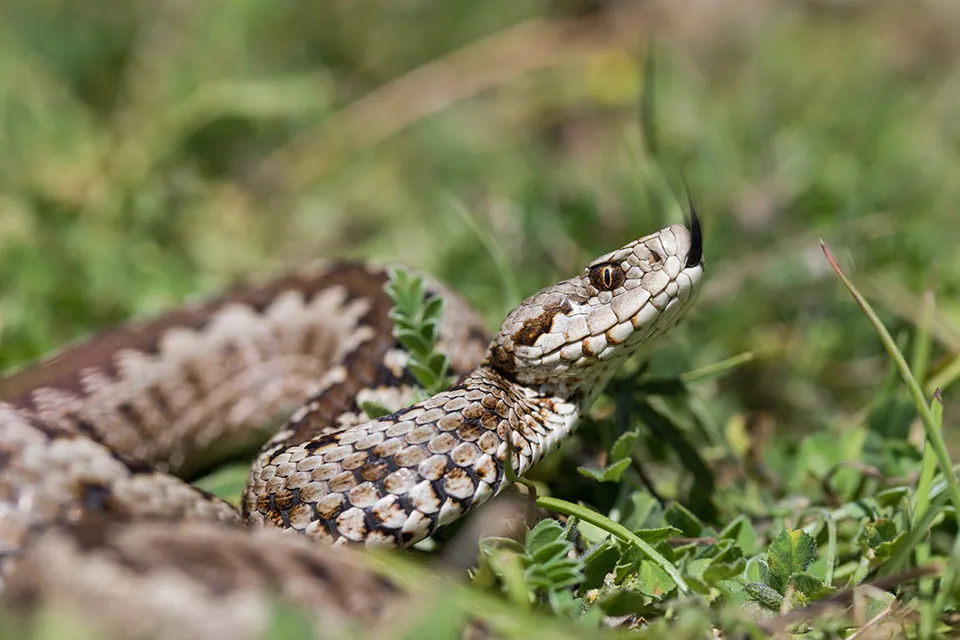
The Greek meadow viper is a small venomous snake that lives in mountain meadows in Albania and Greece. It was once thought to be a type of meadow viper, but scientists now see it as its own species. Its bite is venomous, so it is important to know what it looks like.1

 Tsela ya go e lemoga
- Small body, with a maximum snout-vent length of about 40 to 44 cm, depending on sex. Females are larger.1
- Maximum tail length of about 4 to 5 cm. Males have longer tails.1
- Dark spots are absent from the sides and top of the head, except for stripes behind the eyes and at the back of the head.1
- White or brownish-grey underside.1
- A sharp zigzag pattern along the back. Some males and young show a faint similarity to the meadow viper.1
Gantsi e tlhakanngwa le: It is often compared with the meadow viper (Vipera ursinii), which it closely resembles. The Greek viper has no dark spots on the head sides or top, apart from the head stripes, and it has different scale counts. Some males and juveniles show faint pattern similarities.1
Maatla a botlhole
Botlhole bo tswa ka meno a yone fa e loma.
E kotsi go le kae go batho?
Kotsi go batho: E botlhokoE ka utlwisa botlhoko tota, mme go seoka thata gore e nne masisi. Fa e loma
- Dira gore motho a nne a sa tshikinyege a ritibetse, tshegetsa setho se se lomilweng mo boemong jwa pelo, tlosa direng le dilo tse di tiileng, mme o mo ise bookelong ka bonako.
Ka gale leletsa nomoro ya gago ya tshoganyetso pele (112, 000, 911). Se ke kaelo e e akaretsang ya thuso ya ntlha, ga se kgakololo ya bongaka. Motheo wa thuso ya ntlha
 Nna o babalesegile
- O se ka wa ama, wa tshwara kgotsa wa tshwenya phologolo ya naga, le fa e le e nnye, le fa e lebega e robetse kgotsa e sule.
- E fe sebaka. Fa o kopana le yone, ritibala, boela morago ka bonya mme o e tlogele e tsamaye ka tsela ya yone.
- Fa e nngwe e go loma: ritibala, o se ka wa tshikinyega, leletsa nomoro ya gago ya tshoganyetso (112, 000, 911) kgotsa o ye bookelong ka bonako. Gopola gore e ne e lebega jang, setshwantsho se a thusa.
Ga e go batle. E dirisa botlhole jwa yone go tshwara dijo kgotsa go itshireletsa, mme e rata go iphitlha go feta. Go le gontsi ka go nna o babalesegile
Kae mo lefatsheng?
E kgolo go le kae?
E telele go le kae?
 boleele jo bo lekanang le dipanana di le 2,5 di latelana
 boleele jo bo lekanang le diboloko tsa go aga tsa ditshamekisi di le 14 mo moleng
 e ka taboga dimetara di le 100 ka metsotswana e le 110 (motho yo o bonako go gaisa o tlhoka 9,6)
Greek meadow viper e kgolo go le kae fa e bapisiwa le WENA?
Ke dipalo fela mo sefetleng sa gago (browser). Ga go sepe se se bolokwang kgotsa se se romelwang gope.
E bonako go le kae?


Dintlha
The red fox, common kestrel and short-toed snake eagle are the only known predators of this viper.1
It is most common at high elevations, where annual temperatures average about 6 °C and snow lies until summer.1
Scientists were not sure it was a separate species until 2012, when DNA analysis showed it was its own species.1
Kwa dintlha di tswang teng
- Vipera graeca (Wikipedia (CC BY-SA 4.0))
- Vipera graeca (iNaturalist): maina le thulaganyo ya mefuta.
- Venom Wiki: seelo sa kotsi, bogolo jo bo tlwaelegileng le kakanyo ya lebelo ke tsa rona. Bona kafa re di balang ka teng: Kafa re lekanyang kotsi ka teng.
Ntlha nngwe le nngwe mo tsebeng e e na le nomoro e e supang motswedi wa yone. Fa re dirile phoso, maitshwarelo, re barati ba diphologolo, e seng kgatiso ya saense. Re bolelele kwa [email protected] mme re tla e baakanya.
 Phepheng e tshwerwe ke tlala! Venom Wiki ke porojeke ya motho a le mongwe: ke mahala, ga e na dipapatso le ditraka. Mpho e nnye e thusa go e tshegetsa mo inthaneteng.Fepa phepheng
Tse dingwe tsa setlhopha se se tshwanang: Divaepara le dibolobolo
 Common European adderDivaepara le diboloboloE tlhoka ngaka
 Blunt-nosed viperDivaepara le diboloboloE ka bolaya
 Nose-horned viperDivaepara le diboloboloE ka bolaya
 Ottoman viperDivaepara le diboloboloE ka bolaya
 Asp viperDivaepara le diboloboloE tlhoka ngaka
 Lataste's viperDivaepara le diboloboloE tlhoka ngaka
E tshela gape kwa: Yuropa
 Spanish flyDiphologolo tse dingwe tse di botlhole go di ama kgotsa go di jaE tlhoka ngakaO se ka wa ama
 Common waspDinotshe, diwasepe le dihoneteE utlwisa botlhoko fela
 European hornetDinotshe, diwasepe le dihoneteE utlwisa botlhoko fela
 Fire salamanderDigwagwa tsa botlhole, digwagwa tse dingwe le dinewtE utlwisa botlhoko felaO se ka wa ama
 Western honey beeDinotshe, diwasepe le dihoneteE utlwisa botlhoko fela
 Mediterranean black widowDigokgoE tlhoka ngaka