
 Aforika
 Asia
Asia Yuropa
 Amerika Borwa
 Australia le Oceania
 Antarctica
 Lewatle la Pacific
 Lewatle la Atlantic
 Lewatle la India
 Lewatle la Arctic
 Lewatle la Mediterranean
 Lewatle le Lehibidu
 Lewatle la Caribbean
 Lewatle la Coral
 Lewatle la China Borwa
 Lewatle la Philippines
 Lewatle la Andaman
 Lewatle la Bokone
 Lewatle la Timor le la Arafura
 Kou ya Bengal
 Gulf ya California
White-spotted puffer
 E botlhole go e jaE ja: Bonnye jwa sengwe le sengweE botlhole go e ama kgotsa go e ja, ga e tsenye botlhole
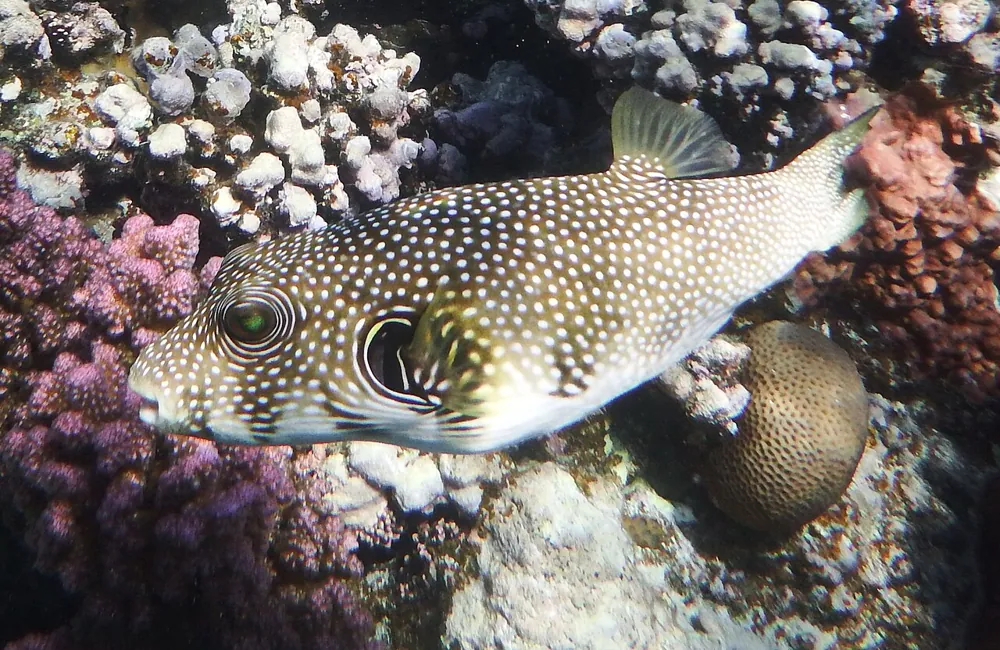
The white-spotted puffer is a medium to large fish that can grow to 50 cm long. It lives in warm seas across the Indo-Pacific, and it is poisonous to eat. Its skin is covered in white spots and it has patterned rings around its eyes.1



 Tsela ya go e lemoga
- Light grey, greyish or yellowish body, covered in white points1
- White spots form concentric white and dark grey lines that radiate around the eyes and pectoral fins1
- White belly1
- A dark 'shoulder' area around the pectoral fins1
- Adults show many white rings around the eyes; juveniles have incomplete rings1
Maatla a botlhole
E kotsi fela fa sengwe se e ja.
E kotsi go le kae go batho?
Kotsi go batho: E kotsi thataE ka bolaya motho yo o sa alafiweng.It is poisonous to eat.1
 Fa mongwe a e amile kgotsa a e jele
- Fa mongwe a e jele kgotsa a na le matshwao morago ga go e ja: leletsa nomoro ya gago ya tshoganyetso kgotsa senthara ya botlhole ka yone nako eo.
Ka gale leletsa nomoro ya gago ya tshoganyetso pele (112, 000, 911). Se ke kaelo e e akaretsang ya thuso ya ntlha, ga se kgakololo ya bongaka. Motheo wa thuso ya ntlha
 Nna o babalesegile
- O se ka wa ama, wa tshwara kgotsa wa tshwenya phologolo ya naga, le fa e le e nnye, le fa e lebega e robetse kgotsa e sule.
- E fe sebaka. Fa o kopana le yone, ritibala, boela morago ka bonya mme o e tlogele e tsamaye ka tsela ya yone.
- Fa o e amile kgotsa o e jele: o se ka wa gotlha matlho kgotsa molomo wa gago, tlhatswa diatla mme o batle thuso ya bongaka.
Ga e go batle. Botlhole jwa yone bo teng fela gore sepe se se ka se e je. Go le gontsi ka go nna o babalesegile
Kae mo lefatsheng?
E kgolo go le kae?
E telele go le kae?
 boleele jo bo lekanang le dipanana di le 3 di latelana
 boleele jo bo lekanang le diboloko tsa go aga tsa ditshamekisi di le 16 mo moleng
 e ka thuma boleele jwa bodiba jo bogolo jwa go thuma (50 m) ka metsotswana e le 45
White-spotted puffer e kgolo go le kae fa e bapisiwa le WENA?
Ke dipalo fela mo sefetleng sa gago (browser). Ga go sepe se se bolokwang kgotsa se se romelwang gope.
E bonako go le kae?
Dintlha
A single juvenile was recorded in the eastern Mediterranean off Cyprus in 2018, well outside its usual range.1
It feeds on a wide mix of plants and animals, from algae and corals to crabs and starfish.1
Adults live alone and are territorial, and they can become somewhat aggressive.1
Its rings around the eyes become more complete as it grows, so juveniles can be identified by their incomplete rings.1
Adults are nocturnal, which means they are most active at night.1
Ya baitseanape ba botlhole
- Leina la saense
- Arothron hispidus
- Setlhopha
- Diphologolo tse dingwe tse di botlhole go di ama kgotsa go di ja
- Lelapa
- Tetraodontidae2
- Lekoko
- Tetraodontiformes
- Dikontinente
- Lewatle la Pacific, Lewatle la India, Lewatle le Lehibidu, Lewatle la Coral, Lewatle la Philippines, Lewatle la China Borwa, Lewatle la Timor le la Arafura, Kou ya Bengal, Gulf ya California, Mawatle
- Kotsi go batho
- 4 / 5: E kotsi thata3
Kwa dintlha di tswang teng
- White-spotted puffer (Wikipedia (CC BY-SA 4.0))
- Arothron hispidus (iNaturalist): maina le thulaganyo ya mefuta.
- Venom Wiki: seelo sa kotsi, bogolo jo bo tlwaelegileng le kakanyo ya lebelo ke tsa rona. Bona kafa re di balang ka teng: Kafa re lekanyang kotsi ka teng.
Ntlha nngwe le nngwe mo tsebeng e e na le nomoro e e supang motswedi wa yone. Fa re dirile phoso, maitshwarelo, re barati ba diphologolo, e seng kgatiso ya saense. Re bolelele kwa [email protected] mme re tla e baakanya.
 Phepheng e tshwerwe ke tlala! Venom Wiki ke porojeke ya motho a le mongwe: ke mahala, ga e na dipapatso le ditraka. Mpho e nnye e thusa go e tshegetsa mo inthaneteng.Fepa phepheng
Tse dingwe tsa setlhopha se se tshwanang: Diphologolo tse dingwe tse di botlhole go di ama kgotsa go di ja
 Japanese pufferfishDiphologolo tse dingwe tse di botlhole go di ama kgotsa go di jaE a bolaya
 Hawksbill sea turtleDiphologolo tse dingwe tse di botlhole go di ama kgotsa go di jaE ka bolaya
 Greenland sharkDiphologolo tse dingwe tse di botlhole go di ama kgotsa go di jaE utlwisa botlhoko fela
 Silver-cheeked toadfishDiphologolo tse dingwe tse di botlhole go di ama kgotsa go di jaE a bolaya
 Blackspotted pufferDiphologolo tse dingwe tse di botlhole go di ama kgotsa go di jaE ka bolaya
 Long-spine porcupinefishDiphologolo tse dingwe tse di botlhole go di ama kgotsa go di jaE tlhoka ngaka
E tshela gape kwa: Lewatle la Pacific
 Australian box jellyfishDijelifishi le dibopiwa tsa lewatle tse di tlhabangE a bolayaO se ka wa ama
 Geography coneDikgopa tsa khouno le diokotopaseE a bolaya
 Greater blue-ringed octopusDikgopa tsa khouno le diokotopaseE a bolaya
 Southern blue-ringed octopusDikgopa tsa khouno le diokotopaseE a bolaya
 Irukandji jellyfishDijelifishi le dibopiwa tsa lewatle tse di tlhabangE ka bolayaO se ka wa ama
 Reef stonefishDitlhapi tse di tsenyang botlholeE ka bolayaO se ka wa ama