
 Aforika
 Asia
Asia Yuropa
 Amerika Borwa
 Australia le Oceania
 Antarctica
 Lewatle la Pacific
 Lewatle la Atlantic
 Lewatle la India
 Lewatle la Arctic
 Lewatle la Mediterranean
 Lewatle le Lehibidu
 Lewatle la Caribbean
 Lewatle la Coral
 Lewatle la China Borwa
 Lewatle la Philippines
 Lewatle la Andaman
 Lewatle la Bokone
 Lewatle la Timor le la Arafura
 Kou ya Bengal
 Gulf ya California
Mangrove box jellyfish
 Mesela e e tlhabang
The mangrove box jellyfish is a small, boxy jellyfish about 1 cm across. It lives in sunlit water among mangrove roots in the Caribbean Sea, the Central Indo-Pacific and off the north coast of South America. Its bell is see-through, so it can be hard to spot.1


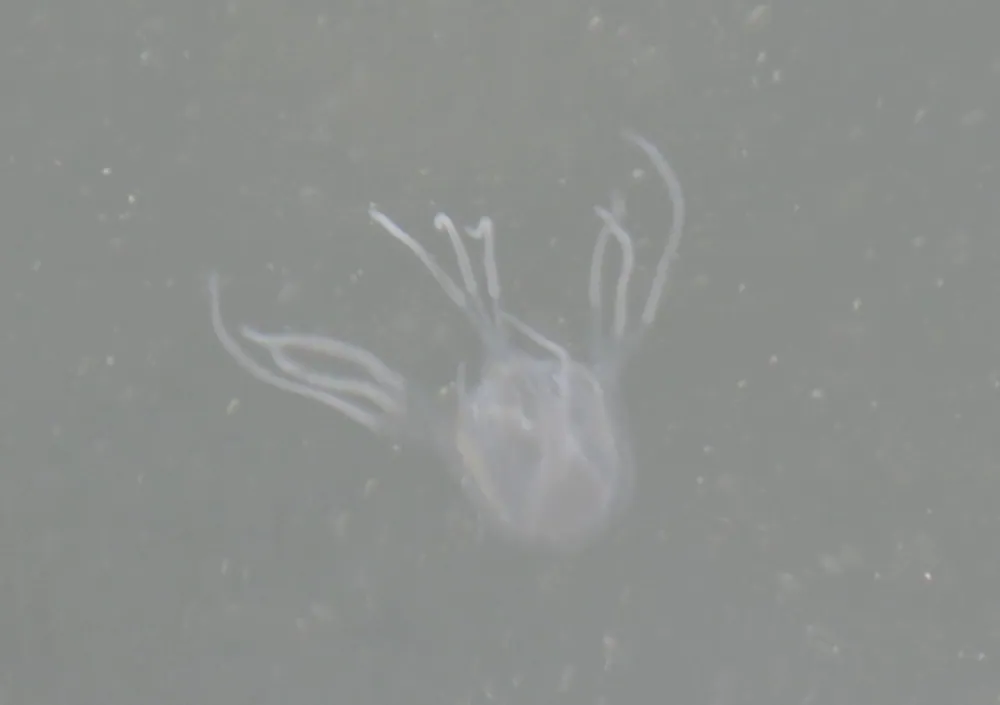
 Tsela ya go e lemoga
Maatla a botlhole
Dikete tsa disele tse dinnye tse di tlhabang di a thuntsha fa sengwe se di ama.
E kotsi go le kae go batho?
Kotsi go batho: Kotsi e nnyeJaaka go tlhabiwa ke notshe kgotsa go le kwa tlase. Ga e na kotsi go batho. Fa e tlhaba
- Tswa mo metsing mme o tlose mesela (tentacles) epe fela e e setseng (ka ditlelafo kgotsa ka lesela).
- Ya dijelifishi tsa lebokoso tsa tropiki: tshela asene mo mafelong a a tlhabilweng bonnye metsotswana e le 30, bitsa thuso mme o ipaakanyetse go dira CPR. Ya dibluebottle le tse dingwe tse dintsi: tlhatswa ka metsi a lewatle, morago ka metsi a a mogote go fokotsa botlhoko.
Ka gale leletsa nomoro ya gago ya tshoganyetso pele (112, 000, 911). Se ke kaelo e e akaretsang ya thuso ya ntlha, ga se kgakololo ya bongaka. Motheo wa thuso ya ntlha
 Nna o babalesegile
- O se ka wa ama, wa tshwara kgotsa wa tshwenya phologolo ya naga, le fa e le e nnye, le fa e lebega e robetse kgotsa e sule.
- E fe sebaka. Fa o kopana le yone, ritibala, boela morago ka bonya mme o e tlogele e tsamaye ka tsela ya yone.
- Fa e nngwe e go tlhaba: ritibala, o se ka wa tshikinyega, leletsa nomoro ya gago ya tshoganyetso (112, 000, 911) kgotsa o ye bookelong ka bonako. Gopola gore e ne e lebega jang, setshwantsho se a thusa.
Ga e go batle. E dirisa botlhole jwa yone go tshwara dijo kgotsa go itshireletsa, mme e rata go iphitlha go feta. Go le gontsi ka go nna o babalesegile
Kae mo lefatsheng?
E kgolo go le kae?
E telele go le kae?
 e nnye mo e ka nnang mo lenaleng la gago
 e ka thuma boleele jwa bodiba jo bogolo jwa go thuma (50 m) ka metsotswana e le 36
Mangrove box jellyfish e kgolo go le kae fa e bapisiwa le WENA?
Ke dipalo fela mo sefetleng sa gago (browser). Ga go sepe se se bolokwang kgotsa se se romelwang gope.
E bonako go le kae?
Dintlha
It has six eyes in each of its four rhopalia, which are structures on the bell that contain light-sensitive cells.1
It can spot a cylindrical object such as a mangrove root when it gets close and swerve sharply to avoid it.1
It stays in shafts of sunlight where its copepod prey gathers, which helps it catch more food.1
Its life cycle includes a small polyp stage that attaches to the seabed before young jellyfish form.1
Ya baitseanape ba botlhole
- Leina la saense
- Tripedalia cystophora
- Setlhopha
- Dijelifishi le dibopiwa tsa lewatle tse di tlhabang
- Lelapa
- Tripedaliidae2
- Lekoko
- Carybdeida
- Dikontinente
- Lewatle la Atlantic, Lewatle la Caribbean, Lewatle la Pacific, Mawatle
- Masea
- After fertilisation, the female broods the planula larva inside her bell until it is expelled. The larva settles on the bottom and becomes a small polyp, which can bud new polyps and eventually produce young jellyfish.1
- Kotsi go batho
- 1 / 5: Kotsi e nnye3
Kwa dintlha di tswang teng
- Tripedalia cystophora (Wikipedia (CC BY-SA 4.0))
- Tripedalia cystophora (iNaturalist): maina le thulaganyo ya mefuta.
- Venom Wiki: seelo sa kotsi, bogolo jo bo tlwaelegileng le kakanyo ya lebelo ke tsa rona. Bona kafa re di balang ka teng: Kafa re lekanyang kotsi ka teng.
Ntlha nngwe le nngwe mo tsebeng e e na le nomoro e e supang motswedi wa yone. Fa re dirile phoso, maitshwarelo, re barati ba diphologolo, e seng kgatiso ya saense. Re bolelele kwa [email protected] mme re tla e baakanya.
 Phepheng e tshwerwe ke tlala! Venom Wiki ke porojeke ya motho a le mongwe: ke mahala, ga e na dipapatso le ditraka. Mpho e nnye e thusa go e tshegetsa mo inthaneteng.Fepa phepheng
Tse dingwe tsa setlhopha se se tshwanang: Dijelifishi le dibopiwa tsa lewatle tse di tlhabang
 Australian box jellyfishDijelifishi le dibopiwa tsa lewatle tse di tlhabangE a bolayaO se ka wa ama
 Irukandji jellyfishDijelifishi le dibopiwa tsa lewatle tse di tlhabangE ka bolayaO se ka wa ama
 Portuguese man o' warDijelifishi le dibopiwa tsa lewatle tse di tlhabangE tlhoka ngakaO se ka wa ama
 Lion's mane jellyfishDijelifishi le dibopiwa tsa lewatle tse di tlhabangE utlwisa botlhoko felaO se ka wa ama
 Moon jellyfishDijelifishi le dibopiwa tsa lewatle tse di tlhabangGa e na kotsi
 Common kingslayerDijelifishi le dibopiwa tsa lewatle tse di tlhabangE ka bolayaO se ka wa ama
E tshela gape kwa: Lewatle la Atlantic
 Hawksbill sea turtleDiphologolo tse dingwe tse di botlhole go di ama kgotsa go di jaE ka bolaya
 Blue sea dragonDikgopa tsa khouno le diokotopaseE utlwisa botlhoko fela
 Greenland sharkDiphologolo tse dingwe tse di botlhole go di ama kgotsa go di jaE utlwisa botlhoko fela
 Common octopusDikgopa tsa khouno le diokotopaseGa e na kotsi
 Common stingrayDitlhapi tse di tsenyang botlholeE tlhoka ngaka
 Greater weeverDitlhapi tse di tsenyang botlholeE tlhoka ngakaO se ka wa ama