
 Aforika
 Asia
Asia Yuropa
 Amerika Borwa
 Australia le Oceania
 Antarctica
 Lewatle la Pacific
 Lewatle la Atlantic
 Lewatle la India
 Lewatle la Arctic
 Lewatle la Mediterranean
 Lewatle le Lehibidu
 Lewatle la Caribbean
 Lewatle la Coral
 Lewatle la China Borwa
 Lewatle la Philippines
 Lewatle la Andaman
 Lewatle la Bokone
 Lewatle la Timor le la Arafura
 Kou ya Bengal
 Gulf ya California
Mitchell's water monitor
 Go loma
Mitchell's water monitor is a large, slender lizard that lives in the northern rivers, swamps and lagoons of Australia. It spends much of its time near water and can climb trees. It is on the IUCN Red List as Critically Endangered, so it matters a great deal to protect it.1



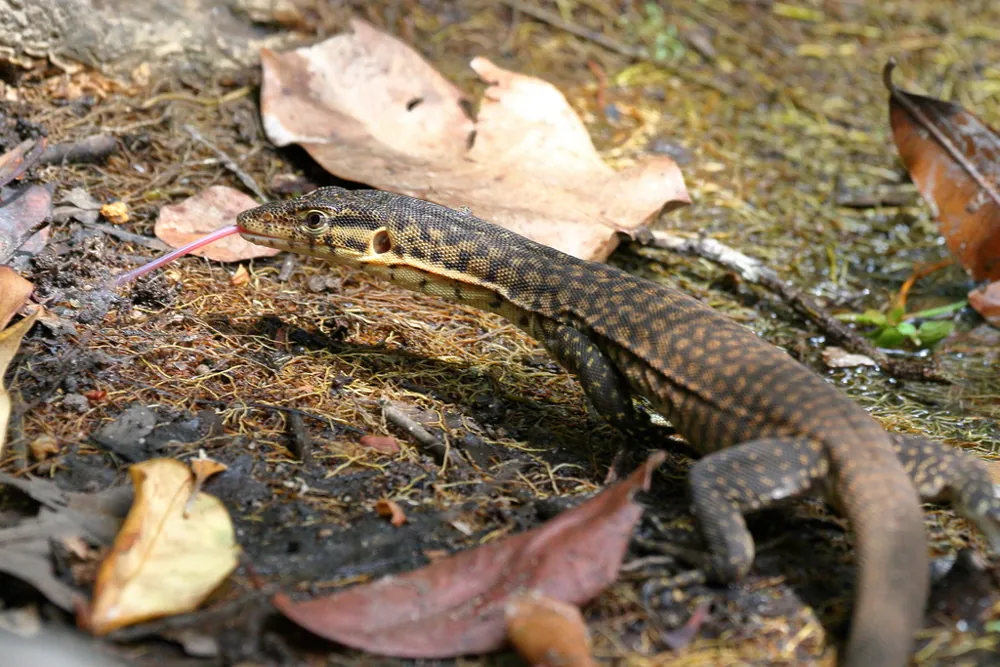
 Tsela ya go e lemoga
Maatla a botlhole
Botlhole bo tswa ka meno a yone fa e loma.
E kotsi go le kae go batho?
Kotsi go batho: Kotsi e nnyeJaaka go tlhabiwa ke notshe kgotsa go le kwa tlase. Ga e na kotsi go batho.E dira eng fa e tshogile?
If disturbed, it heads for the water. It is described as nervous and shy.1
 Fa e loma
- Tlhatswa ntho, dira gore motho a ritibale mme o batle thuso ya bongaka.
Ka gale leletsa nomoro ya gago ya tshoganyetso pele (112, 000, 911). Se ke kaelo e e akaretsang ya thuso ya ntlha, ga se kgakololo ya bongaka. Motheo wa thuso ya ntlha
 Nna o babalesegile
- O se ka wa ama, wa tshwara kgotsa wa tshwenya phologolo ya naga, le fa e le e nnye, le fa e lebega e robetse kgotsa e sule.
- E fe sebaka. Fa o kopana le yone, ritibala, boela morago ka bonya mme o e tlogele e tsamaye ka tsela ya yone.
- Fa e nngwe e go loma: ritibala, o se ka wa tshikinyega, leletsa nomoro ya gago ya tshoganyetso (112, 000, 911) kgotsa o ye bookelong ka bonako. Gopola gore e ne e lebega jang, setshwantsho se a thusa.
Ga e go batle. E dirisa botlhole jwa yone go tshwara dijo kgotsa go itshireletsa, mme e rata go iphitlha go feta. Go le gontsi ka go nna o babalesegile
Kae mo lefatsheng?
E kgolo go le kae?
E telele go le kae?
 boleele jo bo lekanang le dipanana di le 4 di latelana
 e ka taboga dimetara di le 100 ka metsotswana e le 30 (motho yo o bonako go gaisa o tlhoka 9,6)
Mitchell's water monitor e kgolo go le kae fa e bapisiwa le WENA?
Ke dipalo fela mo sefetleng sa gago (browser). Ga go sepe se se bolokwang kgotsa se se romelwang gope.
E bonako go le kae?

Dintlha
Where cane toads arrived at Kakadu National Park, almost the entire population of this lizard was wiped out. Its numbers have been estimated to have dropped by as much as 97% within three years.1
Its eyesight is excellent, but it is night blind because its retinas have no rods, the cells used for night vision.1
The biggest threat to this lizard is the cane toad. Cane toads are poisonous to it, and it can eat the larger toads, which carry lethal doses of poison.1
The Australian name 'goanna' probably comes from 'iguana', because the first European settlers thought these lizards looked like the iguanas of South America.1
Ya baitseanape ba botlhole
- Leina la saense
- Varanus mitchelli
- Setlhopha
- Dikgatitswane tse di tsenyang botlhole
- Lelapa
- Varanidae2
- Lekoko
- Squamata
- Dikontinente
- Australia le Oceania
- Masea
- It lays eggs (it is oviparous). Females lay between April and June in the dry season, with clutches of 3 to 12 eggs.1
- Dingwaga tsa botshelo
- e ka nna dingwaga di le 101
- Seemo sa yone kwa nageng
- Critically Endangered1
- Kotsi go batho
- 1 / 5: Kotsi e nnye3
Kwa dintlha di tswang teng
- Mitchell's water monitor (Wikipedia (CC BY-SA 4.0))
- Varanus mitchelli (iNaturalist): maina le thulaganyo ya mefuta.
- Venom Wiki: seelo sa kotsi, bogolo jo bo tlwaelegileng le kakanyo ya lebelo ke tsa rona. Bona kafa re di balang ka teng: Kafa re lekanyang kotsi ka teng.
Ntlha nngwe le nngwe mo tsebeng e e na le nomoro e e supang motswedi wa yone. Fa re dirile phoso, maitshwarelo, re barati ba diphologolo, e seng kgatiso ya saense. Re bolelele kwa [email protected] mme re tla e baakanya.
 Phepheng e tshwerwe ke tlala! Venom Wiki ke porojeke ya motho a le mongwe: ke mahala, ga e na dipapatso le ditraka. Mpho e nnye e thusa go e tshegetsa mo inthaneteng.Fepa phepheng
Tse dingwe tsa setlhopha se se tshwanang: Dikgatitswane tse di tsenyang botlhole
 Lace monitorDikgatitswane tse di tsenyang botlholeE utlwisa botlhoko fela
 PerentieDikgatitswane tse di tsenyang botlholeE utlwisa botlhoko fela
 Spiny-tailed monitorDikgatitswane tse di tsenyang botlholeGa e na kotsi
 Yellow-spotted monitorDikgatitswane tse di tsenyang botlholeE utlwisa botlhoko fela
 Komodo dragonDikgatitswane tse di tsenyang botlholeE ka bolaya
 Gila monsterDikgatitswane tse di tsenyang botlholeE tlhoka ngaka
E tshela gape kwa: Australia le Oceania
 Coastal taipanDinoga tsa AustraliaE a bolaya
 Common death adderDinoga tsa AustraliaE a bolaya
 Eastern brown snakeDinoga tsa AustraliaE a bolaya
 Taipan ya kwa teng ga nagaDinoga tsa AustraliaE a bolaya
 Sydney funnel-web spiderDitarantula le di-funnel-webE a bolaya
 Noga ya tigerDinoga tsa AustraliaE a bolaya