
 Aforika
 Asia
Asia Yuropa
 Amerika Borwa
 Australia le Oceania
 Antarctica
 Lewatle la Pacific
 Lewatle la Atlantic
 Lewatle la India
 Lewatle la Arctic
 Lewatle la Mediterranean
 Lewatle le Lehibidu
 Lewatle la Caribbean
 Lewatle la Coral
 Lewatle la China Borwa
 Lewatle la Philippines
 Lewatle la Andaman
 Lewatle la Bokone
 Lewatle la Timor le la Arafura
 Kou ya Bengal
 Gulf ya California
Yellow-spotted monitor
 Go loma
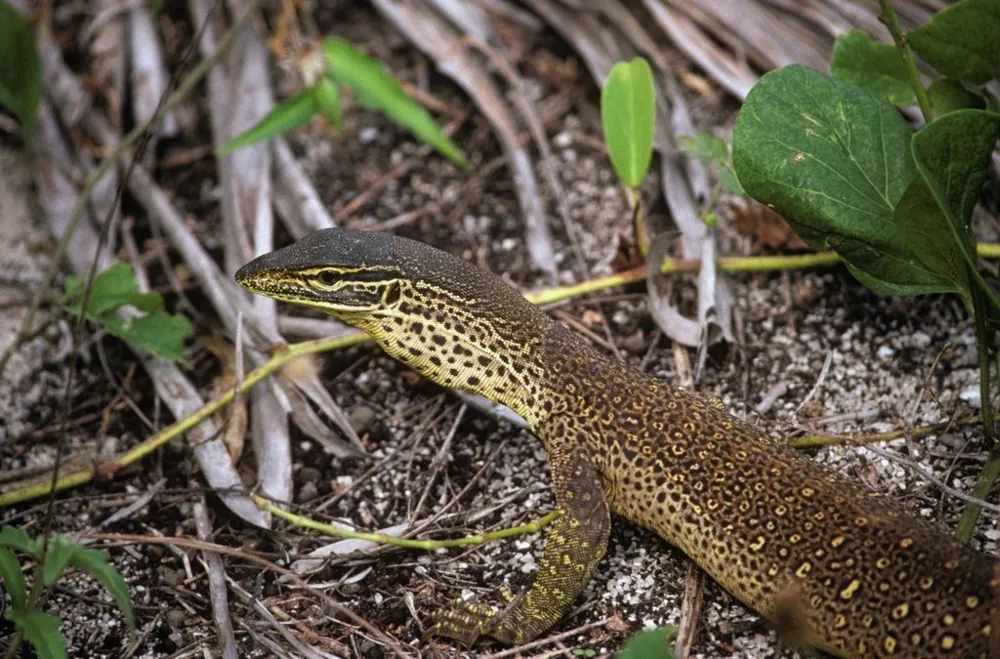
The yellow-spotted monitor is a large, fast lizard that lives in northern and western Australia and southern New Guinea. It is one of Australia's biggest lizards, and it plays an important part in its ecosystem as a predator. It can give a painful bite if it feels threatened.1



 Tsela ya go e lemoga
- Most individuals are yellow, with a brown or dark tan background.1
- Large, dark spots form rows along the back, and they are most distinct in the middle of the back.1
- Bands of colour appear toward the tip of the tail.1
- Adults are large: females average about 90 cm long and males about 120 to 150 cm.1
- Colour varies between individuals and places. The subspecies rubidus is reddish rather than brown.1
Gantsi e tlhakanngwa le: The sand goanna (Varanus gouldii) somewhat resembles the yellow-spotted monitor.1
Maatla a botlhole
Botlhole bo tswa ka meno a yone fa e loma.
E kotsi go le kae go batho?
Kotsi go batho: E botlhokoE ka utlwisa botlhoko tota, mme go seoka thata gore e nne masisi.E dira eng fa e tshogile?
When threatened, it raises itself up on its hind legs and supports itself with its tail, which lets it watch for danger. It can also run up to 100 metres to a tree or burrow.1
 Fa e loma
- Tlhatswa ntho, dira gore motho a ritibale mme o batle thuso ya bongaka.
Ka gale leletsa nomoro ya gago ya tshoganyetso pele (112, 000, 911). Se ke kaelo e e akaretsang ya thuso ya ntlha, ga se kgakololo ya bongaka. Motheo wa thuso ya ntlha
 Nna o babalesegile
- O se ka wa ama, wa tshwara kgotsa wa tshwenya phologolo ya naga, le fa e le e nnye, le fa e lebega e robetse kgotsa e sule.
- E fe sebaka. Fa o kopana le yone, ritibala, boela morago ka bonya mme o e tlogele e tsamaye ka tsela ya yone.
- Fa e nngwe e go loma: ritibala, o se ka wa tshikinyega, leletsa nomoro ya gago ya tshoganyetso (112, 000, 911) kgotsa o ye bookelong ka bonako. Gopola gore e ne e lebega jang, setshwantsho se a thusa.
Ga e go batle. E dirisa botlhole jwa yone go tshwara dijo kgotsa go itshireletsa, mme e rata go iphitlha go feta. Go le gontsi ka go nna o babalesegile
Kae mo lefatsheng?
E kgolo go le kae?
E telele go le kae?
E kima go le kae?
 boleele jo bo lekanang le dikatse tsa ntlo di le 3 go tloga kwa nkong go ya mogatleng
 boleele jo bo lekanang le dipanana di le 9 di latelanae ka nna bokima jo bo lekanang le jwa katse ya ntlo
 e ka taboga dimetara di le 100 ka metsotswana e le 24 (motho yo o bonako go gaisa o tlhoka 9,6)
Yellow-spotted monitor e kgolo go le kae fa e bapisiwa le WENA?
Ke dipalo fela mo sefetleng sa gago (browser). Ga go sepe se se bolokwang kgotsa se se romelwang gope.
E bonako go le kae?

Dintlha
The yellow-spotted monitor digs some of the deepest burrows known for any vertebrate, with an average depth of 2.6 m as of 2015.1
During the dry season, it has been recorded diving underwater to feed on freshwater mussels.1
Argus monitors can mature sexually in less than a year, which is much faster than most other large monitors, which usually take 2 or more years.1
Several individuals may share one interconnected system of burrows, called a warren. One study found at least 6 individuals using the same warren.1
It is the third largest lizard in Australia, after the perentie and the lace monitor.1
Its sense of smell is its sharpest sense, and it flicks its forked tongue to search for food, much as snakes do.1
Kwa dintlha di tswang teng
- Yellow-spotted monitor (Wikipedia (CC BY-SA 4.0))
- Varanus panoptes (iNaturalist): maina le thulaganyo ya mefuta.
- Venom Wiki: seelo sa kotsi, bogolo jo bo tlwaelegileng le kakanyo ya lebelo ke tsa rona. Bona kafa re di balang ka teng: Kafa re lekanyang kotsi ka teng.
Ntlha nngwe le nngwe mo tsebeng e e na le nomoro e e supang motswedi wa yone. Fa re dirile phoso, maitshwarelo, re barati ba diphologolo, e seng kgatiso ya saense. Re bolelele kwa [email protected] mme re tla e baakanya.
 Phepheng e tshwerwe ke tlala! Venom Wiki ke porojeke ya motho a le mongwe: ke mahala, ga e na dipapatso le ditraka. Mpho e nnye e thusa go e tshegetsa mo inthaneteng.Fepa phepheng
Tse dingwe tsa setlhopha se se tshwanang: Dikgatitswane tse di tsenyang botlhole
 Lace monitorDikgatitswane tse di tsenyang botlholeE utlwisa botlhoko fela
 PerentieDikgatitswane tse di tsenyang botlholeE utlwisa botlhoko fela
 Spiny-tailed monitorDikgatitswane tse di tsenyang botlholeGa e na kotsi
 Mitchell's water monitorDikgatitswane tse di tsenyang botlholeGa e na kotsi
 Komodo dragonDikgatitswane tse di tsenyang botlholeE ka bolaya
 Gila monsterDikgatitswane tse di tsenyang botlholeE tlhoka ngaka
E tshela gape kwa: Australia le Oceania
 Coastal taipanDinoga tsa AustraliaE a bolaya
 Common death adderDinoga tsa AustraliaE a bolaya
 Eastern brown snakeDinoga tsa AustraliaE a bolaya
 Taipan ya kwa teng ga nagaDinoga tsa AustraliaE a bolaya
 Sydney funnel-web spiderDitarantula le di-funnel-webE a bolaya
 Noga ya tigerDinoga tsa AustraliaE a bolaya