
 Aforika
 Asia
Asia Yuropa
 Amerika Borwa
 Australia le Oceania
 Antarctica
 Lewatle la Pacific
 Lewatle la Atlantic
 Lewatle la India
 Lewatle la Arctic
 Lewatle la Mediterranean
 Lewatle le Lehibidu
 Lewatle la Caribbean
 Lewatle la Coral
 Lewatle la China Borwa
 Lewatle la Philippines
 Lewatle la Andaman
 Lewatle la Bokone
 Lewatle la Timor le la Arafura
 Kou ya Bengal
 Gulf ya California
Rabbit hutch spider
 Go loma
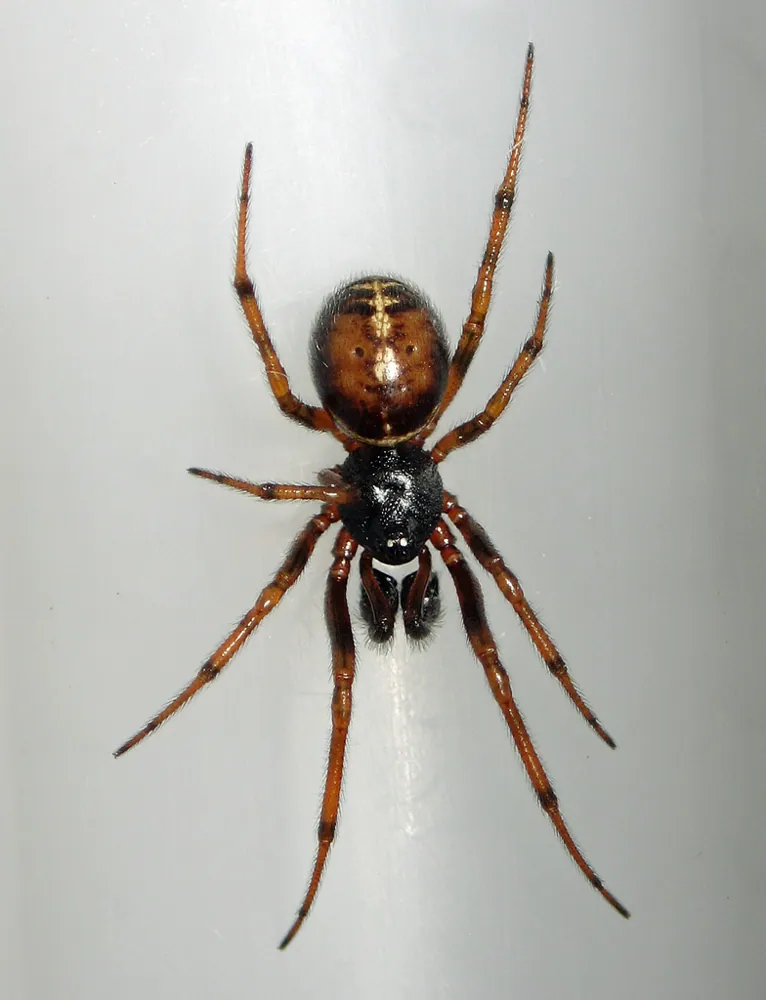
The rabbit hutch spider is a small, brown cobweb spider. It is common in North America and Europe, and often lives close to people in basements and sheds. It is special because it looks a lot like the dangerous black widow spiders, but it is much less harmful.1
 Tsela ya go e lemoga
- The abdomen (rear body) is bulbous, or rounded, and brownish in both sexes.1
- A broken pale line runs down the centre of the abdomen, with another pale line across the front part.1
- The top of the abdomen has a pair of dark dimples, which are places where muscles attach.1
- The underside of the abdomen has a pattern that looks like the infinity sign.1
- Females are light brown and often shiny, while males are usually duller.1
- It rarely grows bigger than 7 mm in body length.1
Gantsi e tlhakanngwa le: It has a similar shape to black widow spiders in the genus Latrodectus, so it can be mistaken for them. Species of the genus Steatoda are commonly called 'false widows' for this reason. Its bite is much less dangerous to people than a black widow's bite.1
Maatla a botlhole
Botlhole bo tswa ka meno a yone fa e loma.
E kotsi go le kae go batho?
Kotsi go batho: Kotsi e nnyeJaaka go tlhabiwa ke notshe kgotsa go le kwa tlase. Ga e na kotsi go batho.There are no known cases of envenomation (venom being injected into a person) by this spider. It is highly unlikely that its small fangs can penetrate human skin. Its bite is significantly less dangerous than that of black widow spiders.1
 Fa e loma
- Tlhatswa fa go lomilweng mme o tsenye pakana ya aese mo go gone go fokotsa botlhoko. Batla thuso ya bongaka fa botlhoko bo le bogolo, bo anama kgotsa motho a ikutlwa a sa siama.
Ka gale leletsa nomoro ya gago ya tshoganyetso pele (112, 000, 911). Se ke kaelo e e akaretsang ya thuso ya ntlha, ga se kgakololo ya bongaka. Motheo wa thuso ya ntlha
 Nna o babalesegile
- O se ka wa ama, wa tshwara kgotsa wa tshwenya phologolo ya naga, le fa e le e nnye, le fa e lebega e robetse kgotsa e sule.
- E fe sebaka. Fa o kopana le yone, ritibala, boela morago ka bonya mme o e tlogele e tsamaye ka tsela ya yone.
- Fa e nngwe e go loma: ritibala, o se ka wa tshikinyega, leletsa nomoro ya gago ya tshoganyetso (112, 000, 911) kgotsa o ye bookelong ka bonako. Gopola gore e ne e lebega jang, setshwantsho se a thusa.
Ga e go batle. E dirisa botlhole jwa yone go tshwara dijo kgotsa go itshireletsa, mme e rata go iphitlha go feta. Go le gontsi ka go nna o babalesegile
Kae mo lefatsheng?
E kgolo go le kae?
E telele go le kae?
 e nnye mo e ka nnang mo lenaleng la gago
Rabbit hutch spider e kgolo go le kae fa e bapisiwa le WENA?
Ke dipalo fela mo sefetleng sa gago (browser). Ga go sepe se se bolokwang kgotsa se se romelwang gope.
E bonako go le kae?


Dintlha
Despite its look, it is not dangerous to people, and no envenomation has been recorded.1
Rabbit hutches often make a suitable home for it, which is why it has its common name.1
The pattern on the underside of its abdomen looks like the infinity sign.1
The dark dimples on its back are places where muscles attach, and they probably gave the spider its Latin name.1
It is called a 'false widow' because it is similar in shape to black widow spiders.1
Mosenyi wa ditlhamane
Tlhamane: Because it looks like a black widow, it is a dangerous spider to people.
Nnete: No envenomation by this spider is known, and its fangs are unlikely to penetrate human skin.1
Kwa dintlha di tswang teng
- Steatoda bipunctata (Wikipedia (CC BY-SA 4.0))
- Steatoda bipunctata (iNaturalist): maina le thulaganyo ya mefuta.
- Venom Wiki: seelo sa kotsi, bogolo jo bo tlwaelegileng le kakanyo ya lebelo ke tsa rona. Bona kafa re di balang ka teng: Kafa re lekanyang kotsi ka teng.
Ntlha nngwe le nngwe mo tsebeng e e na le nomoro e e supang motswedi wa yone. Fa re dirile phoso, maitshwarelo, re barati ba diphologolo, e seng kgatiso ya saense. Re bolelele kwa [email protected] mme re tla e baakanya.
 Phepheng e tshwerwe ke tlala! Venom Wiki ke porojeke ya motho a le mongwe: ke mahala, ga e na dipapatso le ditraka. Mpho e nnye e thusa go e tshegetsa mo inthaneteng.Fepa phepheng
Tse dingwe tsa setlhopha se se tshwanang: Digokgo
 Brown recluse
 Southern black widow
 Mediterranean black widow
 Northern black widow
 Western black widow
 Diving bell spider
E tshela gape kwa: Yuropa
 Common European adderDivaepara le diboloboloE tlhoka ngaka
 Spanish flyDiphologolo tse dingwe tse di botlhole go di ama kgotsa go di jaE tlhoka ngakaO se ka wa ama
 Common waspDinotshe, diwasepe le dihoneteE utlwisa botlhoko fela
 European hornetDinotshe, diwasepe le dihoneteE utlwisa botlhoko fela
 Fire salamanderDigwagwa tsa botlhole, digwagwa tse dingwe le dinewtE utlwisa botlhoko felaO se ka wa ama
 Western honey beeDinotshe, diwasepe le dihoneteE utlwisa botlhoko fela