
 Afrig
Afrig Asi
Asi Tugal
Tugal Amerig gu Bëj-saalum
 Ostarali ak Oseyani
 Antarktig
 Mbàmbulaanu Pasifik
 Mbàmbulaanu Atlantig
 Mbàmbulaanu End
 Mbàmbulaanu Arktik
 Géeju Mediteraane
 Géej gu Xonq
 Géeju Karayib
 Géeju Koraay
 Géeju Siin gu Bëj-saalum
 Géeju Filipin
 Géeju Andaman
 Géeju Bëj-gànnaar
 Géeju Timor ak Arafura
 Golfu Bengal
 Golfu Kaliforni
Bengal slow loris
 Dafay màtt
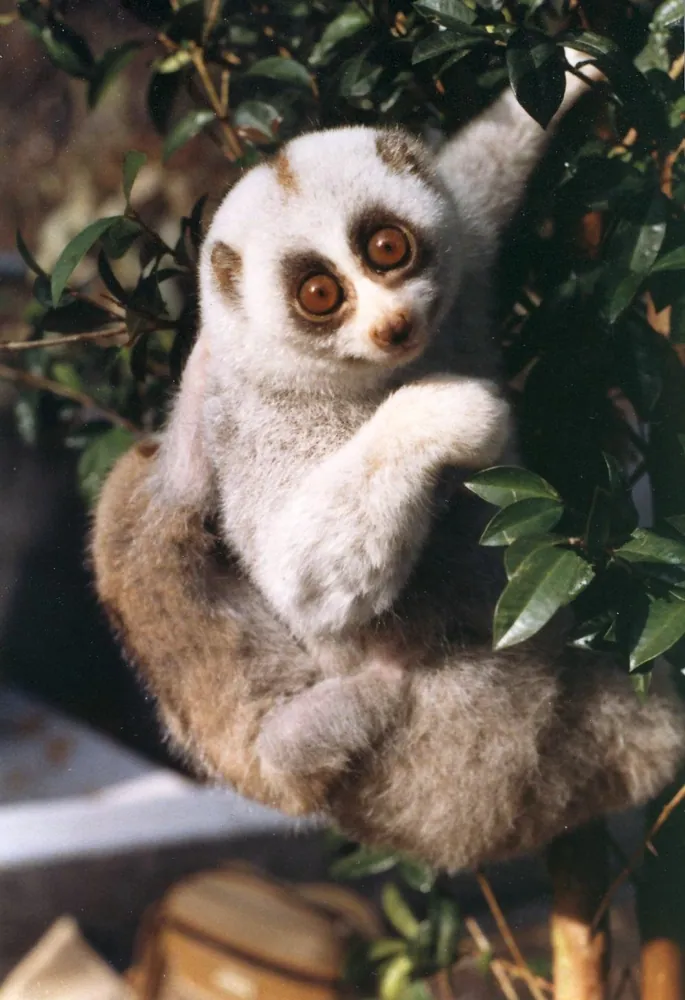
The Bengal slow loris is a small, nocturnal primate with big eyes and dense, woolly fur. It lives in forests across South and Southeast Asia, and it is the largest of the slow loris species. It is endangered, mainly because it is sold in animal markets and used in traditional medicine.1



 Ni ngay ko xàmmee
- Dense, woolly brown-grey fur on its back, with white fur on its underside1
- A dark stripe running up to the top of its head, which does not reach the ears1
- Pale forearms and feet, with limbs that vary from brown to nearly white1
- A round head, flat face, large eyes that show a bright orange eye shine, and short ears1
- Body and head length of 26 to 38 cm1
Ñu ngi koy faral di jaxasoo ak: The Sunda slow loris is similar in size but is smaller and tawny- or golden-brown, without the pale head, nape and shoulders. The pygmy slow loris is much smaller, with dark brown fur, longer ears and no dark dorsal stripe.1
Kàttanu daŋar
Daŋar bi dafay génn ci bëñam yi su màttee.
Lan la daŋar biy sóob di def?
A small gland on the inside of the elbow produces a pungent, clear, oily toxin. The animal wipes this fluid onto its toothcomb as a defence. The main chemical in it is m-cresol, a phenolic compound, and the mixture contains several dozen volatile chemicals.1
Ni mu lore nit ñi?
Musiba ci nit: Dafay mettiMën na metti lool, waaye lu bon du faral di am. Su màttee
- Raxas gaañu-gaañu bi bu baax te wutal ndimbal doktoor.
Saa su nekk, woo jëkk sa nimerob urgence (112, 000, 911). Lii ay ndigal yu yaatu ci ndimbal yu jëkk la, du ndigalu doktoor. Li war a xam ci ndimbal yu jëkk
 Sàmmal sa bopp
- Bul laal mukk, bul jàpp, bul sonal ab rab bu àll, doonte bu ndaw la, te doonte dafa mel ni dafa nelaw walla dafa dee.
- May ko bérab. Su nga ko gisee, dalal, dellu ginnaaw ndànk-ndànk te bàyyi ko mu dem yoonam.
- Su benn màttee la: dalal, bul yëngu, woo sa nimerob urgence (112, 000, 911) walla dem lopitaan ci gaaw. Bul fàtte ni mu meloon, ab nataal dina dimbali.
Du la wut. Dafay jëfandikoo daŋaram ngir jàpp lu muy lekk walla ngir aar boppam, te nëbbu moo ko gën a neex. Yeneen ci ni ngay sàmme sa bopp
Ni mu réye?
Ni mu guddoo?
Ni mu diise?

 guddu na ni 12 bloku tabax yu ñu toftale
 diis na lu tollu ci muusu kër
 mën na daw 100 meetar ci 180 segond (nit ki gën a gaaw soxla na 9,6)
Bengal slow loris ni mu réye ci wetu YOW?
Ay waññ rekk ci sa navigateur. Dara du denc te dara du yónnee fenn.
Ni mu gaawe?


Xibaar
Its toxin may carry information about a loris's sex, age, health and social status, so it may act as a form of scent communication.1
It is the largest species of slow loris.1
Its second hind toe has a curved toilet-claw that it uses for scratching and grooming, while its other nails are straight.1
It has an excellent night vision, helped by a tapetum lucidum, a reflective layer in the eye.1
Females can have a new offspring every 12 to 18 months, and could even become pregnant again when the previous young is about six months old.1
It is an important seed disperser and pollinator, and it is also prey for several carnivores.1
Ngir boroom xam-xam ci daŋar
- Turu xam-xam
- Nycticebus bengalensis
- Mbooloo
- Rab yuy nàmpal yu am daŋar
- Njaboot
- Lorisidae2
- Toftal
- Primates
- Kontinaa yi
- Asi
- Liir yi
- It usually gives birth to a single offspring after a six-month pregnancy, and twins are rare. The mother carries the young for about three months, and it becomes independent at around three months of age.1
- Diiru dund
- lu tollu ci 20 at1
- Ni mu nekke ci àll bi
- Endangered1
- Musiba ci nit
- 2 / 5: Dafay metti3
Fa xibaar yi jóge
- Bengal slow loris (Wikipedia (CC BY-SA 4.0))
- Nycticebus bengalensis (iNaturalist): tur ak ni ñu leen séddale.
- Venom Wiki: tolluwaayu musiba bi, réyaay bu yem bi ak xalaatu gaawaay bi, nun ñoo leen defar. Seetal ni nu leen waññe: Ni nuy natte musiba.
Xibaar bu nekk ci xët wii am na ab nimero buy won fa mu jóge. Su nu juumee, baal nu, nun ay nit ñu bëgg rab lanu, du ab jurnaalu xam-xam. Wax nu ko ci [email protected] te dinanu ko jubbanti.
 Jiit bi dafa xiif! Venom Wiki ab liggéeyu kenn la: amul pay, amul piblisite te amul traceur. Ab may bu tuuti dafay dimbali ngir mu des ci internet.Leel jiit bi
Yeneen ci mbooloo mi: Rab yuy nàmpal yu am daŋar
 Javan slow lorisRab yuy nàmpal yu am daŋarDafay metti rekk
 Pygmy slow lorisRab yuy nàmpal yu am daŋarDafay metti rekk
 Sunda slow lorisRab yuy nàmpal yu am daŋarDafay metti rekk
 Kayan River slow lorisRab yuy nàmpal yu am daŋarDafay metti rekk
 Philippine slow lorisRab yuy nàmpal yu am daŋarDafay metti rekk
 Eurasian water shrewRab yuy nàmpal yu am daŋarAmul lor
 Deathstalker
 Indian cobra
 Indian saw-scaled viper
 King cobra
 Jaan wu ñuul wi (Bitis arietans)
 Jaan wu Russell