
 Afrig
Afrig Asi
Asi Tugal
Tugal Amerig gu Bëj-saalum
 Ostarali ak Oseyani
 Antarktig
 Mbàmbulaanu Pasifik
 Mbàmbulaanu Atlantig
 Mbàmbulaanu End
 Mbàmbulaanu Arktik
 Géeju Mediteraane
 Géej gu Xonq
 Géeju Karayib
 Géeju Koraay
 Géeju Siin gu Bëj-saalum
 Géeju Filipin
 Géeju Andaman
 Géeju Bëj-gànnaar
 Géeju Timor ak Arafura
 Golfu Bengal
 Golfu Kaliforni
Hump-nosed viper
 Dafay màtt
The hump-nosed viper is a small, stout pit viper with an upturned snout that ends in a hump. It lives in India and Sri Lanka, in jungle and coffee plantations. It matters because its bite can cause serious harm, and for a long time it was wrongly thought to be harmless.1
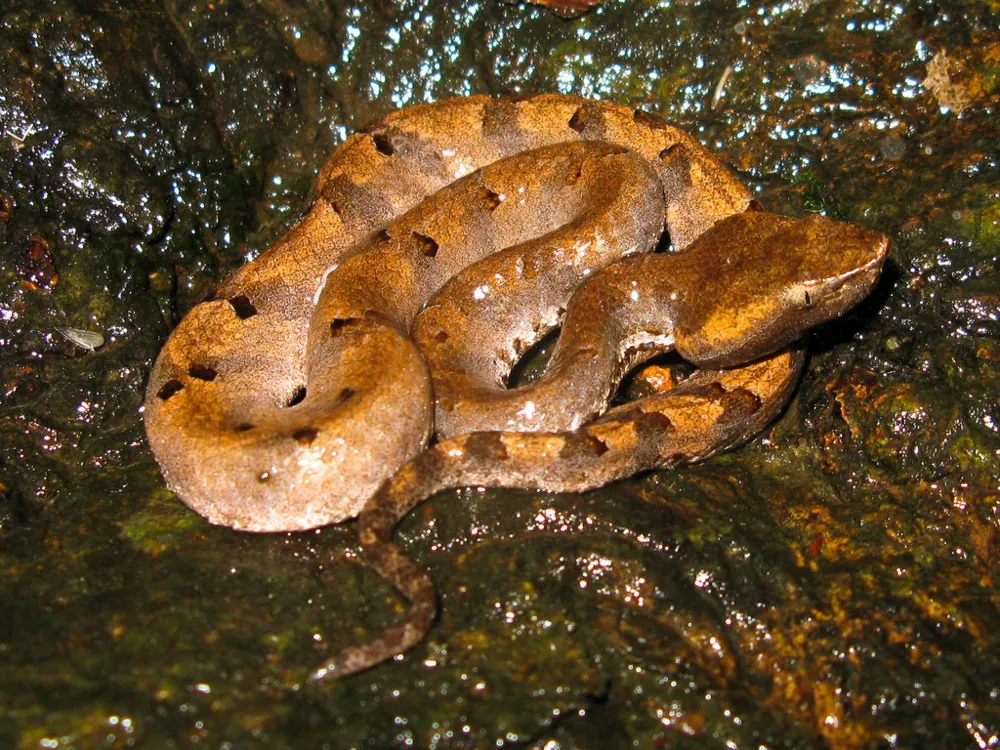
 Ni ngay ko xàmmee
Kàttanu daŋar
Daŋar bi dafay génn ci bëñam yi su màttee.
Lan la daŋar biy sóob di def?
Its venom causes coagulopathy, a problem with blood clotting, and acute renal failure, which is sudden kidney failure. If a bite is not treated within a few hours, it can be fatal to people.1
Ni mu lore nit ñi?
Musiba ci nit: Am na musiba loolMën na rey nit ku ñu fajul.Bites were once thought to be harmless, but they are now known to be serious. It is the snake that causes the highest number of recorded snake bites in Sri Lanka. It is now considered highly venomous and is one of the medically important venomous snakes in Sri Lanka and on the south-west coast of India.1
Lan lay def bu tiitee?
When annoyed it vibrates its tail, a warning behaviour it shares with other pit vipers such as rattlesnakes, and it can make fast strikes despite being a slow mover.1
 Su màttee
- Bites need medical treatment within a few hours. An antivenom is being developed and tested in Sri Lanka.1
- Def ba nit ki bañ a yëngu te dal, yemale cër bi ñu màtt ak kawewaayu xol bi, dindi jaaro yi ak lu xat lépp, te yóbbu ko lopitaan ci gaaw.
Saa su nekk, woo jëkk sa nimerob urgence (112, 000, 911). Lii ay ndigal yu yaatu ci ndimbal yu jëkk la, du ndigalu doktoor. Li war a xam ci ndimbal yu jëkk
 Sàmmal sa bopp
- Bul laal mukk, bul jàpp, bul sonal ab rab bu àll, doonte bu ndaw la, te doonte dafa mel ni dafa nelaw walla dafa dee.
- May ko bérab. Su nga ko gisee, dalal, dellu ginnaaw ndànk-ndànk te bàyyi ko mu dem yoonam.
- Su benn màttee la: dalal, bul yëngu, woo sa nimerob urgence (112, 000, 911) walla dem lopitaan ci gaaw. Bul fàtte ni mu meloon, ab nataal dina dimbali.
Du la wut. Dafay jëfandikoo daŋaram ngir jàpp lu muy lekk walla ngir aar boppam, te nëbbu moo ko gën a neex. Yeneen ci ni ngay sàmme sa bopp
Ni mu réye?
Ni mu guddoo?
 guddu na ni 2,5 banaana yu ñu toftale
 guddu na ni 14 bloku tabax yu ñu toftale
 mën na daw 100 meetar ci 110 segond (nit ki gën a gaaw soxla na 9,6)
Hump-nosed viper ni mu réye ci wetu YOW?
Ay waññ rekk ci sa navigateur. Dara du denc te dara du yónnee fenn.
Ni mu gaawe?


Xibaar
For a long time its bites were thought to be harmless, but they are now known to cause serious complications.1
It causes more recorded snake bites in Sri Lanka than any other snake.1
It vibrates its tail when annoyed, a behaviour it shares with rattlesnakes.1
Although it is a slow mover, it can make fast strikes.1
Females give birth to live young, with broods of 4 to 17 newborns.1
Tasukatu léeb
Xalaat bu juum: Its bites are harmless.
Dëgg: Its bites can cause serious complications, including blood clotting problems and kidney failure, and can be fatal if not treated within a few hours.1
Fa xibaar yi jóge
- Hypnale hypnale (Wikipedia (CC BY-SA 4.0))
- Hypnale hypnale (iNaturalist): tur ak ni ñu leen séddale.
- Venom Wiki: tolluwaayu musiba bi, réyaay bu yem bi ak xalaatu gaawaay bi, nun ñoo leen defar. Seetal ni nu leen waññe: Ni nuy natte musiba.
Xibaar bu nekk ci xët wii am na ab nimero buy won fa mu jóge. Su nu juumee, baal nu, nun ay nit ñu bëgg rab lanu, du ab jurnaalu xam-xam. Wax nu ko ci [email protected] te dinanu ko jubbanti.
 Jiit bi dafa xiif! Venom Wiki ab liggéeyu kenn la: amul pay, amul piblisite te amul traceur. Ab may bu tuuti dafay dimbali ngir mu des ci internet.Leel jiit bi
 Brown spotted pit viper
 Habu
Habu Hundred-pace viper
 Malayan pit viper
 Mamushi
 Mangshan pit viper
 Deathstalker
 Indian cobra
 Indian saw-scaled viper
 King cobra
 Jaan wu ñuul wi (Bitis arietans)
 Jaan wu Russell