
 Afrig
Afrig Asi
Asi Tugal
Tugal Amerig gu Bëj-saalum
 Ostarali ak Oseyani
 Antarktig
 Mbàmbulaanu Pasifik
 Mbàmbulaanu Atlantig
 Mbàmbulaanu End
 Mbàmbulaanu Arktik
 Géeju Mediteraane
 Géej gu Xonq
 Géeju Karayib
 Géeju Koraay
 Géeju Siin gu Bëj-saalum
 Géeju Filipin
 Géeju Andaman
 Géeju Bëj-gànnaar
 Géeju Timor ak Arafura
 Golfu Bengal
 Golfu Kaliforni
Spur-winged goose
 Am daŋar su ñu ko lekkeeDafay lekk: GàncaxAm daŋar ci yaram, du màtt walla jam
The spur-winged goose is a large waterbird from Sub-Saharan Africa, and on average it is the world's largest goose. Some populations are poisonous to eat: birds that feed on many blister beetles carry a poison called cantharidin in their body tissue.1



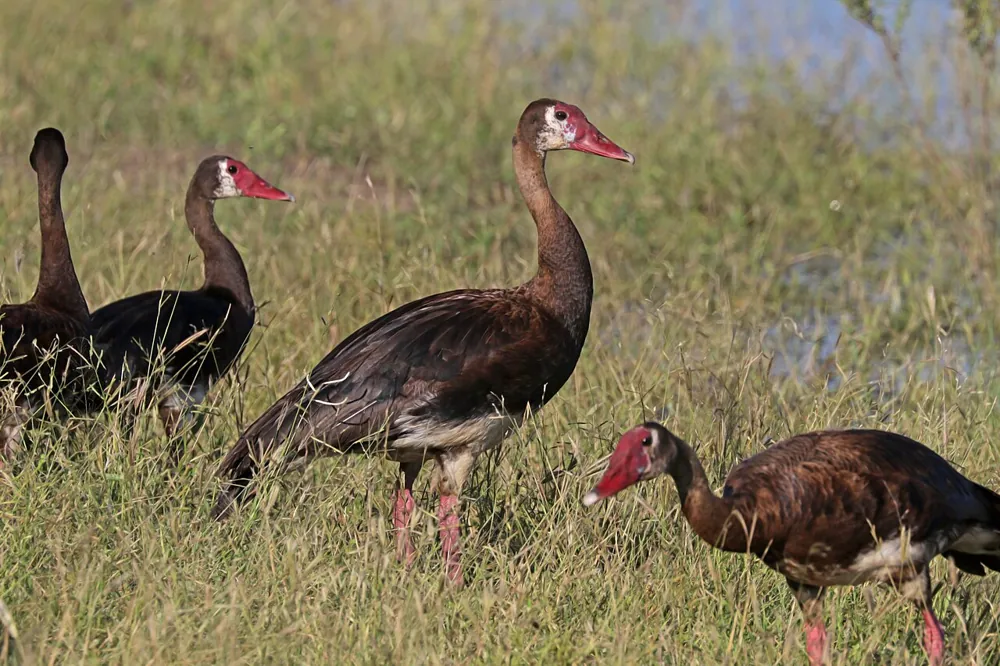
 Ni ngay ko xàmmee
Kàttanu daŋar
Lor na rekk su dara lekkee ko.
Lan la daŋar bi ci yaramam di def?
This goose is not venomous. Its poison, cantharidin, is held in the bird's tissue and comes from blister beetles it eats. Eating the cooked goose poisons the person who eats it.1
Ni mu lore nit ñi?
Musiba ci nit: Dafay mettiMën na metti lool, waaye lu bon du faral di am.Only populations whose diet includes large amounts of blister beetles are poisonous. A dose of 10 mg of cantharidin can kill a human. The risk is to people who eat the cooked goose.1
Lan lay def bu tiitee?
Its alarm call is a soft bubbling "cherwit" when it takes flight or feels alarmed.1
 Su kenn laalee ko walla mu lekk ko
- Su kenn lekkee ko walla mu am ay màndarga ginnaaw bi mu ko lekkee: woo sa nimerob urgence walla centre antipoison ci saa si.
Saa su nekk, woo jëkk sa nimerob urgence (112, 000, 911). Lii ay ndigal yu yaatu ci ndimbal yu jëkk la, du ndigalu doktoor. Li war a xam ci ndimbal yu jëkk
 Sàmmal sa bopp
- Bul laal mukk, bul jàpp, bul sonal ab rab bu àll, doonte bu ndaw la, te doonte dafa mel ni dafa nelaw walla dafa dee.
- May ko bérab. Su nga ko gisee, dalal, dellu ginnaaw ndànk-ndànk te bàyyi ko mu dem yoonam.
- Su nga ko laalee walla nga lekk ko: bul moos say bët walla sa gémmiñ, raxas say loxo te wutal ndimbal doktoor.
Du la wut. Daŋaram nekk na rekk ngir kenn bañ ko lekk. Yeneen ci ni ngay sàmme sa bopp
Ni mu réye?
Ni mu guddoo?
Ni mu diise?
 guddu na ni 2,5 muusu kër, bakkan ba geen
 guddu na ni 6 banaana yu ñu toftale
 mën na naaw ci benn terrain bu futbal bu mat ci 9,5 segond
Spur-winged goose ni mu réye ci wetu YOW?
Ay waññ rekk ci sa navigateur. Dara du denc te dara du yónnee fenn.
Ni mu gaawe?


Xibaar
On average, it is the world's largest goose. It is also one of the largest African waterfowl, after the wading Goliath heron.1
During the breeding season, it is highly aggressive. It can use the spur on the bend of its wing in fights with other birds.1
Its wingspan can reach 150 to 200 cm, which is wider than most adults are tall.1
Its nests can be found in unusual places, including tree holes, rock cavities, old nests of other birds, termite mounds and aardvark burrows.1
Although it belongs to the duck, goose and swan family, Anatidae, its unique features place it in its own subfamily, the Plectropterinae.1
Fa xibaar yi jóge
- Spur-winged goose (Wikipedia (CC BY-SA 4.0))
- Plectropterus gambensis (iNaturalist): tur ak ni ñu leen séddale.
- Venom Wiki: tolluwaayu musiba bi, réyaay bu yem bi ak xalaatu gaawaay bi, nun ñoo leen defar. Seetal ni nu leen waññe: Ni nuy natte musiba.
Xibaar bu nekk ci xët wii am na ab nimero buy won fa mu jóge. Su nu juumee, baal nu, nun ay nit ñu bëgg rab lanu, du ab jurnaalu xam-xam. Wax nu ko ci [email protected] te dinanu ko jubbanti.
 Jiit bi dafa xiif! Venom Wiki ab liggéeyu kenn la: amul pay, amul piblisite te amul traceur. Ab may bu tuuti dafay dimbali ngir mu des ci internet.Leel jiit bi
Yeneen ci mbooloo mi: Yeneen rab yu am daŋar ci seen yaram
 African crested ratYeneen rab yu am daŋar ci seen yaramSoxla na doktoorBul laal
 Common quailYeneen rab yu am daŋar ci seen yaramDafay metti rekk
 Fahaka pufferfishYeneen rab yu am daŋar ci seen yaramMën na rey
 Red-striped oil beetleYeneen rab yu am daŋar ci seen yaramDafay metti rekkBul laal
 Japanese pufferfishYeneen rab yu am daŋar ci seen yaramMën a rey
 Hawksbill sea turtleYeneen rab yu am daŋar ci seen yaramMën na rey
 Black mamba
 Deathstalker
 Egyptian cobra
 Jaan wu ñuul wi (Bitis arietans)
 Boomslang
 Fat-tailed scorpion
.jpg)