
 IAfrika
 IAsiya
 IYurophu
 uMzantsi Melika
 IOstreliya neOceania
 IAntarctica
 uLwandlekazi lwePasifiki
 uLwandlekazi lweAtlantiki
 uLwandlekazi lwaseIndiya
 uLwandlekazi lweArctic
 uLwandle lweMeditera
 uLwandle oluBomvu
 uLwandle lweKharibhiya
 uLwandle lweCoral
 uLwandle lwaseMzantsi China
 uLwandle lwePhilippines
 uLwandle lweAndaman
 uLwandle lwaseMntla (North Sea)
 uLwandle lweTimor ne-Arafura
 iBhayi yaseBengal
 iGulf yaseCalifornia
Iberian ribbed newt
 Amava anetyhefuSitya: InyamaSiyatyhefa, asinatyhefu yokuluma okanye yokuhlaba
The Iberian ribbed newt is a salamander that lives in ponds and wells in Spain, Portugal and northern Morocco. It is the largest European newt species. When threatened, it can push its sharp ribs out through its skin, which gives it a way to defend itself against predators.1



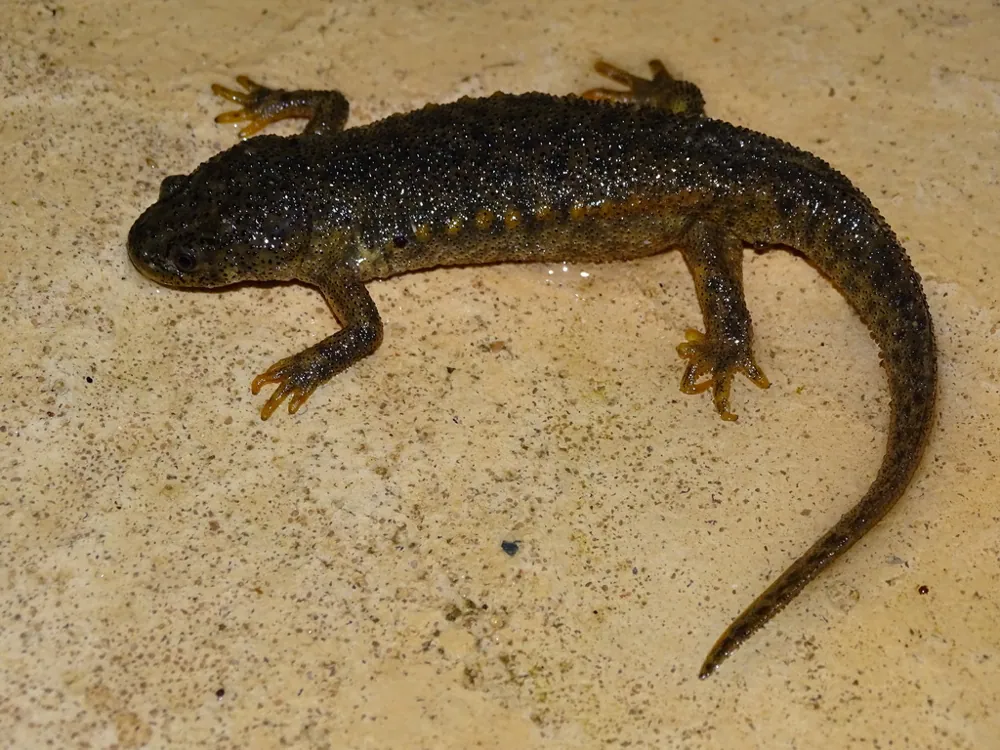
 Indlela yokusiqaphela
- Dark grey on its back and lighter grey on its belly, with small rust-coloured spots1
- Usually 8 to 10 orange, wart-like bumps (tubercles) running down each side of the body1
- Flat, spade-shaped head and a long tail, about half of its body length1
- Males are more slender and usually smaller than females1
- Larvae have bushy external gills and paler colours than adults1
Sidla ngokubhidaniswa no: It is sometimes confused with the Iberian newt (Lissotriton boscai), a different species with a similar common name.1
Amandla etyhefu yokuluma nokuhlaba
Amava abukhali aphethe ityhefu. Ukusinyathela okanye ukusibamba kubuhlungu.
Ityhefu yaso yokuluma okanye yokuhlaba yenza ntoni?
When threatened, the newt releases a milky, thick poison from glands on its neck, back, sides and tail as its ribs push out. The poison coats the ribs, which can pierce the skin of a predator's mouth and inject toxins.1
Siyingozi kangakanani ebantwini?
Ingozi ebantwini: KuthambileNjengokuhlatywa yinyosi okanye ngaphantsi. Phantse asinangozi ebantwini.The rib defence is completely harmless to humans. The ribs cause only little harm to the newt itself, and its skin quickly heals without infection.1
Senza ntoni xa soyika?
It tries to run away from predators first. If it cannot escape, it pushes its sharp ribs through its sides and releases poison.1
 Ukuba amava aso ayakugwaza
- Ukuba umntu usichukumisile: hlamba izandla kakuhle kwaye ungachukumisi amehlo okanye umlomo. Ukuba umntwana okanye isilwanyana sasekhaya sisikhothile okanye sisityile: tsalela iziko lezityhefu okanye inombolo kaxakeka.
Soloko utsalela inombolo kaxakeka kuqala (112, 000, 911). Esi sisikhokelo soncedo lokuqala ngokubanzi, asilocebiso lwezonyango. Iziseko zoncedo lokuqala
 Hlala ukhuselekile
- Ungaze uchukumise, ubambe okanye uqhule isilwanyana sasendle, nokuba sincinci, kwaye nokuba sibonakala silele okanye sifile.
- Sinike indawo. Ukuba udibana naso, hlala uzolile, buyela umva kancinci kwaye usiyeke sihambe ngendlela yaso.
- Ukuba amava aso ayakugwaza: hlala uzolile, musa ukushukuma, tsalela inombolo kaxakeka (112, 000, 911) okanye uye esibhedlele ngokukhawuleza. Khumbula ukuba sasikhangeleka njani, ifoto iyanceda.
Asikuzingeli. Sisebenzisa ityhefu yaso ukubamba ukutya okanye ukuzikhusela, kwaye singakhetha ukuzimela. Okungakumbi malunga nokuhlala ukhuselekile
Sikhulu kangakanani?
Side kangakanani?
 ubude obulingana neebhloko zokudlala zokwakha eziyi-9 zilandelelana
U-Iberian ribbed newt mkhulu kangakanani xa uthelekisa NAWE?
Zizibalo nje kwibhrawuza yakho. Akukho nto igcinwayo okanye ithunyelwa naphi na.
Sikhawuleza kangakanani?


Iinyaniso
Its ribs can push through its skin to act as a defence, a primitive and rudimentary form of envenomation.1
It is a model animal for regeneration research. It can regrow lost limbs, injured heart tissue, brain cells, eye lenses and parts of its spinal cord.1
This newt has been sent into space on at least six missions, starting in 1985.1
In genetic males and females, temperature can override sex chromosomes. Some ZW larvae reared at 32 °C (90 °F) become functional males.1
Its immune system, rib-coated collagen and antimicrobial peptides let the pierced skin heal quickly without infection.1
Females can keep live sperm in their cloaca for up to five months.1
Umqhekezi weentsomi
Intsomi: The newt's ribs and poison are dangerous to people.
Inyaniso: The ribs and poison are a defence against predators. The rib defence is completely harmless to humans.1
Kwiingcali zetyhefu
- Igama lenzululwazi
- Pleurodeles waltl
- Iqela
- Amasele atyhefayo, amaxoxo nee-newt
- Usapho
- Salamandridae2
- Ucwangco
- Caudata
- Amazwekazi
- IYurophu, IAfrika
- Iintsana
- The young are born in water as larvae, breathing through gills. They lose their gills as their limbs grow and can then live on land as well as in water.1
- Imeko yaso endle
- Least Concern (IUCN, assessed October 2020)1
- Ingozi ebantwini
- 1 / 5: Kuthambile3
Apho iinyaniso zivela khona
- Iberian ribbed newt (Wikipedia (CC BY-SA 4.0))
- Pleurodeles waltl (iNaturalist): amagama nokuhlelwa.
- Venom Wiki: inqanaba lengozi, ubungakanani obuqhelekileyo noqikelelo lwesantya zezethu. Bona indlela esizifumana ngayo: Indlela esilinganisa ngayo ingozi.
Inyaniso nganye kweli phepha inenombolo ebonisa umthombo wayo. Ukuba senze impazamo, uxolo, sithanda izilwanyana, asiyomagazini yenzululwazi. Sixelele ku-[email protected] kwaye siza kuyilungisa.
 Unomadudwane ulambile! I-Venom Wiki yiprojekthi yomntu omnye: isimahla, ayinazibhengezo kwaye ayinazilandeli. Isipho esincinci sinceda ukuyigcina ikwi-intanethi.Yondla unomadudwane
Okungakumbi kwiqela elinye: Amasele atyhefayo, amaxoxo nee-newt
 Fire salamanderAmasele atyhefayo, amaxoxo nee-newtKubuhlungu njeMusa ukuchukumisa
 Common toadAmasele atyhefayo, amaxoxo nee-newtKubuhlungu njeMusa ukuchukumisa
 European fire-bellied toadAmasele atyhefayo, amaxoxo nee-newtAsinangozi
 Golden mantellaAmasele atyhefayo, amaxoxo nee-newtAsinangozi
 Natterjack toadAmasele atyhefayo, amaxoxo nee-newtAsinangozi
 Tomato frogAmasele atyhefayo, amaxoxo nee-newtAsinangozi
Sikwahlala: IYurophu
 Common European adderIi-viper namarhambaKufuna ugqirha
 Spanish flyEzinye izilwanyana ezityhefayoKufuna ugqirhaMusa ukuchukumisa
 Common waspIinyosi, oonomeva nee-hornetKubuhlungu nje
 European hornetIinyosi, oonomeva nee-hornetKubuhlungu nje
 Western honey beeIinyosi, oonomeva nee-hornetKubuhlungu nje
 Blunt-nosed viperIi-viper namarhambaSinokubulala