
 Áfíríkà
 Éṣíà
Éṣíà Yúróòpù
 Gúúsù Amẹ́ríkà
 Ọsirélíà àti Òṣéáníà
 Antáktíkà
 Òkun Pàsífíìkì
 Òkun Àtìláńtíìkì
 Òkun Íńdíà
 Òkun Áktíkì
 Òkun Mẹditaréníà
 Òkun Pupa
 Òkun Káríbíànù
 Òkun Coral
 Òkun Gúúsù Ṣáínà
 Òkun Fílípínì
 Òkun Andaman
 Òkun Àríwá
 Òkun Tímọ̀ àti Òkun Àráfúrà
 Ìyawọlẹ̀ Òkun Bẹ̀ngál
 Ìyawọlẹ̀ Òkun Kalifọ́níà
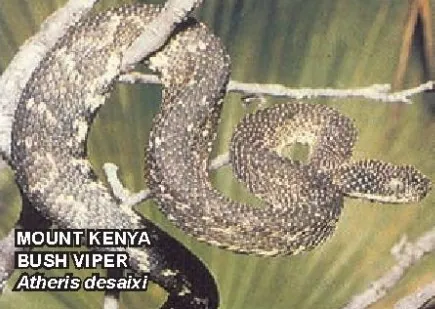
Mount Kenya bush viper
 Ìbùjẹ
ÌbùjẹThe Mount Kenya bush viper is a venomous snake with a striking black and yellow pattern. It lives only in Kenya, in two small, separate areas of forest. Its bite can cause serious swelling and bleeding problems, so it is important to know it.1



 Bí o ṣe lè dá a mọ̀
- Ground colour is greenish-black to charcoal-black, with each scale tipped in yellow or yellowish-green, giving a speckled look.1
- Some scales form a series of loops along the sides, which may join into zigzag patterns towards the back.1
- The underside is yellow near the front, fading to purplish-black towards the rear and under the tail.1
- Young snakes are mainly yellow with a white-tipped tail. They darken as they grow and reach adult colours at about 30 cm.1
- Adults are usually 40 to 60 cm long, including the tail.1
Agbára oró
Oró ń jáde láti inú eyín oró tàbí eyín rẹ̀ nígbà tí ó bá bùjẹ.
Kí ni oró rẹ̀ máa ń ṣe?
Its venom contains powerful anticoagulants, which are substances that stop blood from clotting properly. A bite causes significant swelling and pain. Poor clotting may be severe enough to need blood transfusions.1
Báwo ló ṣe léwu tó fún ènìyàn?
Ewu fún ènìyàn: Ó le gan-anÌbùjẹ nílò dókítà. Ikú kò wọ́pọ̀ rárá.In the one recorded bite, a Kenyan collector was bitten on a finger by an adult snake. The bite caused significant swelling and pain, and he made a full recovery. The snakes are relatively large for their genus, so a bite should be taken seriously.1
Kí ni ó máa ń ṣe nígbà tí ẹ̀rù bá bà á?
When captured, it strikes readily and struggles vigorously. It may also give a threat display, rubbing its coils and keeled scales together to make a loud hiss.1
 Bí ó bá bùjẹ
- Because the venom can stop blood clotting, any bite should be treated as serious and needs urgent medical care. In the one recorded bite, a tourniquet was applied and an unknown antivenin was given, but the antivenin probably made no difference.1
- Jẹ́ kí ẹni náà wà láìmira kí ó sì farabalẹ̀, jẹ́ kí apá tàbí ẹsẹ̀ tí ó bù jẹ wà ní ìpele ọkàn, yọ òrùka àti àwọn nǹkan tó há, kí ẹ sì lọ sí ilé ìwòsàn kíákíá.
Máa kọ́kọ́ pe nọ́ńbà pàjáwìrì rẹ nígbà gbogbo (112, 000, 911). Èyí jẹ́ ìtọ́sọ́nà ìtọ́jú àkọ́kọ́ gbogbogbò, kì í ṣe ìmọ̀ràn ìṣègùn. Ìpìlẹ̀ ìtọ́jú àkọ́kọ́
 Wà láìléwu
- Má ṣe fọwọ́ kan, mú tàbí yọ ẹranko igbó lẹ́nu láéláé, kódà bí ó bá kéré, kódà bí ó bá dà bí ẹni pé ó ń sùn tàbí ó ti kú.
- Fún un ní àyè. Bí o bá pàdé ọ̀kan, farabalẹ̀, sẹ́yìn díẹ̀díẹ̀ kí o sì jẹ́ kí ó máa bá ọ̀nà rẹ̀ lọ.
- Bí ọ̀kan bá bù ọ́ jẹ: farabalẹ̀, má ṣe mira, pe nọ́ńbà pàjáwìrì rẹ (112, 000, 911) tàbí lọ sí ilé ìwòsàn kíákíá. Rántí bí ó ṣe rí, fọ́tò máa ń ṣèrànwọ́.
Kò wá ọ kiri láti ṣe ọ́ léṣe. Ó ń lo oró rẹ̀ láti mú oúnjẹ tàbí láti dáàbò bo ara rẹ̀, ó sì fẹ́ràn láti farapamọ́ jù. Sí i nípa wíwà láìléwu
Báwo ló ṣe tóbi tó?
Báwo ló ṣe gùn tó?
 ó gùn tó ọ̀gẹ̀dẹ̀ 4 tí a tò tẹ̀léra
 lè sáré mítà 100 ní ìṣẹ́jú-àáyá 110 (ènìyàn tó yára jùlọ nílò 9.6)
Báwo ni Mount Kenya bush viper ṣe tóbi tó tí a bá fi wé ÌWỌ?
Ìṣirò nìkan nínú bráwúsà rẹ. A kò fi ohunkóhun pamọ́, a kò sì fi ránṣẹ́ sí ibikíbi.
Báwo ló ṣe yára tó?


Òtítọ́
Its coloration gives it excellent camouflage in the forest, so it is very hard to spot.1
Its speckled, looped pattern changes from juvenile yellow to adult black and yellow as it grows.1
It is arboreal, which means it lives in trees and bushes, moving slowly and deliberately among the branches.1
Captive snakes soon calm down, and their threat display disappears.1
Fún àwọn amòye oró
- Orúkọ sáyẹ́ǹsì
- Atheris desaixi
- Ẹgbẹ́
- Viper àti paramọ́lẹ̀
- Ìdílé
- Viperidae2
- Ètò
- Squamata
- Àwọn kọ́ńtínẹ́ńtì
- Áfíríkà
- Àwọn ọmọ
- It gives birth to live young. One recorded female gave birth to 13 offspring in August, each measuring 17 to 21 cm.1
- Bí ó ṣe ń ṣe nínú igbó
- Endangered on the IUCN Red List (as of 2019). Listed in Appendix II of CITES, so international trade is regulated by permit.1
- Ewu fún ènìyàn
- 3 / 5: Ó le gan-an3
Ibi tí àwọn òtítọ́ ti wá
- Atheris desaixi (Wikipedia (CC BY-SA 4.0))
- Atheris desaixi (iNaturalist): orúkọ àti ìpínsísọ̀rí.
- Venom Wiki: ìpele ewu, ìtóbi déédé àti àfojúbù ìyára jẹ́ tiwa. Wo bí a ṣe ń ṣírò wọn: Bí a ṣe ń díwọ̀n ewu.
Gbogbo òtítọ́ ojú-ìwé yìí ní nọ́ńbà tó tọ́ka sí orísun rẹ̀. Bí a bá ṣe àṣìṣe, má bínú, olólùfẹ́ ẹranko ni wá, kì í ṣe ìwé ìròyìn sáyẹ́ǹsì. Sọ fún wa ní [email protected] a ó sì tún un ṣe.
 Ebi ń pa àkekèé! Iṣẹ́ akanṣe ẹnì kan ṣoṣo ni Venom Wiki: ọ̀fẹ́ ni, kò sí ìpolówó, kò sì sí olùtọpinpin. Ẹ̀bùn kékeré ń ràn án lọ́wọ́ láti wà lórí íńtánẹ́ẹ̀tì.Bọ́ àkekèé
 Puff adder
 Gaboon viper
 Northeast African carpet viper
 West African carpet viper
 Rhinoceros viper
 West African Gaboon viper
 Black mamba
 Deathstalker
 Egyptian cobra
 Boomslang
 Fat-tailed scorpion
 Western honey bee