
 I-Afrika
 I-Asia
 I-Yurophu
 INingizimu Melika
 I-Australia ne-Oceania
 I-Antarctica
 ULwandlekazi iPacific
 ULwandlekazi i-Atlantic
 ULwandlekazi i-India
 ULwandlekazi i-Arctic
 Ulwandle iMediterranean
 Ulwandle Olubomvu
 Ulwandle iCaribbean
 Ulwandle iCoral
 Ulwandle lwaseNingizimu China
 Ulwandle lwasePhilippines
 Ulwandle i-Andaman
 Ulwandle i-North Sea
 Ulwandle lwaseTimor ne-Arafura
 Ichweba laseBengal
 Ichweba laseCalifornia
Gaboon viper
 Ukuluma
The Gaboon viper is a large, heavy snake with a striking pattern of pale and dark markings. It lives in the rainforests and savannas of sub-Saharan Africa. It is one of the most venomous snakes in the world, so knowing what it looks like matters.1


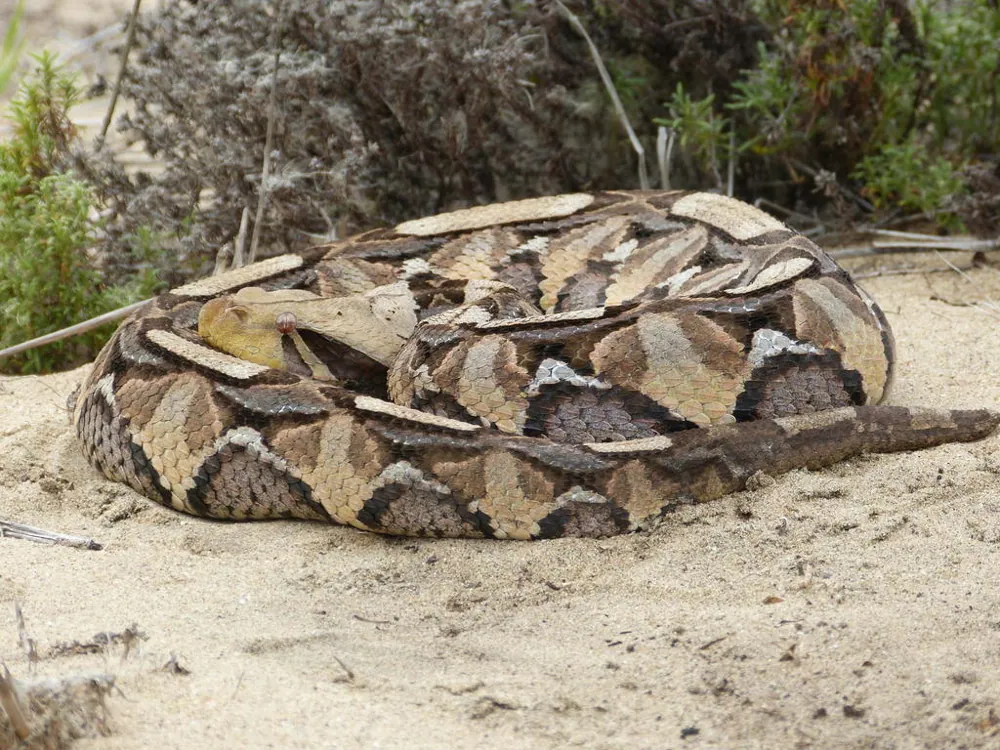
 Indlela yokusibona
- A large, heavy, stout body, with a large triangular head and a neck much narrower than the head1
- A series of pale, rectangular blotches down the centre of the back, with dark hourglass markings edged in yellow1
- A white or cream head with a fine dark central line and a dark blue-black triangle behind and below each eye1
- Small raised 'horns' between the nostrils, which are tiny in this species1
- Its camouflage works well among dead leaves under trees, so it can be hard to see1
Ivamise ukudidaniswa ne: The Congolese giant toad (Sclerophrys channingi) may be a mimic of this snake. Its head appears to resemble the viper's head, while its body is darker.1
Amandla obuthi
Ubuthi buphuma ngamazinyo aso obuthi noma ngamazinyo uma siluma.
Ubuthi baso benzani?
The venom is cytotoxic, which means it damages cells, and cardiotoxic, which means it harms the heart. Each bite can deliver a large amount of venom, because the snake does not release its grip after biting.1
Siyingozi kangakanani ebantwini?
Ingozi ebantwini: Kuyingozi kakhuluSingabulala umuntu ongatholi kwelashwa.Bites are extremely rare, because the snake is seldom aggressive and lives mostly in rainforest areas. Most bites happen when people accidentally step on it. Even an average bite from an average-sized snake is potentially fatal.1
 Izindaba ezinhle: odokotela banomuthi (i-antivenom) noma indlela yokwelapha lokhu.1
Senzani uma sesabile?
When threatened it hisses loudly in a deep, steady rhythm and flattens its head slightly with each breath. It is unlikely to strike unless it is severely provoked.1
 Uma siluma
- Any bite should be treated as a serious medical emergency. Antivenom should be given as soon as possible to save the limb or the person's life.1
- Gcina umuntu engashukumi futhi ezolile, gcina isitho esilunyiwe sisezingeni lenhliziyo, khipha izindandatho nezinto eziqinile, bese umusa esibhedlela ngokushesha.
Njalo shayela kuqala inombolo yezimo eziphuthumayo (112, 000, 911). Lokhu kuyiseluleko sosizo lokuqala esijwayelekile, akusona iseluleko sezokwelapha. Izisekelo zosizo lokuqala
 Hlala uphephile
- Ungalokothi uthinte, ubambe noma ugcone isilwane sasendle, ngisho noma sincane, futhi ngisho noma sibukeka silele noma sifile.
- Sinike isikhala. Uma uhlangana naso, hlala uzolile, uhlehle kancane bese usiyeka sihambe ngendlela yaso.
- Uma sikuluma: hlala uzolile, ungashukumi, shayela inombolo yezimo eziphuthumayo (112, 000, 911) noma uye esibhedlela ngokushesha. Khumbula ukuthi besibukeka kanjani, isithombe siyasiza.
Asikuzingeli wena. Sisebenzisa ubuthi baso ukuze sibambe ukudla noma ukuzivikela, futhi singancamela ukucasha. Okwengeziwe mayelana nokuhlala uphephile
Sikhulu kangakanani?
Side kangakanani?
Sisinda kangakanani?
 side njengamakati asekhaya angu-4 kusuka ekhaleni kuya emsileni
 side njengobhanana abangu-10 abalandelanayo
 singahamba amamitha ali-100 ngemizuzwana engu-90 (umuntu oshesha kunabo bonke udinga engu-9,6)
Gaboon viper mkhulu kangakanani uma uqhathanisa NAWE?
Yizibalo nje kusiphequluli sakho. Akukho okulondolozwayo noma okuthunyelwa ndawo.
Sishesha kangakanani?


Amaqiniso
A 1.8 m specimen caught in 1973 weighed 11.3 kg with an empty stomach. It is the heaviest venomous snake in Africa.1
Its eyes can move in unusual ways. If its head is turned 360°, one eye tilts up and the other tilts down.1
Although it is one of the fastest-striking snakes in the world, it usually tolerates handling and rarely bites or hisses.1
Unlike many African vipers, such as the puff adder, it does not release its grip after biting.1
Males fight by intertwining their necks and pushing. The winner pushes the other's head to the ground and raises his own head by 20–30 cm.1
Umqothuli wezinganekwane
Inganekwane: Because it is calm and tolerant, it is safe to handle.
Iqiniso: Some writers have described it as so docile it can be handled as freely as a harmless snake. This is absolutely not recommended: it is one of the fastest-striking snakes, and bites by bad-tempered individuals do occur.1
Lapho amaqiniso evela khona
- Gaboon viper (Wikipedia (CC BY-SA 4.0))
- Bitis gabonica (iNaturalist): amagama nokuhlelwa ngezigaba.
- Venom Wiki: izinga lengozi, usayizi ojwayelekile nesiqagela sejubane kungokwethu. Bona ukuthi sikubala kanjani: Indlela esilinganisa ngayo ingozi.
Iqiniso ngalinye kuleli khasi linenombolo ekhomba umthombo walo. Uma senze iphutha, uxolo, singabathandi bezilwane, hhayi iphephabhuku lesayensi. Sitshele ku-[email protected] futhi sizolilungisa.
 Ufezela ulambile! I-Venom Wiki iwumsebenzi womuntu oyedwa: imahhala, ayinazo izikhangiso noma izilandeli. Isipho esincane sisiza ukuyigcina ku-inthanethi.Phakela ufezela
Okunye okuvela eqenjini elifanayo: Ama-viper namabululu
 IbululuAma-viper namabululuKuyabulala
 Northeast African carpet viperAma-viper namabululuKuyabulala
 West African carpet viperAma-viper namabululuKuyabulala
 Rhinoceros viperAma-viper namabululuKungabulala
 West African Gaboon viperAma-viper namabululuKungabulala
 Horned adderAma-viper namabululuKudinga udokotela
 Black mamba
 Deathstalker
 Egyptian cobra
 Boomslang
 Fat-tailed scorpion
 Western honey bee