
 I-Afrika
 I-Asia
 I-Yurophu
 INingizimu Melika
 I-Australia ne-Oceania
 I-Antarctica
 ULwandlekazi iPacific
 ULwandlekazi i-Atlantic
 ULwandlekazi i-India
 ULwandlekazi i-Arctic
 Ulwandle iMediterranean
 Ulwandle Olubomvu
 Ulwandle iCaribbean
 Ulwandle iCoral
 Ulwandle lwaseNingizimu China
 Ulwandle lwasePhilippines
 Ulwandle i-Andaman
 Ulwandle i-North Sea
 Ulwandle lwaseTimor ne-Arafura
 Ichweba laseBengal
 Ichweba laseCalifornia
Goldenrod crab spider
 Ukuluma
The goldenrod crab spider is a small, flat spider that hides on flowers and waits for insects to land nearby. It lives in Europe and North America. It is named for the way it walks, and it can change its colour to match the flower it sits on.1



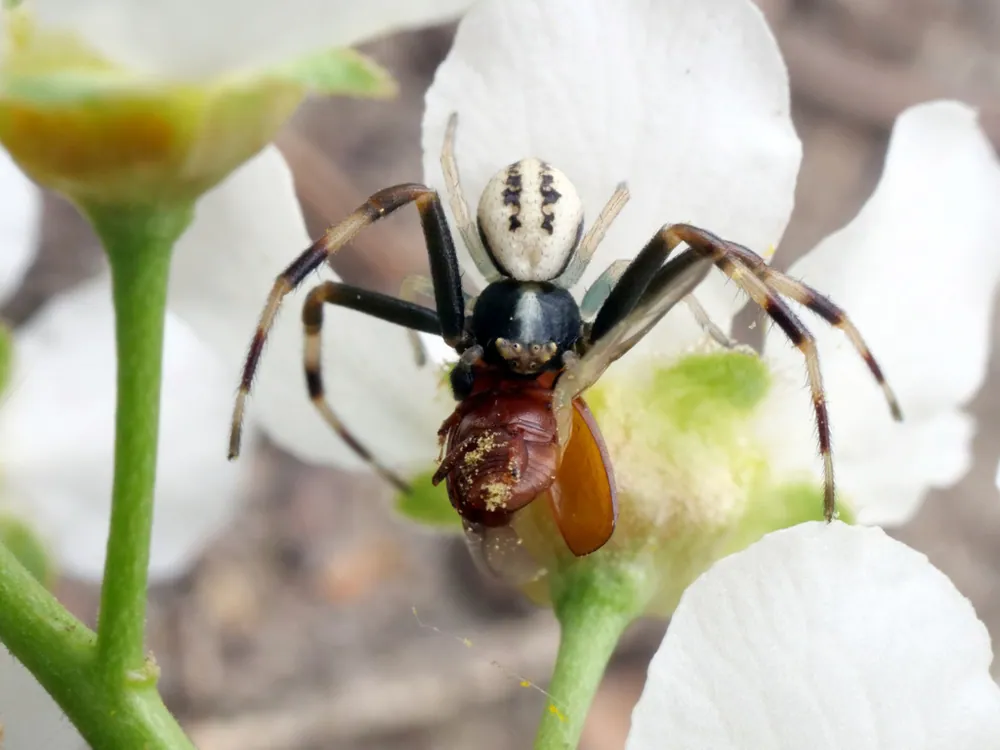
 Indlela yokusibona
- Wide, flat, short body that is shaped like a crab.1
- Usually yellow or white, or a pattern of these two colours. It can also be pale green or pink, with white.1
- Females have white or yellow legs. Males are darker, with red or brown outer shells and red and white bands.1
- Holds its first two pairs of legs open, which are the longest, ready to grab prey.1
- Can walk sideways, forwards and backwards.1
Ivamise ukudidaniswa ne: Mecaphesa asperata is similar in size and shape, but it is light grey to brown with pink stripes on its abdomen and cephalothorax. Diaea crab spiders can be lime green, and some Xysticus and Coriarchne species are brown.1
Amandla obuthi
Ubuthi buphuma ngamazinyo aso obuthi noma ngamazinyo uma siluma.
Ubuthi baso benzani?
Its venom is paralysing, which means it stops prey from moving. The spider injects digestive enzymes with its fangs to break down the insides of its prey. The venom is too weak to harm larger animals.1
Siyingozi kangakanani ebantwini?
Ingozi ebantwini: KuncaneNjengokuhlatshwa yinyosi noma ngaphansi. Cishe akunangozi ebantwini.This spider is harmless to humans. Its fangs are not strong enough to pierce human skin, and its venom is too weak to harm larger animals.1
 Uma siluma
- Geza inxeba lokulunywa bese ubeka iphakethe leqhwa phezu kwalo ngenxa yobuhlungu. Thola usizo lwezokwelapha uma ubuhlungu bunamandla, busabalala noma umuntu ezizwa engaphilile.
Njalo shayela kuqala inombolo yezimo eziphuthumayo (112, 000, 911). Lokhu kuyiseluleko sosizo lokuqala esijwayelekile, akusona iseluleko sezokwelapha. Izisekelo zosizo lokuqala
 Hlala uphephile
- Ungalokothi uthinte, ubambe noma ugcone isilwane sasendle, ngisho noma sincane, futhi ngisho noma sibukeka silele noma sifile.
- Sinike isikhala. Uma uhlangana naso, hlala uzolile, uhlehle kancane bese usiyeka sihambe ngendlela yaso.
- Uma sikuluma: hlala uzolile, ungashukumi, shayela inombolo yezimo eziphuthumayo (112, 000, 911) noma uye esibhedlela ngokushesha. Khumbula ukuthi besibukeka kanjani, isithombe siyasiza.
Asikuzingeli wena. Sisebenzisa ubuthi baso ukuze sibambe ukudla noma ukuzivikela, futhi singancamela ukucasha. Okwengeziwe mayelana nokuhlala uphephile
Sikhulu kangakanani?
Side kangakanani?
 sincane kangangokuthi singahlala ezinzipheni zakho
Goldenrod crab spider mkhulu kangakanani uma uqhathanisa NAWE?
Yizibalo nje kusiphequluli sakho. Akukho okulondolozwayo noma okuthunyelwa ndawo.
Sishesha kangakanani?


Amaqiniso
Females can change colour from yellow to white, or back again, to match the flower they sit on. This process can take up to 25 days.1
The spider can catch prey much larger than itself, because its paralysing venom works so well.1
Unlike many spiders, it does not wrap its prey in silk. It relies entirely on venom to hold its meals still.1
Females leave silk trails called draglines behind them as they move, and males follow these trails rather than pheromones.1
Females wait on flowers and do not travel far, while males roam over great distances to look for mates.1
Females live longer than males, on average.1
Umqothuli wezinganekwane
Inganekwane: Because it is a venomous spider with a name like Whitedeath, it is dangerous to people.
Iqiniso: The goldenrod crab spider is harmless to humans. Its fangs cannot pierce human skin, and its venom is too weak to harm larger animals.1
Lapho amaqiniso evela khona
- Misumena vatia (Wikipedia (CC BY-SA 4.0))
- Misumena vatia (iNaturalist): amagama nokuhlelwa ngezigaba.
- Venom Wiki: izinga lengozi, usayizi ojwayelekile nesiqagela sejubane kungokwethu. Bona ukuthi sikubala kanjani: Indlela esilinganisa ngayo ingozi.
Iqiniso ngalinye kuleli khasi linenombolo ekhomba umthombo walo. Uma senze iphutha, uxolo, singabathandi bezilwane, hhayi iphephabhuku lesayensi. Sitshele ku-[email protected] futhi sizolilungisa.
 Ufezela ulambile! I-Venom Wiki iwumsebenzi womuntu oyedwa: imahhala, ayinazo izikhangiso noma izilandeli. Isipho esincane sisiza ukuyigcina ku-inthanethi.Phakela ufezela
Okunye okuvela eqenjini elifanayo: Izicabucabu
 Brown recluse
 Southern black widow
 Mediterranean black widow
 Northern black widow
 Western black widow
 Diving bell spider
Futhi ihlala: I-Yurophu
 Common European adderAma-viper namabululuKudinga udokotela
 Spanish flyEzinye izilwane ezinoshevuKudinga udokotelaUngathinti
 Common waspIzinyosi, imivi nama-hornetKubuhlungu nje
 European hornetIzinyosi, imivi nama-hornetKubuhlungu nje
 Fire salamanderAmaxoxo anoshevu, amaxoxo e-toad nama-newtKubuhlungu njeUngathinti
 Western honey beeIzinyosi, imivi nama-hornetKubuhlungu nje