
 I-Afrika
 I-Asia
 I-Yurophu
 INingizimu Melika
 I-Australia ne-Oceania
 I-Antarctica
 ULwandlekazi iPacific
 ULwandlekazi i-Atlantic
 ULwandlekazi i-India
 ULwandlekazi i-Arctic
 Ulwandle iMediterranean
 Ulwandle Olubomvu
 Ulwandle iCaribbean
 Ulwandle iCoral
 Ulwandle lwaseNingizimu China
 Ulwandle lwasePhilippines
 Ulwandle i-Andaman
 Ulwandle i-North Sea
 Ulwandle lwaseTimor ne-Arafura
 Ichweba laseBengal
 Ichweba laseCalifornia
Kokoe poison frog
 Ushevu esikhumbeni sasoSidla: IzinambuzaneSinoshevu, asinabo ubuthi bokuluma noma bokuhlaba
The Kokoe poison frog is a small, brightly striped frog that lives on the forest floor of western Colombia. It is one of the most poisonous frogs in the world. Its skin holds a toxin that can be deadly, so it should never be handled.1



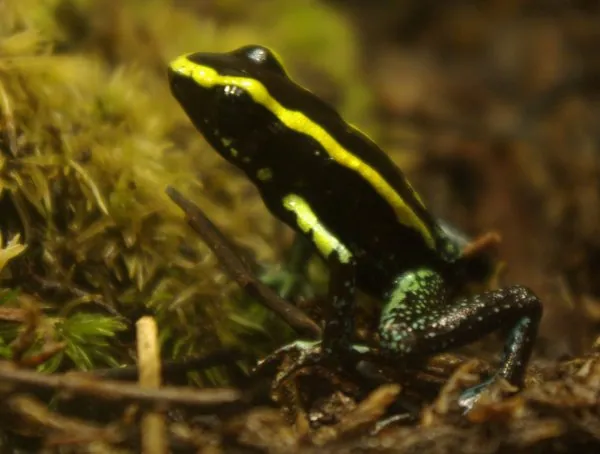
 Indlela yokusibona
- Black back, sometimes with orange patches.1
- Green, yellow, orange or brownish gold stripes along each side of the body.1
- Black belly with blue or green dots.1
- The smallest of the poison dart frogs in its genus, Phyllobates.1
- Two forms exist: a smaller form with large stripes and a larger form with small stripes.1
Amandla oshevu
Isikhumba saso sinoshevu. Kuyingozi ukusithinta, ukusikhotha noma ukusidla.
Ushevu waso wenzani?
This frog is poisonous rather than venomous, because its toxin is held in its skin and does not come from a bite or sting. The toxin, batrachotoxin, is a steroidal alkaloid. It keeps the sodium channels in nerve and muscle cells permanently open, which stops the cells from resetting. The result is paralysis, and often death, as affected muscles stay locked in a contracted state.1
Siyingozi kangakanani ebantwini?
Ingozi ebantwini: Kuyingozi kakhuluSingabulala umuntu ongatholi kwelashwa.Wild frogs are extremely deadly to humans, and the toxin can be fatal in doses as small as 100 μg. Frogs raised in captivity are generally non-toxic.1
Senzani uma sesabile?
It releases its toxin from skin glands only when under stress.1
 Uma umuntu esithintile noma esidlile
- Uma umuntu esithintile: geza izandla kahle futhi ungathinti amehlo noma umlomo. Uma ingane noma isilwane sasekhaya sisikhothile noma sisidlile: shayela isikhungo soshevu noma inombolo yezimo eziphuthumayo.
Njalo shayela kuqala inombolo yezimo eziphuthumayo (112, 000, 911). Lokhu kuyiseluleko sosizo lokuqala esijwayelekile, akusona iseluleko sezokwelapha. Izisekelo zosizo lokuqala
 Hlala uphephile
- Ungalokothi uthinte, ubambe noma ugcone isilwane sasendle, ngisho noma sincane, futhi ngisho noma sibukeka silele noma sifile.
- Sinike isikhala. Uma uhlangana naso, hlala uzolile, uhlehle kancane bese usiyeka sihambe ngendlela yaso.
- Uma usithintile noma usidlile: ungahlikihli amehlo noma umlomo wakho, geza izandla zakho futhi uthole usizo lwezokwelapha.
Asikuzingeli wena. Ushevu waso ukhona nje ukuze kungabikho okusidlayo. Okwengeziwe mayelana nokuhlala uphephile
Sikhulu kangakanani?
Side kangakanani?
 side cishe njengesibophi sephepha
 singahamba amamitha ali-100 ngemizuzwana engu-100 (umuntu oshesha kunabo bonke udinga engu-9,6)
Kokoe poison frog mkhulu kangakanani uma uqhathanisa NAWE?
Yizibalo nje kusiphequluli sakho. Akukho okulondolozwayo noma okuthunyelwa ndawo.
Sishesha kangakanani?


Amaqiniso
It is known as the third most poisonous frog in the world.1
Indigenous peoples of Colombia have used its poison on hunting darts.1
Unlike many other dart frogs, males do not wrestle. Rivals face off and call loudly until one backs down.1
Its mating calls are a loud, bird-like whirring twitter, which can last up to 45 seconds.1
Unlike other Phyllobates species, it does not breed in coconut shells. It lays its eggs in narrow tubes on the ground instead.1
Umqothuli wezinganekwane
Inganekwane: All poison frogs make their own poison.
Iqiniso: These frogs probably do not make batrachotoxin themselves. They take it in from their diet of beetles, millipedes and flies, and from the leaf litter. That is why captive frogs are generally non-toxic.1
Okongoti bobuthi
- Igama lesayensi
- Phyllobates aurotaenia
- Iqembu
- Amaxoxo anoshevu, amaxoxo e-toad nama-newt
- Umndeni
- Dendrobatidae2
- Ukuhleleka
- Anura
- Amazwekazi
- INingizimu Melika
- Izinsana
- The female lays a clutch of eggs in leaf litter, averaging 15 to 20. After the eggs hatch, the male carries the tadpoles to slow-flowing water.1
- Simo saso endle
- Least Concern (IUCN), although its numbers and range are declining, mainly due to habitat loss1
- Ingozi ebantwini
- 4 / 5: Kuyingozi kakhulu3
Lapho amaqiniso evela khona
- Phyllobates aurotaenia (Wikipedia (CC BY-SA 4.0))
- Phyllobates aurotaenia (iNaturalist): amagama nokuhlelwa ngezigaba.
- Venom Wiki: izinga lengozi, usayizi ojwayelekile nesiqagela sejubane kungokwethu. Bona ukuthi sikubala kanjani: Indlela esilinganisa ngayo ingozi.
Iqiniso ngalinye kuleli khasi linenombolo ekhomba umthombo walo. Uma senze iphutha, uxolo, singabathandi bezilwane, hhayi iphephabhuku lesayensi. Sitshele ku-[email protected] futhi sizolilungisa.
 Ufezela ulambile! I-Venom Wiki iwumsebenzi womuntu oyedwa: imahhala, ayinazo izikhangiso noma izilandeli. Isipho esincane sisiza ukuyigcina ku-inthanethi.Phakela ufezela
Okunye okuvela eqenjini elifanayo: Amaxoxo anoshevu, amaxoxo e-toad nama-newt
 Golden poison frogAmaxoxo anoshevu, amaxoxo e-toad nama-newtKuyabulalaUngathinti
 Cane toadAmaxoxo anoshevu, amaxoxo e-toad nama-newtKudinga udokotelaUngathinti
 Dyeing poison dart frogAmaxoxo anoshevu, amaxoxo e-toad nama-newtKubuhlungu njeUngathinti
 Black-legged poison frogAmaxoxo anoshevu, amaxoxo e-toad nama-newtKungabulalaUngathinti
 Bruno's casque-headed frogAmaxoxo anoshevu, amaxoxo e-toad nama-newtKudinga udokotelaUngathinti
 Harlequin poison frogAmaxoxo anoshevu, amaxoxo e-toad nama-newtKudinga udokotelaUngathinti
 Terciopelo
 Brazilian wandering spider
 Eyelash viper
 Golden lancehead
 South American bushmaster
 Peruvian giant centipede