
 I-Afrika
 I-Asia
 I-Yurophu
 INingizimu Melika
 I-Australia ne-Oceania
 I-Antarctica
 ULwandlekazi iPacific
 ULwandlekazi i-Atlantic
 ULwandlekazi i-India
 ULwandlekazi i-Arctic
 Ulwandle iMediterranean
 Ulwandle Olubomvu
 Ulwandle iCaribbean
 Ulwandle iCoral
 Ulwandle lwaseNingizimu China
 Ulwandle lwasePhilippines
 Ulwandle i-Andaman
 Ulwandle i-North Sea
 Ulwandle lwaseTimor ne-Arafura
 Ichweba laseBengal
 Ichweba laseCalifornia
Lehmann's poison frog
 Ushevu esikhumbeni sasoSidla: IzinambuzaneSinoshevu, asinabo ubuthi bokuluma noma bokuhlaba
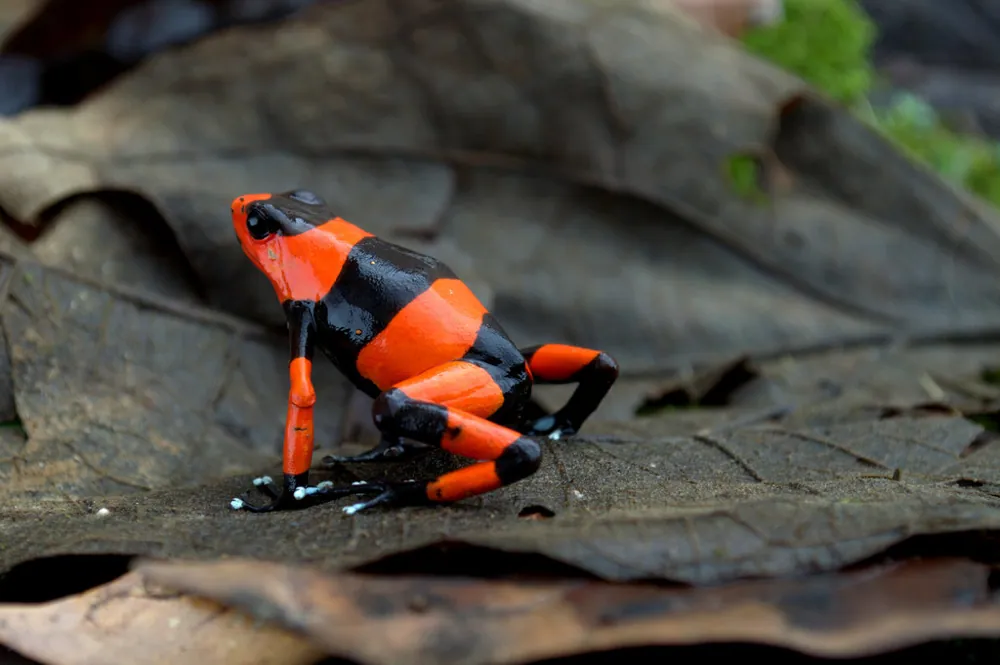
Lehmann's poison frog is a small, brightly marked frog that lives only in a small part of western Colombia. Its skin produces strong toxins, and its bright colours warn predators to leave it alone. It is critically endangered, so it matters for conservation as well as for safety.1


 Indlela yokusibona
- Black or dark brown background with two bright, broad bands of colour round the body1
- Coloured bands on the arms and legs, and on the belly1
- Red, orange or yellow colour forms; each frog has its own unique pattern1
- Males have silver-tipped toes1
- Adults measure 31 to 36 mm from snout to vent1
Ivamise ukudidaniswa ne: The harlequin poison frog (Oophaga histrionicus) looks very similar and can interbreed with it. Scientists still debate whether Lehmann's poison frog is a separate species. The main difference is that Lehmann's frog lacks histrionicotoxins, a type of toxin found in the harlequin frog. Males also have calls that differ between northern and southern populations.1
Amandla oshevu
Isikhumba saso sinoshevu. Kuyingozi ukusithinta, ukusikhotha noma ukusidla.
Ushevu waso wenzani?
It is not venomous. Its skin produces toxins, including alkaloids such as pumiliotoxins, that can be very poisonous. Frogs bred in captivity are not poisonous, because their diet lacks the chemicals needed to make the toxins.1
Siyingozi kangakanani ebantwini?
Ingozi ebantwini: Kubi kakhuluUma umuntu esithinta noma esidla, yana kudokotela. Ukufa kuyivelakancane kakhulu.The skin toxins can be very poisonous to predators, and some native tribes of Colombia used them to coat their darts. Frogs in captivity are not poisonous.1
Senzani uma sesabile?
Its bright, vivid colours act as a warning to predators that it is inedible.1
 Uma umuntu esithintile noma esidlile
- Uma umuntu esithintile: geza izandla kahle futhi ungathinti amehlo noma umlomo. Uma ingane noma isilwane sasekhaya sisikhothile noma sisidlile: shayela isikhungo soshevu noma inombolo yezimo eziphuthumayo.
Njalo shayela kuqala inombolo yezimo eziphuthumayo (112, 000, 911). Lokhu kuyiseluleko sosizo lokuqala esijwayelekile, akusona iseluleko sezokwelapha. Izisekelo zosizo lokuqala
 Hlala uphephile
- Ungalokothi uthinte, ubambe noma ugcone isilwane sasendle, ngisho noma sincane, futhi ngisho noma sibukeka silele noma sifile.
- Sinike isikhala. Uma uhlangana naso, hlala uzolile, uhlehle kancane bese usiyeka sihambe ngendlela yaso.
- Uma usithintile noma usidlile: ungahlikihli amehlo noma umlomo wakho, geza izandla zakho futhi uthole usizo lwezokwelapha.
Asikuzingeli wena. Ushevu waso ukhona nje ukuze kungabikho okusidlayo. Okwengeziwe mayelana nokuhlala uphephile
Sikhulu kangakanani?
Side kangakanani?
 side cishe njengesibophi sephepha
 singahamba amamitha ali-100 ngemizuzwana engu-97 (umuntu oshesha kunabo bonke udinga engu-9,6)
Lehmann's poison frog mkhulu kangakanani uma uqhathanisa NAWE?
Yizibalo nje kusiphequluli sakho. Akukho okulondolozwayo noma okuthunyelwa ndawo.
Sishesha kangakanani?


Amaqiniso
In the wild, this frog is toxic, but frogs kept in captivity lose their toxicity because the toxins come from their diet.1
Tadpoles in the same pool may eat each other, so the male carries them to separate water pools.1
The male is the one who guards the eggs and carries the tadpoles on his back for two to four weeks.1
Its skin toxins are being studied for possible medicinal uses.1
Its bright colours are a warning, a strategy called aposematism.1
Umqothuli wezinganekwane
Inganekwane: Lehmann's poison frog is always poisonous.
Iqiniso: Wild frogs are toxic, but frogs bred in captivity are not, because their diet lacks the chemicals needed to make the poison.1
Okongoti bobuthi
- Igama lesayensi
- Oophaga lehmanni
- Iqembu
- Amaxoxo anoshevu, amaxoxo e-toad nama-newt
- Umndeni
- Dendrobatidae2
- Ukuhleleka
- Anura
- Amazwekazi
- INingizimu Melika
- Izinsana
- The female lays a small number of large eggs on leaves about 1.2 metres above the forest floor. The male fertilises them, keeps them moist, then carries the tadpoles on his back to small water pools such as tree hollows and bromeliad rosettes.1
- Simo saso endle
- Critically endangered (IUCN); listed on CITES Appendix II1
- Ingozi ebantwini
- 3 / 5: Kubi kakhulu3
Lapho amaqiniso evela khona
- Lehmann's poison frog (Wikipedia (CC BY-SA 4.0))
- Oophaga lehmanni (iNaturalist): amagama nokuhlelwa ngezigaba.
- Venom Wiki: izinga lengozi, usayizi ojwayelekile nesiqagela sejubane kungokwethu. Bona ukuthi sikubala kanjani: Indlela esilinganisa ngayo ingozi.
Iqiniso ngalinye kuleli khasi linenombolo ekhomba umthombo walo. Uma senze iphutha, uxolo, singabathandi bezilwane, hhayi iphephabhuku lesayensi. Sitshele ku-[email protected] futhi sizolilungisa.
 Ufezela ulambile! I-Venom Wiki iwumsebenzi womuntu oyedwa: imahhala, ayinazo izikhangiso noma izilandeli. Isipho esincane sisiza ukuyigcina ku-inthanethi.Phakela ufezela
Okunye okuvela eqenjini elifanayo: Amaxoxo anoshevu, amaxoxo e-toad nama-newt
 Golden poison frogAmaxoxo anoshevu, amaxoxo e-toad nama-newtKuyabulalaUngathinti
 Cane toadAmaxoxo anoshevu, amaxoxo e-toad nama-newtKudinga udokotelaUngathinti
 Dyeing poison dart frogAmaxoxo anoshevu, amaxoxo e-toad nama-newtKubuhlungu njeUngathinti
 Black-legged poison frogAmaxoxo anoshevu, amaxoxo e-toad nama-newtKungabulalaUngathinti
 Bruno's casque-headed frogAmaxoxo anoshevu, amaxoxo e-toad nama-newtKudinga udokotelaUngathinti
 Harlequin poison frogAmaxoxo anoshevu, amaxoxo e-toad nama-newtKudinga udokotelaUngathinti
 Terciopelo
 Brazilian wandering spider
 Eyelash viper
 Golden lancehead
 South American bushmaster
 Peruvian giant centipede