
 I-Afrika
 I-Asia
 I-Yurophu
 INingizimu Melika
 I-Australia ne-Oceania
 I-Antarctica
 ULwandlekazi iPacific
 ULwandlekazi i-Atlantic
 ULwandlekazi i-India
 ULwandlekazi i-Arctic
 Ulwandle iMediterranean
 Ulwandle Olubomvu
 Ulwandle iCaribbean
 Ulwandle iCoral
 Ulwandle lwaseNingizimu China
 Ulwandle lwasePhilippines
 Ulwandle i-Andaman
 Ulwandle i-North Sea
 Ulwandle lwaseTimor ne-Arafura
 Ichweba laseBengal
 Ichweba laseCalifornia
Mangrove snake
 Ukuluma
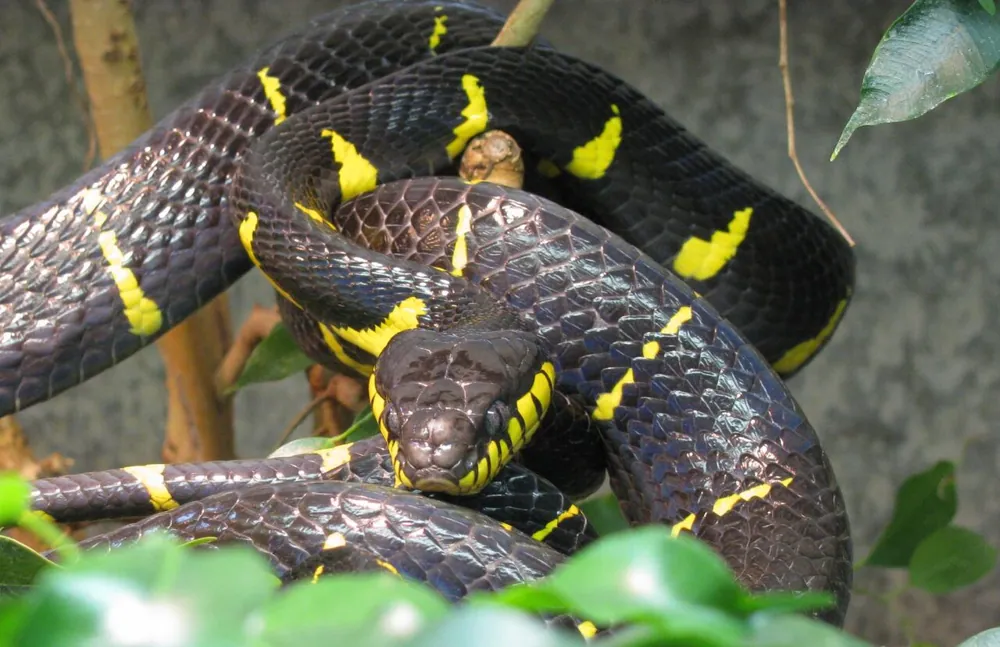
The mangrove snake is a large, tree-climbing snake with yellow and black bands. It lives in Southeast Asia and is one of the biggest cat snake species. It is mildly venomous, and it is often mistaken for a much more dangerous snake, the banded krait.1



 Indlela yokusibona
- Black above, with yellow bands across the back1
- Yellow lips with black edges1
- Black or bluish underside, sometimes speckled with yellow, and a yellow throat1
- Can grow to about 240 to 270 cm long1
- Has a triangular body cross-section1
Ivamise ukudidaniswa ne: The mangrove snake can be confused with the banded krait, which has alternating black and yellow crossbands and a triangular body. The banded krait is extremely venomous, so treat any black and yellow banded snake with caution.1
Amandla obuthi
Ubuthi buphuma ngamazinyo aso obuthi noma ngamazinyo uma siluma.
Ubuthi baso benzani?
The snake has rear fangs and a venom gland linked to them. It has to chew to release the venom, which is released gradually. Its venom is weak, and the rear fangs are small, so it is hard for the snake to sink them into a person's arm or leg. Moderate bites have caused intense swelling.1
Siyingozi kangakanani ebantwini?
Ingozi ebantwini: KubuhlunguKungaba buhlungu ngempela, kodwa cishe akukaze kube kubi kakhulu.It is considered mildly venomous. Moderate bites have caused intense swelling, but there has never been a confirmed death, as of 2016.1
Senzani uma sesabile?
It is a potentially defensive snake that may strike repeatedly, even when captive bred.1
 Uma siluma
- Geza inxeba lokulunywa, gcina umuntu ezolile bese uthola usizo lwezokwelapha. Ezinye izinhlobo (njenge-boomslang) zingabulala emahoreni amaningi kamuva.
Njalo shayela kuqala inombolo yezimo eziphuthumayo (112, 000, 911). Lokhu kuyiseluleko sosizo lokuqala esijwayelekile, akusona iseluleko sezokwelapha. Izisekelo zosizo lokuqala
 Hlala uphephile
- Ungalokothi uthinte, ubambe noma ugcone isilwane sasendle, ngisho noma sincane, futhi ngisho noma sibukeka silele noma sifile.
- Sinike isikhala. Uma uhlangana naso, hlala uzolile, uhlehle kancane bese usiyeka sihambe ngendlela yaso.
- Uma sikuluma: hlala uzolile, ungashukumi, shayela inombolo yezimo eziphuthumayo (112, 000, 911) noma uye esibhedlela ngokushesha. Khumbula ukuthi besibukeka kanjani, isithombe siyasiza.
Asikuzingeli wena. Sisebenzisa ubuthi baso ukuze sibambe ukudla noma ukuzivikela, futhi singancamela ukucasha. Okwengeziwe mayelana nokuhlala uphephile
Sikhulu kangakanani?
Side kangakanani?
 side njengezinja ezingu-2.5 kusuka ekhaleni kuya emsileni
 side njengobhanana abangu-15 abalandelanayo
 singahamba amamitha ali-100 ngemizuzwana engu-54 (umuntu oshesha kunabo bonke udinga engu-9,6)
Mangrove snake mkhulu kangakanani uma uqhathanisa NAWE?
Yizibalo nje kusiphequluli sakho. Akukho okulondolozwayo noma okuthunyelwa ndawo.
Sishesha kangakanani?


Amaqiniso
Its venom contains denmotoxin, a three-finger toxin that is the first fully characterised bird-specific toxin.1
It is one of the biggest cat snake species.1
Despite its name, it is found more often in lowland rainforests than in mangrove swamps.1
It may refuse food for long periods if it is disturbed.1
Umqothuli wezinganekwane
Inganekwane: It is a dangerous killer because it looks like the banded krait.
Iqiniso: It is mildly venomous, and there has never been a confirmed death from its bite. Its look can be confused with the extremely venomous banded krait.1
Lapho amaqiniso evela khona
- Boiga dendrophila (Wikipedia (CC BY-SA 4.0))
- Boiga dendrophila (iNaturalist): amagama nokuhlelwa ngezigaba.
- Venom Wiki: izinga lengozi, usayizi ojwayelekile nesiqagela sejubane kungokwethu. Bona ukuthi sikubala kanjani: Indlela esilinganisa ngayo ingozi.
Iqiniso ngalinye kuleli khasi linenombolo ekhomba umthombo walo. Uma senze iphutha, uxolo, singabathandi bezilwane, hhayi iphephabhuku lesayensi. Sitshele ku-[email protected] futhi sizolilungisa.
 Ufezela ulambile! I-Venom Wiki iwumsebenzi womuntu oyedwa: imahhala, ayinazo izikhangiso noma izilandeli. Isipho esincane sisiza ukuyigcina ku-inthanethi.Phakela ufezela
Okunye okuvela eqenjini elifanayo: Izinyoka ezinamazinyo obuthi ngemuva
 Brown tree snakeIzinyoka ezinamazinyo obuthi ngemuvaKubuhlungu nje
 Tiger keelbackIzinyoka ezinamazinyo obuthi ngemuvaKungabulala
 Red-necked keelbackIzinyoka ezinamazinyo obuthi ngemuvaKudinga udokotela
 Green cat snakeIzinyoka ezinamazinyo obuthi ngemuvaKubuhlungu nje
 Asian vine snakeIzinyoka ezinamazinyo obuthi ngemuvaAkunangozi
 Golden tree snakeIzinyoka ezinamazinyo obuthi ngemuvaAkunangozi
 Deathstalker
 Indian cobra
 Indian saw-scaled viper
 King cobra
 Ibululu
 Inhlangwane kaRussell
.JPG)