
 Abibirem
 Asia
Asia Yuropu
 Amerika Anaafoɔ
 Australia ne Oceania
 Antarctica
 Pacific Po
 Atlantic Po
 India Po
 Arctic Po
 Mediterranean Po
 Po Kɔkɔɔ
 Caribbean Po
 Coral Po
 China Anaafoɔ Po
 Philippine Po
 Andaman Po
 Atifi Po
 Timor ne Arafura Po
 Bengal Ɛpo Ano
 California Ɛpo Ano
Blackspotted puffer
 Ɛyɛ awuduro sɛ wodi aƆdi: Biribiara kakraNe ho yɛ awuduro, onni bɔre
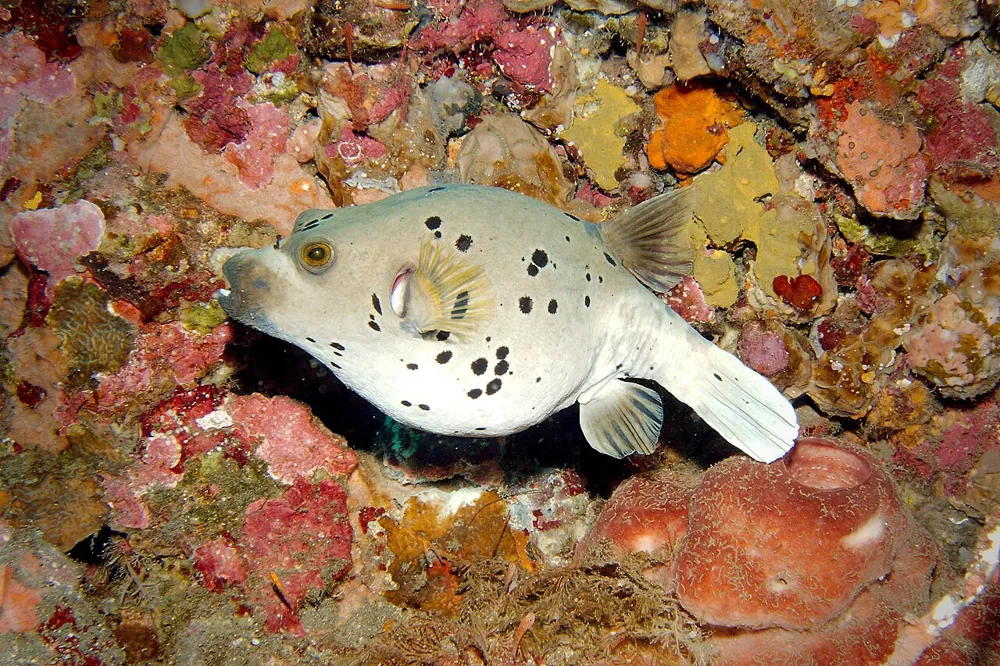
The blackspotted puffer is a small tropical sea fish that lives on coral reefs and in lagoons across the Indian and Pacific Oceans. It is poisonous rather than venomous, so it is dangerous to eat but does not bite or sting.1


.jpg)
 Sɛdeɛ wobɛhunu no
- Small, oval, rounded body with no scales; the skin is smooth.1
- Short snout with two pairs of nostrils and four strong teeth.1
- Background colour varies: grey, light brown, bluish, bright yellow or orangey yellow, and sometimes two colours such as blue and yellow.1
- Skin covered in dark blotches of varying size and shape.1
- Dark colouring around the eyes and mouth.1
Wɔtaa fa no sɛ: The yellow colour forms are very similar to those of Arothron meleagris, but they can be told apart. The fully yellow form is much rarer in this species (about 1% of individuals, compared with 10% in A. meleagris). It usually keeps dark markings around the mouth, eyes and base of the dorsal fin, while A. meleagris is uniformly yellow with black spots.1
Awuduro ahoɔden
Ɛyɛ asiane bere a biribi adi no nko ara.
Ne ho awuduro yɛ dɛn?
It is not venomous. It holds tetrodotoxin, a deadly poison that protects it from predators.1
Ne asiane ma nnipa te sɛn?
Asiane ma nnipa: Asiane kɛseɛ womƐtumi kum onipa a wɔnhwɛ no yareɛ.Its tetrodotoxin is deadly. The risk comes from eating or handling the fish.1
Ɛyɛ dɛn bere a ehu aka no?
When threatened, it inflates its body by swallowing air or water.1
 Sɛ obi de ne nsa ka anaa ɔdi a
- Sɛ obi adi bi anaa ne ho anyɛ no dɛ bere a wadi akyi a: frɛ wo ahohiahia nɔma anaa awuduro ho mmoa adwumayɛbea (poison centre) ntɛm ara.
Di kan frɛ wo ahohiahia nɔma (112, 000, 911). Yei yɛ mmoa a ɛdi kan ho akwankyerɛ, ɛnyɛ dɔkota afotuo. Mmoa a ɛdi kan ho nsɛm titiriw
 Hwɛ wo ho so
- Mfa wo nsa nka wiram aboa biara, nkyere no na mfa no nni agorɔ, sɛ ɔyɛ ketewa mpo, na sɛ ɛte sɛ ɔrededa anaa wawu mpo a.
- Ma no kwan. Sɛ wohyia baako a, ma wo bo nnwo, san w'akyi brɛoo na ma ɔnkɔ ne kwan.
- Sɛ wode wo nsa kaa no anaa wodii a: mfa wo nsa ntwitwi w'ani anaa w'ano, hohoro wo nsa na hwehwɛ dɔkota mmoa.
Ɛnhwehwɛ wo sɛ ɛbɛpira wo. Ne ho awuduro no wɔ hɔ sɛdeɛ ɛbɛyɛ a biribiara renni no. Nsɛm pii fa ahobammɔ ho
Wiase mu baabi bɛn?
Ne kɛseɛ te sɛn?
Ne tenten te sɛn?
 ne tenten te sɛ agodeɛ blɔk 10 a wɔde to ntoatoasoɔ mu
 ɛbɛtumi aguare aguare tare kɛseɛ tenten (50 m) wɔ anibu 45 mu
Blackspotted puffer kɛseɛ te sɛn sɛ wode toto WO ho a?
Akontabuo kɛkɛ wɔ wo browser mu. Wɔnkora hwee, na wɔmfa hwee nkɔ baabiara.
Ne ntɛm te sɛn?
Nsɛm
Its tetrodotoxin poison is strong enough to protect it from predators.1
It has no scales, and its skin is covered with dark blotches.1
It has no pelvic fins and no lateral line.1
It is active during the day and lives alone, defending its own territory.1
It has four strong teeth set in a terminal mouth.1
Ma bɔre ho animdefoɔ
Baabi a nsɛm no fi
- Blackspotted puffer (Wikipedia (CC BY-SA 4.0))
- Arothron nigropunctatus (iNaturalist): din ne nkyekyɛmu.
- Venom Wiki: asiane gyinabea, kɛseɛ a ɛtaa yɛ ne ntɛm susuo no yɛ yɛn ankasa deɛ. Hwɛ sɛdeɛ yɛbu no: Sɛdeɛ yɛkyerɛ asiane gyinabea.
Nsɛm biara a ɛwɔ kratafa yi so wɔ nɔma a ɛkyerɛ ne fibea. Sɛ yɛfom biribi a, kafra, yɛyɛ mmoa ho akɔnnɔfoɔ, ɛnyɛ nyansahu nwoma. Ka kyerɛ yɛn wɔ [email protected] na yɛbɛsiesie.
 Ɔkɔm de akekantwerɛ no! Onipa baako na ɔyɛ Venom Wiki: ɛyɛ kwa, dawurubɔ nni so na biribiara nni so a ɛdi w'akyi. Akyɛdeɛ ketewa bi boa ma ɛkɔ so tena internet so.Ma akekantwere no aduane
Pii fi kuo korɔ no mu: Mmoa afoforɔ a wɔn ho yɛ awuduro
 Japanese pufferfishMmoa afoforɔ a wɔn ho yɛ awuduroƐkum
 Hawksbill sea turtleMmoa afoforɔ a wɔn ho yɛ awuduroƐtumi kum
 Greenland sharkMmoa afoforɔ a wɔn ho yɛ awuduroƐyɛ yaw kɛkɛ
 Silver-cheeked toadfishMmoa afoforɔ a wɔn ho yɛ awuduroƐkum
 White-spotted pufferMmoa afoforɔ a wɔn ho yɛ awuduroƐtumi kum
 Long-spine porcupinefishMmoa afoforɔ a wɔn ho yɛ awuduroƐhia dɔkota
Ɔte nso wɔ: Pacific Po
 Australian box jellyfishJellyfish ne ɛpo mu mmoa a wɔwɔƐkumMfa wo nsa nka
 Geography coneCone snails ne octopusƐkum
 Greater blue-ringed octopusCone snails ne octopusƐkum
 Southern blue-ringed octopusCone snails ne octopusƐkum
 Irukandji jellyfishJellyfish ne ɛpo mu mmoa a wɔwɔƐtumi kumMfa wo nsa nka
 Reef stonefishApataa a wɔwɔ bɔreƐtumi kumMfa wo nsa nka