
 Abibirem
 Asia
Asia Yuropu
 Amerika Anaafoɔ
 Australia ne Oceania
 Antarctica
 Pacific Po
 Atlantic Po
 India Po
 Arctic Po
 Mediterranean Po
 Po Kɔkɔɔ
 Caribbean Po
 Coral Po
 China Anaafoɔ Po
 Philippine Po
 Andaman Po
 Atifi Po
 Timor ne Arafura Po
 Bengal Ɛpo Ano
 California Ɛpo Ano
Long-spine porcupinefish
 Ɛyɛ awuduro sɛ wodi aƆdi: Biribiara kakraNe ho yɛ awuduro, onni bɔre
The long-spine porcupinefish is a marine fish covered in long, sharp spines. It lives in warm tropical and subtropical seas around the world, often over muddy seabeds or on reefs. Its beak-like jaws can crush hard prey such as sea urchins and shellfish.1



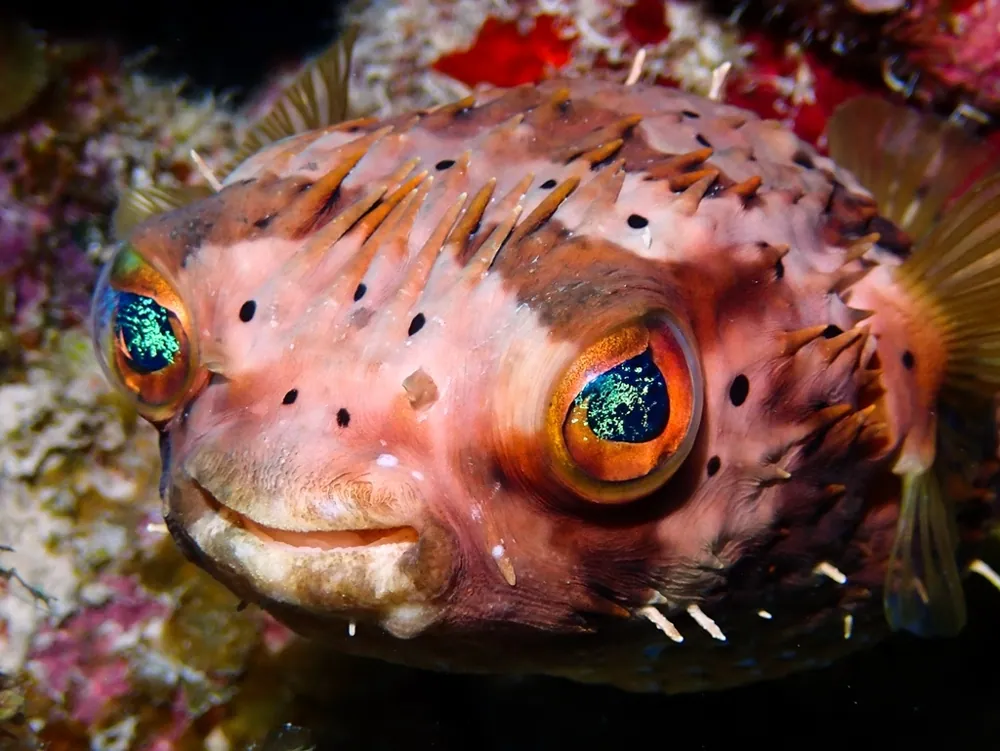
 Sɛdeɛ wobɛhunu no
- Pale in colour, with large black blotches and smaller black spots. The spots become fewer as the fish gets older.1
- Many long spines, each with two roots, which can be raised or lowered. They are especially numerous on the head.1
- The teeth of the two jaws are fused into a parrot-like beak.1
- Adults can reach 50 cm in length.1
Wɔtaa fa no sɛ: The black-blotched porcupinefish (Diodon liturosus) is the only other fish it might be confused with. The long-spine porcupinefish has much longer spines.1
Awuduro ahoɔden
Ɛyɛ asiane bere a biribi adi no nko ara.
Ne asiane ma nnipa te sɛn?
Asiane ma nnipa: Ɛyɛ denSɛ obi di no a, kɔ dɔkota nkyɛn. Ɛntaa nkum obi koraa. Sɛ obi de ne nsa ka anaa ɔdi a
- Sɛ obi adi bi anaa ne ho anyɛ no dɛ bere a wadi akyi a: frɛ wo ahohiahia nɔma anaa awuduro ho mmoa adwumayɛbea (poison centre) ntɛm ara.
Di kan frɛ wo ahohiahia nɔma (112, 000, 911). Yei yɛ mmoa a ɛdi kan ho akwankyerɛ, ɛnyɛ dɔkota afotuo. Mmoa a ɛdi kan ho nsɛm titiriw
 Hwɛ wo ho so
- Mfa wo nsa nka wiram aboa biara, nkyere no na mfa no nni agorɔ, sɛ ɔyɛ ketewa mpo, na sɛ ɛte sɛ ɔrededa anaa wawu mpo a.
- Ma no kwan. Sɛ wohyia baako a, ma wo bo nnwo, san w'akyi brɛoo na ma ɔnkɔ ne kwan.
- Sɛ wode wo nsa kaa no anaa wodii a: mfa wo nsa ntwitwi w'ani anaa w'ano, hohoro wo nsa na hwehwɛ dɔkota mmoa.
Ɛnhwehwɛ wo sɛ ɛbɛpira wo. Ne ho awuduro no wɔ hɔ sɛdeɛ ɛbɛyɛ a biribiara renni no. Nsɛm pii fa ahobammɔ ho
Wiase mu baabi bɛn?
Ne kɛseɛ te sɛn?
Ne tenten te sɛn?
 ne tenten te sɛ kwadu 3 a wɔde to ntoatoasoɔ mu
 ne tenten te sɛ agodeɛ blɔk 16 a wɔde to ntoatoasoɔ mu
 ɛbɛtumi aguare aguare tare kɛseɛ tenten (50 m) wɔ anibu 45 mu
Long-spine porcupinefish kɛseɛ te sɛn sɛ wode toto WO ho a?
Akontabuo kɛkɛ wɔ wo browser mu. Wɔnkora hwee, na wɔmfa hwee nkɔ baabiara.
Ne ntɛm te sɛn?
Nsɛm
Its jaws are fused into a beak that looks like a parrot's, and it uses it to crack open sea urchins and molluscs.1
Its spines have two roots and can be raised or lowered.1
The black spots on its pale body become fewer as it ages.1
Young fish are found in groups, and they stay in open water until they reach about 7 cm.1
Ma bɔre ho animdefoɔ
- Nyansahu din
- Diodon holocanthus
- Kuo
- Mmoa afoforɔ a wɔn ho yɛ awuduro
- Abusua
- Diodontidae2
- Nhyehyɛeɛ (Order)
- Tetraodontiformes
- Asaase akɛseɛ
- Pacific Po, Atlantic Po, India Po, Po Kɔkɔɔ, Caribbean Po, Coral Po, Philippine Po, China Anaafoɔ Po, Mexico Ɛpo Ano, Timor ne Arafura Po, Bengal Ɛpo Ano, California Ɛpo Ano, Po akɛseɛ
- Mmofra nketewa
- It spawns at the surface at dawn or dusk, in pairs or in groups of males with one female. The young stay pelagic (living in open water) until they are at least 7 cm long.1
- Asiane ma nnipa
- 3 / 5: Ɛyɛ den3
Baabi a nsɛm no fi
- Long-spine porcupinefish (Wikipedia (CC BY-SA 4.0))
- Diodon holocanthus (iNaturalist): din ne nkyekyɛmu.
- Venom Wiki: asiane gyinabea, kɛseɛ a ɛtaa yɛ ne ntɛm susuo no yɛ yɛn ankasa deɛ. Hwɛ sɛdeɛ yɛbu no: Sɛdeɛ yɛkyerɛ asiane gyinabea.
Nsɛm biara a ɛwɔ kratafa yi so wɔ nɔma a ɛkyerɛ ne fibea. Sɛ yɛfom biribi a, kafra, yɛyɛ mmoa ho akɔnnɔfoɔ, ɛnyɛ nyansahu nwoma. Ka kyerɛ yɛn wɔ [email protected] na yɛbɛsiesie.
 Ɔkɔm de akekantwerɛ no! Onipa baako na ɔyɛ Venom Wiki: ɛyɛ kwa, dawurubɔ nni so na biribiara nni so a ɛdi w'akyi. Akyɛdeɛ ketewa bi boa ma ɛkɔ so tena internet so.Ma akekantwere no aduane
Pii fi kuo korɔ no mu: Mmoa afoforɔ a wɔn ho yɛ awuduro
 Japanese pufferfishMmoa afoforɔ a wɔn ho yɛ awuduroƐkum
 Hawksbill sea turtleMmoa afoforɔ a wɔn ho yɛ awuduroƐtumi kum
 Greenland sharkMmoa afoforɔ a wɔn ho yɛ awuduroƐyɛ yaw kɛkɛ
 Silver-cheeked toadfishMmoa afoforɔ a wɔn ho yɛ awuduroƐkum
 Blackspotted pufferMmoa afoforɔ a wɔn ho yɛ awuduroƐtumi kum
 White-spotted pufferMmoa afoforɔ a wɔn ho yɛ awuduroƐtumi kum
Ɔte nso wɔ: Pacific Po
 Australian box jellyfishJellyfish ne ɛpo mu mmoa a wɔwɔƐkumMfa wo nsa nka
 Geography coneCone snails ne octopusƐkum
 Greater blue-ringed octopusCone snails ne octopusƐkum
 Southern blue-ringed octopusCone snails ne octopusƐkum
 Irukandji jellyfishJellyfish ne ɛpo mu mmoa a wɔwɔƐtumi kumMfa wo nsa nka
 Reef stonefishApataa a wɔwɔ bɔreƐtumi kumMfa wo nsa nka