
 Abibirem
 Asia
Asia Yuropu
 Amerika Anaafoɔ
 Australia ne Oceania
 Antarctica
 Pacific Po
 Atlantic Po
 India Po
 Arctic Po
 Mediterranean Po
 Po Kɔkɔɔ
 Caribbean Po
 Coral Po
 China Anaafoɔ Po
 Philippine Po
 Andaman Po
 Atifi Po
 Timor ne Arafura Po
 Bengal Ɛpo Ano
 California Ɛpo Ano
Iberian ribbed newt
 Nsɔe a bɔre wom
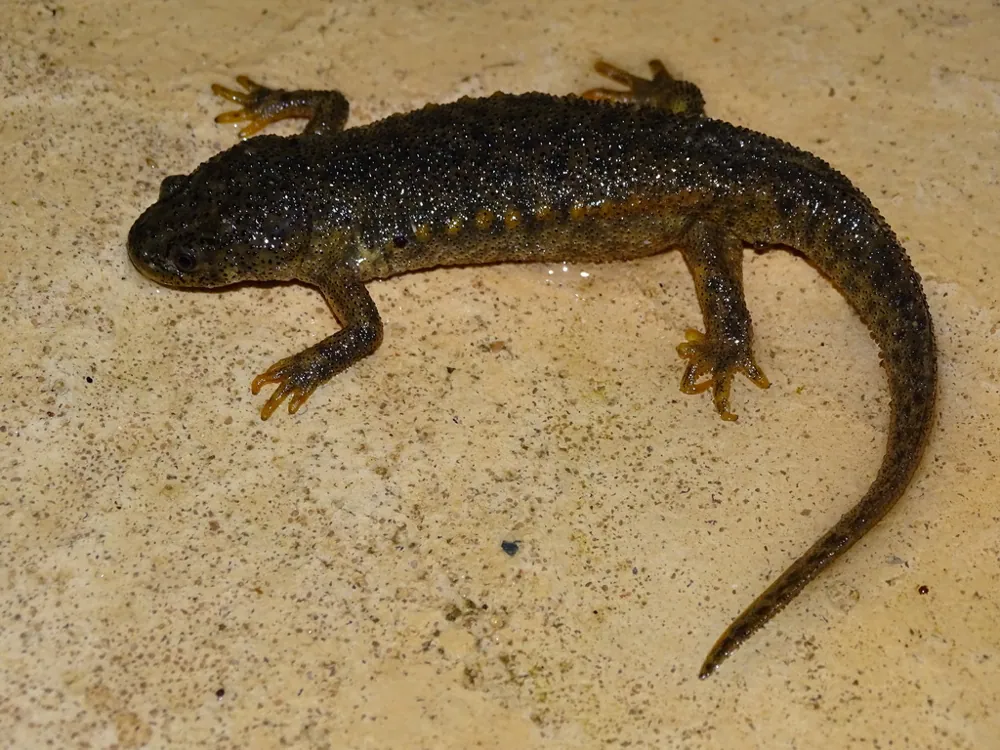
The Iberian ribbed newt is a salamander that lives in ponds and wells in Spain, Portugal and northern Morocco. It is the largest European newt species. When threatened, it can push its sharp ribs out through its skin, which gives it a way to defend itself against predators.1



 Sɛdeɛ wobɛhunu no
- Dark grey on its back and lighter grey on its belly, with small rust-coloured spots1
- Usually 8 to 10 orange, wart-like bumps (tubercles) running down each side of the body1
- Flat, spade-shaped head and a long tail, about half of its body length1
- Males are more slender and usually smaller than females1
- Larvae have bushy external gills and paler colours than adults1
Wɔtaa fa no sɛ: It is sometimes confused with the Iberian newt (Lissotriton boscai), a different species with a similar common name.1
Bɔre ahoɔden
Nsɔe a ano yɛ nnam na ɛkura bɔre no. Sɛ wotiatia so anaa wosɔ mu a, ɛyɛ yaw.
Ne bɔre yɛ dɛn?
When threatened, the newt releases a milky, thick poison from glands on its neck, back, sides and tail as its ribs push out. The poison coats the ribs, which can pierce the skin of a predator's mouth and inject toxins.1
Ne asiane ma nnipa te sɛn?
Asiane ma nnipa: Ɛnyɛ denƐte sɛ wowa wɔ anaa ɛnnu saa. Ɛkame ayɛ sɛ ɛnni asiane ma nnipa.The rib defence is completely harmless to humans. The ribs cause only little harm to the newt itself, and its skin quickly heals without infection.1
Ɛyɛ dɛn bere a ehu aka no?
It tries to run away from predators first. If it cannot escape, it pushes its sharp ribs through its sides and releases poison.1
 Sɛ ne nsɔe hyɛ wo mu a
- Sɛ obi de ne nsa aka bi a: hohoro ne nsa yie na mfa nsa nka ani anaa ano. Sɛ abofra anaa fie aboa bi taforɔɔ bi anaa ɔdii bi a: frɛ awuduro ho mmoa adwumayɛbea (poison centre) anaa wo ahohiahia nɔma.
Di kan frɛ wo ahohiahia nɔma (112, 000, 911). Yei yɛ mmoa a ɛdi kan ho akwankyerɛ, ɛnyɛ dɔkota afotuo. Mmoa a ɛdi kan ho nsɛm titiriw
 Hwɛ wo ho so
- Mfa wo nsa nka wiram aboa biara, nkyere no na mfa no nni agorɔ, sɛ ɔyɛ ketewa mpo, na sɛ ɛte sɛ ɔrededa anaa wawu mpo a.
- Ma no kwan. Sɛ wohyia baako a, ma wo bo nnwo, san w'akyi brɛoo na ma ɔnkɔ ne kwan.
- Sɛ ne nsɔe hyɛ wo mu a: ma wo bo nnwo, tena dinn, frɛ wo ahohiahia nɔma (112, 000, 911) anaa kɔ ayaresabea ntɛm. Kae sɛdeɛ na ɛte, mfonini bɛboa.
Ɛnhwehwɛ wo sɛ ɛbɛpira wo. Ɛde ne bɔre kyere aduane anaa ɛbɔ ne ho ban, na ɛpɛ sɛ ɛhinta sene biribiara. Nsɛm pii fa ahobammɔ ho
Wiase mu baabi bɛn?
Ne kɛseɛ te sɛn?
Ne tenten te sɛn?
 ne tenten te sɛ agodeɛ blɔk 9 a wɔde to ntoatoasoɔ mu
Iberian ribbed newt kɛseɛ te sɛn sɛ wode toto WO ho a?
Akontabuo kɛkɛ wɔ wo browser mu. Wɔnkora hwee, na wɔmfa hwee nkɔ baabiara.
Ne ntɛm te sɛn?


Nsɛm
Its ribs can push through its skin to act as a defence, a primitive and rudimentary form of envenomation.1
It is a model animal for regeneration research. It can regrow lost limbs, injured heart tissue, brain cells, eye lenses and parts of its spinal cord.1
This newt has been sent into space on at least six missions, starting in 1985.1
In genetic males and females, temperature can override sex chromosomes. Some ZW larvae reared at 32 °C (90 °F) become functional males.1
Its immune system, rib-coated collagen and antimicrobial peptides let the pierced skin heal quickly without infection.1
Females can keep live sperm in their cloaca for up to five months.1
Atosɛm sɛefoɔ
Atosɛm: The newt's ribs and poison are dangerous to people.
Nokorɛ: The ribs and poison are a defence against predators. The rib defence is completely harmless to humans.1
Ma bɔre ho animdefoɔ
- Nyansahu din
- Pleurodeles waltl
- Kuo
- Apɔtorɔwa a wɔn ho yɛ awuduro, apɔtorɔ ne newt
- Abusua
- Salamandridae2
- Nhyehyɛeɛ (Order)
- Caudata
- Asaase akɛseɛ
- Yuropu, Abibirem
- Mmofra nketewa
- The young are born in water as larvae, breathing through gills. They lose their gills as their limbs grow and can then live on land as well as in water.1
- Sɛdeɛ ɔte wɔ kwaem
- Least Concern (IUCN, assessed October 2020)1
- Asiane ma nnipa
- 1 / 5: Ɛnyɛ den3
Baabi a nsɛm no fi
- Iberian ribbed newt (Wikipedia (CC BY-SA 4.0))
- Pleurodeles waltl (iNaturalist): din ne nkyekyɛmu.
- Venom Wiki: asiane gyinabea, kɛseɛ a ɛtaa yɛ ne ntɛm susuo no yɛ yɛn ankasa deɛ. Hwɛ sɛdeɛ yɛbu no: Sɛdeɛ yɛkyerɛ asiane gyinabea.
Nsɛm biara a ɛwɔ kratafa yi so wɔ nɔma a ɛkyerɛ ne fibea. Sɛ yɛfom biribi a, kafra, yɛyɛ mmoa ho akɔnnɔfoɔ, ɛnyɛ nyansahu nwoma. Ka kyerɛ yɛn wɔ [email protected] na yɛbɛsiesie.
 Ɔkɔm de akekantwerɛ no! Onipa baako na ɔyɛ Venom Wiki: ɛyɛ kwa, dawurubɔ nni so na biribiara nni so a ɛdi w'akyi. Akyɛdeɛ ketewa bi boa ma ɛkɔ so tena internet so.Ma akekantwere no aduane
Pii fi kuo korɔ no mu: Apɔtorɔwa a wɔn ho yɛ awuduro, apɔtorɔ ne newt
 Fire salamanderApɔtorɔwa a wɔn ho yɛ awuduro, apɔtorɔ ne newtƐyɛ yaw kɛkɛMfa wo nsa nka
 Common toadApɔtorɔwa a wɔn ho yɛ awuduro, apɔtorɔ ne newtƐyɛ yaw kɛkɛMfa wo nsa nka
 European fire-bellied toadApɔtorɔwa a wɔn ho yɛ awuduro, apɔtorɔ ne newtƐnni asiane
 Golden mantellaApɔtorɔwa a wɔn ho yɛ awuduro, apɔtorɔ ne newtƐnni asiane
 Natterjack toadApɔtorɔwa a wɔn ho yɛ awuduro, apɔtorɔ ne newtƐnni asiane
 Tomato frogApɔtorɔwa a wɔn ho yɛ awuduro, apɔtorɔ ne newtƐnni asiane
Ɔte nso wɔ: Yuropu
 Common European adderViper ne adderƐhia dɔkota
 Spanish flyMmoa afoforɔ a wɔn ho yɛ awuduroƐhia dɔkotaMfa wo nsa nka
 Common waspWowa, kotokurodu ne kotokurodu akɛseɛƐyɛ yaw kɛkɛ
 European hornetWowa, kotokurodu ne kotokurodu akɛseɛƐyɛ yaw kɛkɛ
 Western honey beeWowa, kotokurodu ne kotokurodu akɛseɛƐyɛ yaw kɛkɛ
 Blunt-nosed viperViper ne adderƐtumi kum