
 Abibirem
 Asia
Asia Yuropu
 Amerika Anaafoɔ
 Australia ne Oceania
 Antarctica
 Pacific Po
 Atlantic Po
 India Po
 Arctic Po
 Mediterranean Po
 Po Kɔkɔɔ
 Caribbean Po
 Coral Po
 China Anaafoɔ Po
 Philippine Po
 Andaman Po
 Atifi Po
 Timor ne Arafura Po
 Bengal Ɛpo Ano
 California Ɛpo Ano
Tomato frog
 Awuduro wɔ ne honam muƆdi: MmoawaNe ho yɛ awuduro, onni bɔre
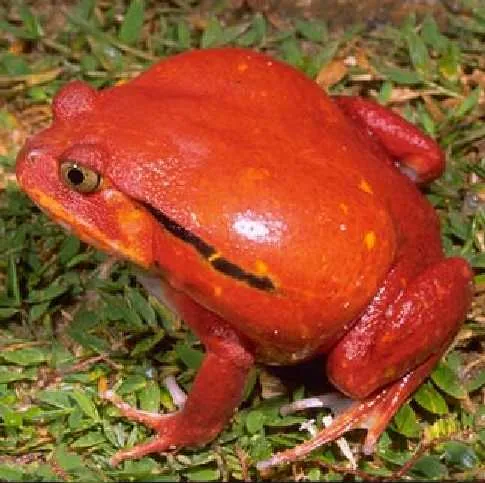
The tomato frog is a bright orange-red frog that lives only on the island of Madagascar. Its colour is a warning: its skin produces a sticky white substance that can cause an allergic reaction in people. It is also a species of conservation concern, because many have been taken for the pet trade.1
 Sɛdeɛ wobɛhunu no
- Vibrant orange-red colour on the back1
- Females have brighter red or orange tones and a pale underside1
- Some individuals have black spots on the throat1
- Females are much larger than males1
Wɔtaa fa no sɛ: The tomato frog is closely related to D. guineti, and the two are often confused. It is not yet clear how far the tomato frog's range extends, or whether it is a separate species or a variant of D. guineti.1
Awuduro ahoɔden
Ne honam yɛ awuduro. Ɛyɛ asiane sɛ wode wo nsa bɛka, wobɛtaforɔ anaa wobɛdi.
Ne ho awuduro yɛ dɛn?
The tomato frog is poisonous to touch rather than venomous, as it does not inject venom. A white substance secreted from its skin acts as a glue and can produce an allergic reaction in humans.1
Ne asiane ma nnipa te sɛn?
Asiane ma nnipa: Ɛnyɛ denƐte sɛ wowa wɔ anaa ɛnnu saa. Ɛkame ayɛ sɛ ɛnni asiane ma nnipa.The skin secretion can cause an allergic reaction in people.1
Ɛyɛ dɛn bere a ehu aka no?
When threatened, it inflates its body to look larger, and its skin secretion acts as a sticky glue to deter predators.1
 Sɛ obi de ne nsa ka anaa ɔdi a
- Sɛ obi de ne nsa aka bi a: hohoro ne nsa yie na mfa nsa nka ani anaa ano. Sɛ abofra anaa fie aboa bi taforɔɔ bi anaa ɔdii bi a: frɛ awuduro ho mmoa adwumayɛbea (poison centre) anaa wo ahohiahia nɔma.
Di kan frɛ wo ahohiahia nɔma (112, 000, 911). Yei yɛ mmoa a ɛdi kan ho akwankyerɛ, ɛnyɛ dɔkota afotuo. Mmoa a ɛdi kan ho nsɛm titiriw
 Hwɛ wo ho so
- Mfa wo nsa nka wiram aboa biara, nkyere no na mfa no nni agorɔ, sɛ ɔyɛ ketewa mpo, na sɛ ɛte sɛ ɔrededa anaa wawu mpo a.
- Ma no kwan. Sɛ wohyia baako a, ma wo bo nnwo, san w'akyi brɛoo na ma ɔnkɔ ne kwan.
- Sɛ wode wo nsa kaa no anaa wodii a: mfa wo nsa ntwitwi w'ani anaa w'ano, hohoro wo nsa na hwehwɛ dɔkota mmoa.
Ɛnhwehwɛ wo sɛ ɛbɛpira wo. Ne ho awuduro no wɔ hɔ sɛdeɛ ɛbɛyɛ a biribiara renni no. Nsɛm pii fa ahobammɔ ho
Wiase mu baabi bɛn?
Ne kɛseɛ te sɛn?
Ne tenten te sɛn?
Ne mu duru te sɛn?

 ne tenten te sɛ agodeɛ blɔk 3 a wɔde to ntoatoasoɔ mu
 ɛbɛtumi atu mita 100 wɔ anibu 78 mu (onipa a ɔwɔ ntɛm sen biara hia 9.6)
Tomato frog kɛseɛ te sɛn sɛ wode toto WO ho a?
Akontabuo kɛkɛ wɔ wo browser mu. Wɔnkora hwee, na wɔmfa hwee nkɔ baabiara.
Ne ntɛm te sɛn?


Nsɛm
Females are much larger than males, reaching up to 230 g, while males reach only about 41 g.1
Each female can lay between 1,000 and 1,500 eggs at once, on the surface of the water.1
Tadpoles are only about 6 mm long when they hatch and feed by filter-feeding.1
Tadpoles turn into yellow juveniles about 45 days after the eggs were laid.1
Ma bɔre ho animdefoɔ
- Nyansahu din
- Dyscophus antongilii
- Kuo
- Apɔtorɔwa a wɔn ho yɛ awuduro, apɔtorɔ ne newt
- Abusua
- Microhylidae2
- Nhyehyɛeɛ (Order)
- Anura
- Asaase akɛseɛ
- Abibirem
- Mmofra nketewa
- Females lay a clutch of 1,000 to 1,500 eggs on the water surface. The tadpoles hatch about 36 hours later.1
- Sɛdeɛ ɔte wɔ kwaem
- Near Threatened (IUCN Red List)1
- Asiane ma nnipa
- 1 / 5: Ɛnyɛ den3
Baabi a nsɛm no fi
- Dyscophus antongilii (Wikipedia (CC BY-SA 4.0))
- Dyscophus antongilii (iNaturalist): din ne nkyekyɛmu.
- Venom Wiki: asiane gyinabea, kɛseɛ a ɛtaa yɛ ne ntɛm susuo no yɛ yɛn ankasa deɛ. Hwɛ sɛdeɛ yɛbu no: Sɛdeɛ yɛkyerɛ asiane gyinabea.
Nsɛm biara a ɛwɔ kratafa yi so wɔ nɔma a ɛkyerɛ ne fibea. Sɛ yɛfom biribi a, kafra, yɛyɛ mmoa ho akɔnnɔfoɔ, ɛnyɛ nyansahu nwoma. Ka kyerɛ yɛn wɔ [email protected] na yɛbɛsiesie.
 Ɔkɔm de akekantwerɛ no! Onipa baako na ɔyɛ Venom Wiki: ɛyɛ kwa, dawurubɔ nni so na biribiara nni so a ɛdi w'akyi. Akyɛdeɛ ketewa bi boa ma ɛkɔ so tena internet so.Ma akekantwere no aduane
Pii fi kuo korɔ no mu: Apɔtorɔwa a wɔn ho yɛ awuduro, apɔtorɔ ne newt
 Golden mantellaApɔtorɔwa a wɔn ho yɛ awuduro, apɔtorɔ ne newtƐnni asiane
 Iberian ribbed newtApɔtorɔwa a wɔn ho yɛ awuduro, apɔtorɔ ne newtƐnni asiane
 African common toadApɔtorɔwa a wɔn ho yɛ awuduro, apɔtorɔ ne newtƐyɛ yaw kɛkɛMfa wo nsa nka
 Baron's mantellaApɔtorɔwa a wɔn ho yɛ awuduro, apɔtorɔ ne newtƐnni asiane
 Blue-legged mantellaApɔtorɔwa a wɔn ho yɛ awuduro, apɔtorɔ ne newtƐnni asiane
 Climbing mantellaApɔtorɔwa a wɔn ho yɛ awuduro, apɔtorɔ ne newtƐnni asiane
 Black mamba
 Deathstalker
 Egyptian cobra
 Puff adder
 Boomslang
 Fat-tailed scorpion