
 Abibirem
 Asia
Asia Yuropu
 Amerika Anaafoɔ
 Australia ne Oceania
 Antarctica
 Pacific Po
 Atlantic Po
 India Po
 Arctic Po
 Mediterranean Po
 Po Kɔkɔɔ
 Caribbean Po
 Coral Po
 China Anaafoɔ Po
 Philippine Po
 Andaman Po
 Atifi Po
 Timor ne Arafura Po
 Bengal Ɛpo Ano
 California Ɛpo Ano
McMahon's viper
 Ka
KaMcMahon's viper is a small, venomous snake that lives in the sandy deserts of Balochistan, near the borders of Iran, Pakistan and Afghanistan. It is well known for its habit of sinking into loose sand so that only its snout and eyes stay uncovered. Scientists have also studied a protein from its venom for its possible use against melanoma, a type of skin cancer.1



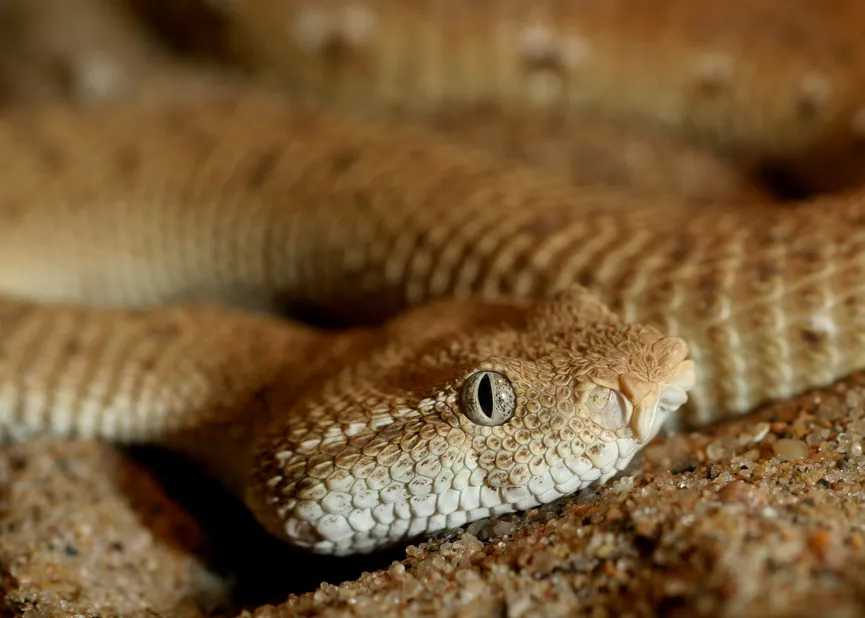
 Sɛdeɛ wobɛhunu no
- Reddish to yellowish brown body with a regular series of 20 to 25 dark spots, each bordered partly or fully with white scales1
- A white stripe runs from the back of the eye to the corner of the mouth1
- Large, broad, flat, wedge-shaped head that is clearly distinct from the neck1
- Short tail with a yellow tip and distinct crossbands1
- Adults are under 1 m (39 in) in total length, tail included1
Bɔre ahoɔden
Bɔre fi ne se mu ba bere a ɔka.
Ne bɔre yɛ dɛn?
Relatively few data are available on its venom. The species is regarded as potentially dangerous, and its venom is said to be similar to that of snakes in the genus Echis. A venom protein called eristostatin has been reported to help in the fight against melanoma.1
Ne asiane ma nnipa te sɛn?
Asiane ma nnipa: Ɛyɛ denSɛ ɛka wo a, kɔ dɔkota nkyɛn. Ɛntaa nkum obi koraa.It is regarded as a potentially dangerous species. It is described as bad-tempered, hissing very loudly and deeply, and it will strike aggressively when threatened.1
Ɛyɛ dɛn bere a ehu aka no?
It hisses very loudly and deeply, raises the front of its body off the ground in a loop and strikes aggressively. It may also sink into sand and cover its head, leaving only its snout and eyes uncovered.1
 Sɛ ɛka a
- Ma onipa no ntena dinn na ne bo nnwo, ma nsa anaa nan a ɛkaa no no nna pɛpɛɛpɛ ne ne koma (ɛnkɔ soro, ɛnsiane fam), yi kawa ne nneɛma a ɛkyere no den, na kɔ ayaresabea ntɛm.
Di kan frɛ wo ahohiahia nɔma (112, 000, 911). Yei yɛ mmoa a ɛdi kan ho akwankyerɛ, ɛnyɛ dɔkota afotuo. Mmoa a ɛdi kan ho nsɛm titiriw
 Hwɛ wo ho so
- Mfa wo nsa nka wiram aboa biara, nkyere no na mfa no nni agorɔ, sɛ ɔyɛ ketewa mpo, na sɛ ɛte sɛ ɔrededa anaa wawu mpo a.
- Ma no kwan. Sɛ wohyia baako a, ma wo bo nnwo, san w'akyi brɛoo na ma ɔnkɔ ne kwan.
- Sɛ baako ka wo a: ma wo bo nnwo, tena dinn, frɛ wo ahohiahia nɔma (112, 000, 911) anaa kɔ ayaresabea ntɛm. Kae sɛdeɛ na ɛte, mfonini bɛboa.
Ɛnhwehwɛ wo sɛ ɛbɛpira wo. Ɛde ne bɔre kyere aduane anaa ɛbɔ ne ho ban, na ɛpɛ sɛ ɛhinta sene biribiara. Nsɛm pii fa ahobammɔ ho
Wiase mu baabi bɛn?
Ne kɛseɛ te sɛn?
Ne tenten te sɛn?
 ne tenten te sɛ kwadu 4 a wɔde to ntoatoasoɔ mu
 ɛbɛtumi atu mita 100 wɔ anibu 110 mu (onipa a ɔwɔ ntɛm sen biara hia 9.6)
McMahon's viper kɛseɛ te sɛn sɛ wode toto WO ho a?
Akontabuo kɛkɛ wɔ wo browser mu. Wɔnkora hwee, na wɔmfa hwee nkɔ baabiara.
Ne ntɛm te sɛn?


Nsɛm
A protein in its venom, called eristostatin, has been reported to help in the fight against melanoma.1
It can sink down into loose sand using a rocking or wave-like motion, then shake its head to cover it with sand.1
Its enlarged nasorostral scales are thought to keep sand out of its nostrils.1
It moves by sidewinding when crossing loose sand or when alarmed.1
Its short tail is prehensile, and it sometimes climbs into bushes with it.1
Baabi a nsɛm no fi
- Eristicophis (Wikipedia (CC BY-SA 4.0))
- Venom Wiki: asiane gyinabea, kɛseɛ a ɛtaa yɛ ne ntɛm susuo no yɛ yɛn ankasa deɛ. Hwɛ sɛdeɛ yɛbu no: Sɛdeɛ yɛkyerɛ asiane gyinabea.
Nsɛm biara a ɛwɔ kratafa yi so wɔ nɔma a ɛkyerɛ ne fibea. Sɛ yɛfom biribi a, kafra, yɛyɛ mmoa ho akɔnnɔfoɔ, ɛnyɛ nyansahu nwoma. Ka kyerɛ yɛn wɔ [email protected] na yɛbɛsiesie.
 Ɔkɔm de akekantwerɛ no! Onipa baako na ɔyɛ Venom Wiki: ɛyɛ kwa, dawurubɔ nni so na biribiara nni so a ɛdi w'akyi. Akyɛdeɛ ketewa bi boa ma ɛkɔ so tena internet so.Ma akekantwere no aduane
 Indian saw-scaled viper
 Puff adder
 Russell ɔnanka
 Common European adder
 Eastern Russell's viper
 Northeast African carpet viper
 Deathstalker
 Indian cobra
 King cobra
 Asian giant hornet
 Komodo dragon
 Spanish fly