
 Abibirem
 Asia
Asia Yuropu
 Amerika Anaafoɔ
 Australia ne Oceania
 Antarctica
 Pacific Po
 Atlantic Po
 India Po
 Arctic Po
 Mediterranean Po
 Po Kɔkɔɔ
 Caribbean Po
 Coral Po
 China Anaafoɔ Po
 Philippine Po
 Andaman Po
 Atifi Po
 Timor ne Arafura Po
 Bengal Ɛpo Ano
 California Ɛpo Ano
Red-headed krait
 Ka
KaThe red-headed krait is a large, highly venomous snake with a striking look: a bright red head and tail and a glossy black body. It lives in lowland rain forests across Southeast Asia, including on some islands, and it is uncommon. It is a night-time hunter, and people rarely meet it.1



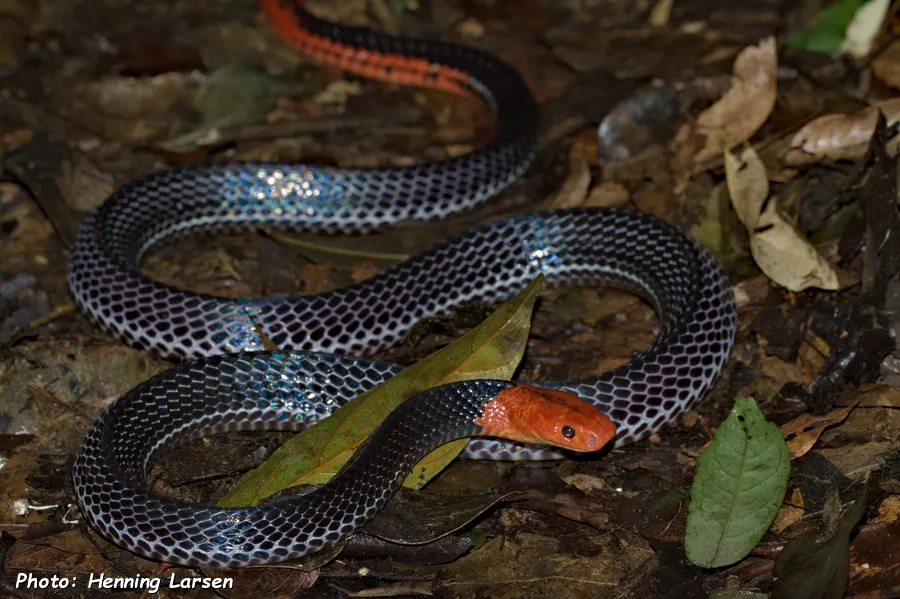
 Sɛdeɛ wobɛhunu no
- A bright red head and tail1
- A black body with a narrow bluish white stripe along the side1
- Large, smooth, glossy scales1
- Adults can reach 2.1 metres, with an average of 1.2 to 1.5 metres1
Wɔtaa fa no sɛ: It is similar to the blue Malayan coral snake, which is also venomous, and to the nonvenomous red-headed reed snake.1
Bɔre ahoɔden
Bɔre fi ne se mu ba bere a ɔka.
Ne bɔre yɛ dɛn?
Its venom is a neurotoxin, which attacks the nerves. It blocks signals between nerves and muscles, causing paralysis. Victims can stop breathing, which can lead to death by asphyxiation. Between 20 minutes and several hours after a bite, drooping eyelids may appear, along with double vision, difficulty swallowing, vomiting, headache and excess saliva. Symptoms can then worsen as more muscles, including the jaw, become paralysed, and breathing can become difficult.1
Ne asiane ma nnipa te sɛn?
Asiane ma nnipa: Asiane kɛseɛ womƐtumi kum onipa a wɔnhwɛ no yareɛ.Bites are reported rarely, and the venom is little studied for this reason. It is not usually considered high risk to people in the daytime, because it is sluggish and hides. At night it is active and extremely dangerous.1
 Asɛmpa: dɔkotafoɔ wɔ aduro (antivenom) anaa ayaresa ma yei.1
Ɛyɛ dɛn bere a ehu aka no?
When disturbed, it presses its head into the ground or hides its head within its flattened or rolled coils. Captives will generally refuse to strike until they have been teased for a long time.1
 Sɛ ɛka a
- Get to a hospital fast. Neurotoxic symptoms can be treated in hospital with antivenin or with drugs that inactivate acetylcholinesterase, an enzyme that breaks down the chemical messenger between nerves and muscles. Symptoms may also settle on their own.1
- Ma onipa no ntena dinn na ne bo nnwo, yi kawa ne nneɛma a ɛkyere no den, na kɔ ayaresabea ntɛm: antivenom ne ayaresa no.
Di kan frɛ wo ahohiahia nɔma (112, 000, 911). Yei yɛ mmoa a ɛdi kan ho akwankyerɛ, ɛnyɛ dɔkota afotuo. Mmoa a ɛdi kan ho nsɛm titiriw
 Hwɛ wo ho so
- Mfa wo nsa nka wiram aboa biara, nkyere no na mfa no nni agorɔ, sɛ ɔyɛ ketewa mpo, na sɛ ɛte sɛ ɔrededa anaa wawu mpo a.
- Ma no kwan. Sɛ wohyia baako a, ma wo bo nnwo, san w'akyi brɛoo na ma ɔnkɔ ne kwan.
- Sɛ baako ka wo a: ma wo bo nnwo, tena dinn, frɛ wo ahohiahia nɔma (112, 000, 911) anaa kɔ ayaresabea ntɛm. Kae sɛdeɛ na ɛte, mfonini bɛboa.
Ɛnhwehwɛ wo sɛ ɛbɛpira wo. Ɛde ne bɔre kyere aduane anaa ɛbɔ ne ho ban, na ɛpɛ sɛ ɛhinta sene biribiara. Nsɛm pii fa ahobammɔ ho
Wiase mu baabi bɛn?
Ne kɛseɛ te sɛn?
Ne tenten te sɛn?
 ne tenten te sɛ fie agyinamoa 4 a wɔde hwene ne dua to ntoatoasoɔ mu
 ne tenten te sɛ kwadu 12 a wɔde to ntoatoasoɔ mu
 ɛbɛtumi atu mita 100 wɔ anibu 46 mu (onipa a ɔwɔ ntɛm sen biara hia 9.6)
Red-headed krait kɛseɛ te sɛn sɛ wode toto WO ho a?
Akontabuo kɛkɛ wɔ wo browser mu. Wɔnkora hwee, na wɔmfa hwee nkɔ baabiara.
Ne ntɛm te sɛn?


Nsɛm
Its venom contains a novel toxin called κ-flavitoxin, which blocks nicotinic transmission in autonomic ganglia, clusters of nerve cells that control automatic body functions.1
It has short, hollow fangs at the front of its upper jaw, and venom is forced out through a hole near the tip of each fang.1
It is partly aquatic and mainly active at night.1
It was once thought to eat mainly other snakes, but its diet is now known to be much wider.1
Atosɛm sɛefoɔ
Atosɛm: It only eats other snakes.
Nokorɛ: Its diet includes skinks, lizards, frogs, caecilians, small mammals and snake eggs, as well as snakes.1
Baabi a nsɛm no fi
- Red-headed krait (Wikipedia (CC BY-SA 4.0))
- Bungarus flaviceps (iNaturalist): din ne nkyekyɛmu.
- Venom Wiki: asiane gyinabea, kɛseɛ a ɛtaa yɛ ne ntɛm susuo no yɛ yɛn ankasa deɛ. Hwɛ sɛdeɛ yɛbu no: Sɛdeɛ yɛkyerɛ asiane gyinabea.
Nsɛm biara a ɛwɔ kratafa yi so wɔ nɔma a ɛkyerɛ ne fibea. Sɛ yɛfom biribi a, kafra, yɛyɛ mmoa ho akɔnnɔfoɔ, ɛnyɛ nyansahu nwoma. Ka kyerɛ yɛn wɔ [email protected] na yɛbɛsiesie.
 Ɔkɔm de akekantwerɛ no! Onipa baako na ɔyɛ Venom Wiki: ɛyɛ kwa, dawurubɔ nni so na biribiara nni so a ɛdi w'akyi. Akyɛdeɛ ketewa bi boa ma ɛkɔ so tena internet so.Ma akekantwere no aduane
 Indian cobra
 King cobra
 Caspian cobra
 Common krait
 Malayan krait
 Many-banded krait
 Deathstalker
 Indian saw-scaled viper
 Puff adder
 Russell ɔnanka
 Asian giant hornet
 Komodo dragon