
 Abibirem
 Asia
Asia Yuropu
 Amerika Anaafoɔ
 Australia ne Oceania
 Antarctica
 Pacific Po
 Atlantic Po
 India Po
 Arctic Po
 Mediterranean Po
 Po Kɔkɔɔ
 Caribbean Po
 Coral Po
 China Anaafoɔ Po
 Philippine Po
 Andaman Po
 Atifi Po
 Timor ne Arafura Po
 Bengal Ɛpo Ano
 California Ɛpo Ano
Sri Lankan green vine snake
 Ka
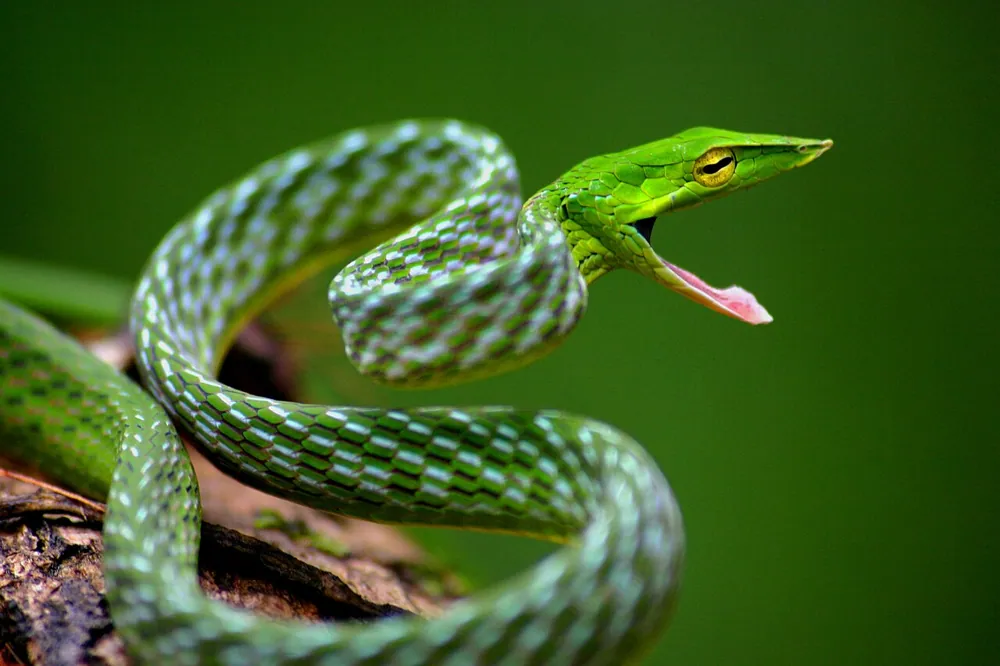
KaThe Sri Lankan green vine snake is a slim, bright green tree snake. It lives only in Sri Lanka, mostly in forests and bush near streams and villages. It is mildly venomous, and its unusual horizontal pupils make it easy to recognise.1



 Sɛdeɛ wobɛhunu no
- Long, slender body with a very pointed snout1
- Bright green to pale brownish colour1
- A yellow line runs along each side of the lower body1
- Black-and-white patterned skin shows between the scales1
- Horizontal pupils, unlike the vertical slit pupils of many vipers1
Wɔtaa fa no sɛ: It was once grouped with several other green vine snakes across India and Southeast Asia. Recent studies have split these into separate species, and the Sri Lankan form is now restricted to Sri Lanka.1
Bɔre ahoɔden
Bɔre fi ne se mu ba bere a ɔka.
Ne bɔre yɛ dɛn?
The snake is mildly venomous. Its bite causes a moderate reaction, with localised pain, swelling, bruising and numbness. These symptoms usually fade within three days.1
Ne asiane ma nnipa te sɛn?
Asiane ma nnipa: Ɛnyɛ denƐte sɛ wowa wɔ anaa ɛnnu saa. Ɛkame ayɛ sɛ ɛnni asiane ma nnipa.Bites usually do not need medical attention. Some bites near vital organs could be more severe.1
Ɛyɛ dɛn bere a ehu aka no?
When disturbed, it expands its body to show a black-and-white scale marking and opens its mouth in a threat display.1
 Sɛ ɛka a
- Bites typically do not require medical attention, but bites near vital organs could be more severe.1
- Hohoro baabi a ɛkaa no, ma onipa no bo nnwo na hwehwɛ dɔkota mmoa. Awɔ bi (te sɛ boomslang) betumi akum nnɔnhwerew pii akyi.
Di kan frɛ wo ahohiahia nɔma (112, 000, 911). Yei yɛ mmoa a ɛdi kan ho akwankyerɛ, ɛnyɛ dɔkota afotuo. Mmoa a ɛdi kan ho nsɛm titiriw
 Hwɛ wo ho so
- Mfa wo nsa nka wiram aboa biara, nkyere no na mfa no nni agorɔ, sɛ ɔyɛ ketewa mpo, na sɛ ɛte sɛ ɔrededa anaa wawu mpo a.
- Ma no kwan. Sɛ wohyia baako a, ma wo bo nnwo, san w'akyi brɛoo na ma ɔnkɔ ne kwan.
- Sɛ baako ka wo a: ma wo bo nnwo, tena dinn, frɛ wo ahohiahia nɔma (112, 000, 911) anaa kɔ ayaresabea ntɛm. Kae sɛdeɛ na ɛte, mfonini bɛboa.
Ɛnhwehwɛ wo sɛ ɛbɛpira wo. Ɛde ne bɔre kyere aduane anaa ɛbɔ ne ho ban, na ɛpɛ sɛ ɛhinta sene biribiara. Nsɛm pii fa ahobammɔ ho
Wiase mu baabi bɛn?
Ne kɛseɛ te sɛn?
Ne tenten te sɛn?
 ne tenten te sɛ fie agyinamoa 4 a wɔde hwene ne dua to ntoatoasoɔ mu
 ne tenten te sɛ kwadu 11 a wɔde to ntoatoasoɔ mu
 ɛbɛtumi atu mita 100 wɔ anibu 64 mu (onipa a ɔwɔ ntɛm sen biara hia 9.6)
Sri Lankan green vine snake kɛseɛ te sɛn sɛ wode toto WO ho a?
Akontabuo kɛkɛ wɔ wo browser mu. Wɔnkora hwee, na wɔmfa hwee nkɔ baabiara.
Ne ntɛm te sɛn?


Nsɛm
Western internet users have humorously nicknamed it the "judgmental shoelace", because of its long, thin body and narrowed-looking eyes.1
Its horizontal pupils are very unusual among snakes.1
Its name comes from an old Sinhalese belief that it plucks out human eyes. A Portuguese traveller first reported this belief in 1685.1
It hunts by camouflage, slowly swaying to look like a branch.1
A female at London Zoo, kept in isolation from August 1885, gave birth in August 1888.1
Ma bɔre ho animdefoɔ
Baabi a nsɛm no fi
- Ahaetulla nasuta (Wikipedia (CC BY-SA 4.0))
- Ahaetulla nasuta (iNaturalist): din ne nkyekyɛmu.
- Venom Wiki: asiane gyinabea, kɛseɛ a ɛtaa yɛ ne ntɛm susuo no yɛ yɛn ankasa deɛ. Hwɛ sɛdeɛ yɛbu no: Sɛdeɛ yɛkyerɛ asiane gyinabea.
Nsɛm biara a ɛwɔ kratafa yi so wɔ nɔma a ɛkyerɛ ne fibea. Sɛ yɛfom biribi a, kafra, yɛyɛ mmoa ho akɔnnɔfoɔ, ɛnyɛ nyansahu nwoma. Ka kyerɛ yɛn wɔ [email protected] na yɛbɛsiesie.
 Ɔkɔm de akekantwerɛ no! Onipa baako na ɔyɛ Venom Wiki: ɛyɛ kwa, dawurubɔ nni so na biribiara nni so a ɛdi w'akyi. Akyɛdeɛ ketewa bi boa ma ɛkɔ so tena internet so.Ma akekantwere no aduane
Pii fi kuo korɔ no mu: Awɔ a wɔn bɔre se wɔ akyi
 Brown tree snakeAwɔ a wɔn bɔre se wɔ akyiƐyɛ yaw kɛkɛ
 Tiger keelbackAwɔ a wɔn bɔre se wɔ akyiƐtumi kum
 Red-necked keelbackAwɔ a wɔn bɔre se wɔ akyiƐhia dɔkota
 Green cat snakeAwɔ a wɔn bɔre se wɔ akyiƐyɛ yaw kɛkɛ
 Mangrove snakeAwɔ a wɔn bɔre se wɔ akyiƐyɛ yaw kɛkɛ
 Asian vine snakeAwɔ a wɔn bɔre se wɔ akyiƐnni asiane
 Deathstalker
 Indian cobra
 Indian saw-scaled viper
 King cobra
 Puff adder
 Russell ɔnanka