
 Abibirem
 Asia
Asia Yuropu
 Amerika Anaafoɔ
 Australia ne Oceania
 Antarctica
 Pacific Po
 Atlantic Po
 India Po
 Arctic Po
 Mediterranean Po
 Po Kɔkɔɔ
 Caribbean Po
 Coral Po
 China Anaafoɔ Po
 Philippine Po
 Andaman Po
 Atifi Po
 Timor ne Arafura Po
 Bengal Ɛpo Ano
 California Ɛpo Ano
Valentin's sharpnose puffer
 Ɛyɛ awuduro sɛ wodi aƆdi: Biribiara kakraNe ho yɛ awuduro, onni bɔre
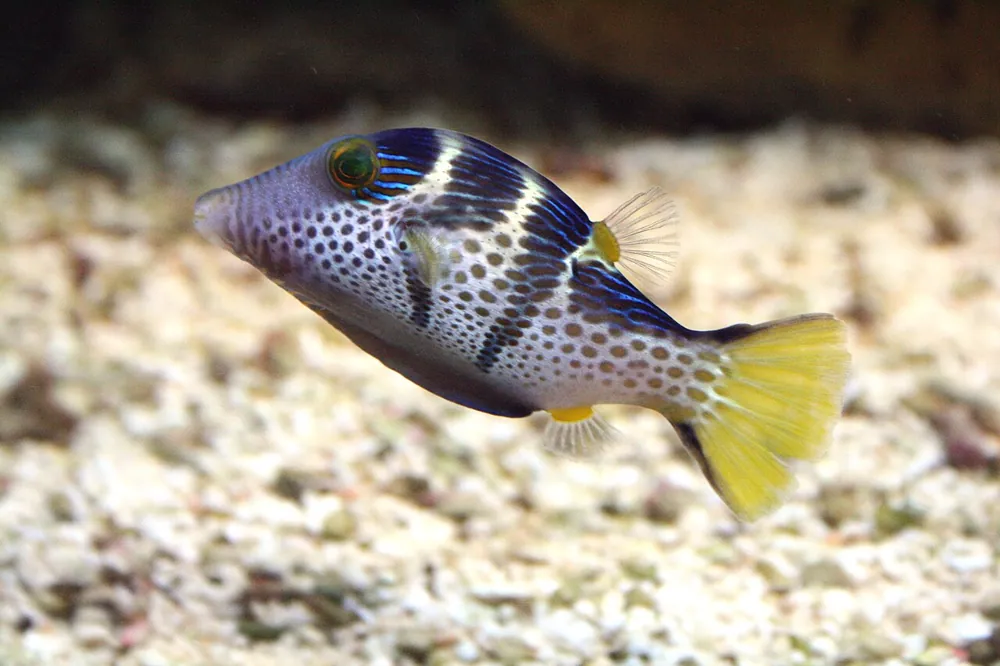
Valentin's sharpnose puffer is a small reef fish with four black stripes across its back. It lives in warm seas across the Indian Ocean, the Red Sea and parts of the Pacific. It is special because its skin holds one of the most potent natural poisons known, which keeps most predators away.1




 Sɛdeɛ wobɛhunu no
- Four distinct black stripes, called saddles, run across its back.1
- The head is blue-grey.1
- The main body is white, speckled with blue-grey spots.1
- The tail and fins show hints of yellow, and a rainbow streak sits behind the eyes.1
Wɔtaa fa no sɛ: The filefish Paraluteres prionurus has similar colours and sometimes swims in schools with this puffer. It mimics the puffer's appearance for protection, but it is not toxic.1
Awuduro ahoɔden
Ɛyɛ asiane bere a biribi adi no nko ara.
Ne ho awuduro yɛ dɛn?
Its skin and other tissues contain tetrodotoxin, a neurotoxin, which attacks the nerves. It is one of the most potent naturally occurring toxins and is lethal to many species of fish. This makes the fish unpalatable to predators.1
Ne asiane ma nnipa te sɛn?
Asiane ma nnipa: Ɛyɛ denSɛ obi di no a, kɔ dɔkota nkyɛn. Ɛntaa nkum obi koraa.It is highly poisonous to eat.1
Ɛyɛ dɛn bere a ehu aka no?
It gulps water to puff its body up to three or four times its normal volume, and its toxic skin deters predators.1
 Sɛ obi de ne nsa ka anaa ɔdi a
- Sɛ obi adi bi anaa ne ho anyɛ no dɛ bere a wadi akyi a: frɛ wo ahohiahia nɔma anaa awuduro ho mmoa adwumayɛbea (poison centre) ntɛm ara.
Di kan frɛ wo ahohiahia nɔma (112, 000, 911). Yei yɛ mmoa a ɛdi kan ho akwankyerɛ, ɛnyɛ dɔkota afotuo. Mmoa a ɛdi kan ho nsɛm titiriw
 Hwɛ wo ho so
- Mfa wo nsa nka wiram aboa biara, nkyere no na mfa no nni agorɔ, sɛ ɔyɛ ketewa mpo, na sɛ ɛte sɛ ɔrededa anaa wawu mpo a.
- Ma no kwan. Sɛ wohyia baako a, ma wo bo nnwo, san w'akyi brɛoo na ma ɔnkɔ ne kwan.
- Sɛ wode wo nsa kaa no anaa wodii a: mfa wo nsa ntwitwi w'ani anaa w'ano, hohoro wo nsa na hwehwɛ dɔkota mmoa.
Ɛnhwehwɛ wo sɛ ɛbɛpira wo. Ne ho awuduro no wɔ hɔ sɛdeɛ ɛbɛyɛ a biribiara renni no. Nsɛm pii fa ahobammɔ ho
Wiase mu baabi bɛn?
Ne kɛseɛ te sɛn?
Ne tenten te sɛn?
 ne tenten te sɛ agodeɛ blɔk 3 a wɔde to ntoatoasoɔ mu
 ɛbɛtumi aguare aguare tare kɛseɛ tenten (50 m) wɔ anibu 45 mu
Valentin's sharpnose puffer kɛseɛ te sɛn sɛ wode toto WO ho a?
Akontabuo kɛkɛ wɔ wo browser mu. Wɔnkora hwee, na wɔmfa hwee nkɔ baabiara.
Ne ntɛm te sɛn?
Nsɛm
Its tetrodotoxin is one of the most potent naturally occurring toxins, and it is lethal to many fish.1
A non-toxic filefish, Paraluteres prionurus, has evolved to look like this puffer, which helps it avoid predators.1
Its eggs are unpalatable, so predatory fish rarely eat them, and any swallowed eggs are quickly passed out again. This means the parents need not guard them.1
Juveniles of the grouper Plectropomus laevis also mimic its colours.1
Its eggs, at 0.68 to 0.72 mm across, are among the smallest in the puffer family Tetraodontidae.1
Atosɛm sɛefoɔ
Atosɛm: Pufferfish hold their breath while they puff up.
Nokorɛ: A 2014 study found that oxygen consumption actually increases while the fish is inflated. Oxygen intake through the gills is almost five times higher than normal.1
Ma bɔre ho animdefoɔ
- Nyansahu din
- Canthigaster valentini
- Kuo
- Mmoa afoforɔ a wɔn ho yɛ awuduro
- Abusua
- Tetraodontidae2
- Nhyehyɛeɛ (Order)
- Tetraodontiformes
- Asaase akɛseɛ
- Pacific Po, India Po, Po Kɔkɔɔ, Coral Po, Philippine Po, China Anaafoɔ Po, Timor ne Arafura Po, Po akɛseɛ
- Mmofra nketewa
- Females lay anywhere between fifteen and over 800 eggs at a time, every four to ten days depending on the season.1
- Asiane ma nnipa
- 3 / 5: Ɛyɛ den3
Baabi a nsɛm no fi
- Valentin's sharpnose puffer (Wikipedia (CC BY-SA 4.0))
- Canthigaster valentini (iNaturalist): din ne nkyekyɛmu.
- Venom Wiki: asiane gyinabea, kɛseɛ a ɛtaa yɛ ne ntɛm susuo no yɛ yɛn ankasa deɛ. Hwɛ sɛdeɛ yɛbu no: Sɛdeɛ yɛkyerɛ asiane gyinabea.
Nsɛm biara a ɛwɔ kratafa yi so wɔ nɔma a ɛkyerɛ ne fibea. Sɛ yɛfom biribi a, kafra, yɛyɛ mmoa ho akɔnnɔfoɔ, ɛnyɛ nyansahu nwoma. Ka kyerɛ yɛn wɔ [email protected] na yɛbɛsiesie.
 Ɔkɔm de akekantwerɛ no! Onipa baako na ɔyɛ Venom Wiki: ɛyɛ kwa, dawurubɔ nni so na biribiara nni so a ɛdi w'akyi. Akyɛdeɛ ketewa bi boa ma ɛkɔ so tena internet so.Ma akekantwere no aduane
Pii fi kuo korɔ no mu: Mmoa afoforɔ a wɔn ho yɛ awuduro
 Japanese pufferfishMmoa afoforɔ a wɔn ho yɛ awuduroƐkum
 Hawksbill sea turtleMmoa afoforɔ a wɔn ho yɛ awuduroƐtumi kum
 Greenland sharkMmoa afoforɔ a wɔn ho yɛ awuduroƐyɛ yaw kɛkɛ
 Silver-cheeked toadfishMmoa afoforɔ a wɔn ho yɛ awuduroƐkum
 Blackspotted pufferMmoa afoforɔ a wɔn ho yɛ awuduroƐtumi kum
 White-spotted pufferMmoa afoforɔ a wɔn ho yɛ awuduroƐtumi kum
Ɔte nso wɔ: Pacific Po
 Australian box jellyfishJellyfish ne ɛpo mu mmoa a wɔwɔƐkumMfa wo nsa nka
 Geography coneCone snails ne octopusƐkum
 Greater blue-ringed octopusCone snails ne octopusƐkum
 Southern blue-ringed octopusCone snails ne octopusƐkum
 Irukandji jellyfishJellyfish ne ɛpo mu mmoa a wɔwɔƐtumi kumMfa wo nsa nka
 Reef stonefishApataa a wɔwɔ bɔreƐtumi kumMfa wo nsa nka