
 Bitten or stung?
 All animals
 Pick a continent
 Africa
 Asia
 Europe
 South America
 Australia & Oceania
 Antarctica
 Pacific Ocean
 Atlantic Ocean
 Indian Ocean
 Arctic Ocean
 Mediterranean Sea
 Red Sea
 Caribbean Sea
 Coral Sea
 South China Sea
 Philippine Sea
 Andaman Sea
 North Sea
 Timor & Arafura Sea
 Bay of Bengal
 Gulf of California
 Games
 Venom battle
 Animal race
 Field notebook
 Venom TOP lists
 Stay safe
 Surprise me

Bat ray
 StingsEats: MeatTOP 50 · No. 11: HeaviestTOP 50 · No. 12: FastestTOP 50 · No. 17: Longest livingTOP 50 · No. 22: Gentle giants
The bat ray is a flat, diamond-shaped fish related to sharks, with wing-like fins that it flaps to swim. It lives in shallow coastal waters from central Oregon in the USA down to the Gulf of California in Mexico, and around the Galápagos Islands. It has a venomous spine near the base of its tail, but it uses it only when it feels threatened.1
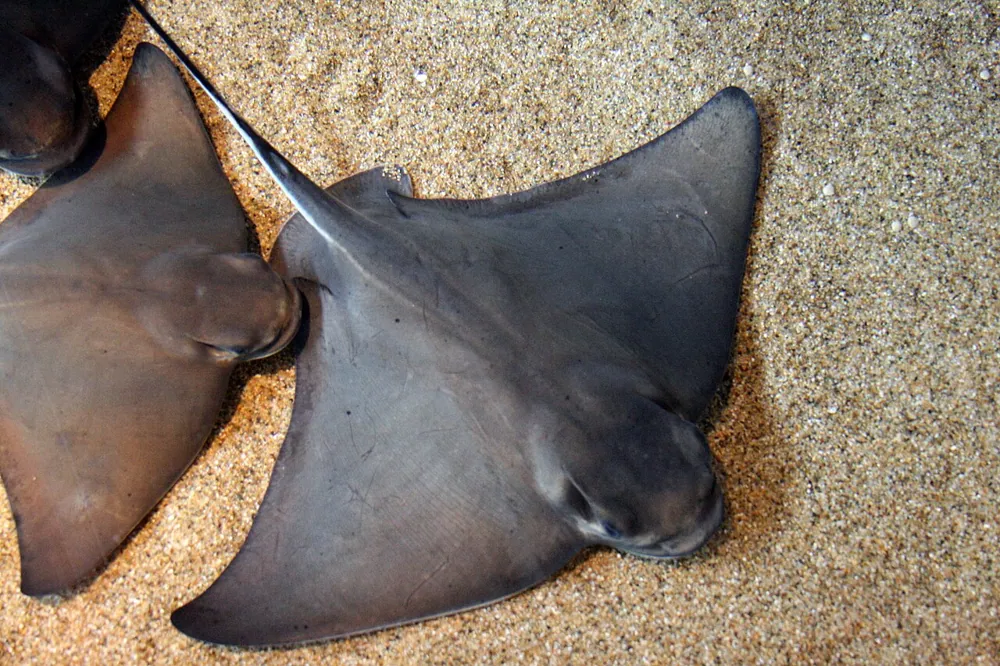
 How to recognise it
- Diamond-shaped body, with wing-like pectoral fins that end in blunt points1
- Broad head raised higher than the fins, with eyes set on the sides of the head1
- Dark back, black or dark brown, with a white underside1
- Whip-like tail with at least one venomous spine at its base1
- Usually two small cephalic horns (projections from the front of the head) used for pushing food into the mouth1
Venom power
Venom comes out through a stinger.
How dangerous is it to people?
Danger to people: PainfulIt can really hurt, but it is almost never serious.The bat ray is not considered dangerous to people. It uses its venomous tail spine only when it is attacked or frightened.1
What does it do when it is scared?
The bat ray camouflages itself in the sand and uses its tail spine only when attacked or frightened.1
 If it stings
Call your emergency number at once if the person has trouble breathing, swelling of the face or throat, or feels faint.
- Soak the wound in hot water, as hot as the person can stand without burning (about 45 °C), for 30 to 90 minutes to ease the pain. Clean the wound and remove any spine pieces only if it is easy. See a doctor, as stingray wounds often get infected. Call the emergency number if the spine went into the chest or belly.1
- Put the wound in hot water, about 45 °C: as hot as the helper can comfortably hold their own hand in, never hotter, for 30 to 90 minutes. Get medical help, especially for stonefish and stingrays.
This is general first aid guidance, not medical advice. Based on the first aid guidelines of the World Health Organization and the Australian Resuscitation Council. Facts come from public sources and may contain mistakes. When in doubt, always get medical help. First aid basics
 Stay safe
- Never touch, catch or tease a wild animal, even a small one, and even if it looks asleep or dead.
- Give it space. If you meet one, stay calm, step back slowly and let it go its own way.
- If it hurts you: wash the spot, stay calm and get medical help if the pain is strong or spreads, or the person feels unwell.
It is not out to get you. It uses its venom to catch food or to protect itself, and it would much rather hide. More about staying safe
Where in the world?
How big is it?
How long is it?
How heavy is it?

 as long as 4 house cats nose to tail
 as long as 10 bananas end to end
 could swim the length of a big swimming pool (50 m) in 8.2 seconds
How big is Bat ray compared to you?
Just maths in your browser. Nothing is saved or sent anywhere.
How fast is it?

Facts
Bat rays dig pits in the seabed that can be up to 4 m long, and small fish gather to eat the creatures the rays expose.1
The bat ray's young are born with the spine's sheath, which falls off within hours of birth.1
Bat rays can grow to a wingspan of 1.8 m, and the largest individuals weigh about 91 kg.1
Some bat rays live alone, while others form schools of thousands.1
Bat rays have teeth that are replaced continuously, as is the case with all elasmobranchs (sharks, rays and their relatives).1
Myth buster
Myth: Bat rays are dangerous to people because of their venomous spine.
Truth: Bat rays are not considered dangerous. They use the spine only when attacked or frightened, and people can avoid it by shuffling their feet when walking through shallow sand.1
For venom experts
- Scientific name
- Myliobatis californica
- Group
- Venomous fish
- Family
- Myliobatidae2
- Order
- Myliobatiformes
- Continents
- Pacific Ocean, Gulf of California, The oceans
- Babies
- Bat rays are ovoviviparous, so the eggs hatch inside the mother and the young are born live. A litter has two to ten pups, which are born tail first with their fins wrapped around their bodies.1
- Lifespan
- about 23 years1
- How it is doing in the wild
- Least Concern1
- Danger to people
- 2 / 5: Painful3
Where the facts come from
- Bat ray (Wikipedia (CC BY-SA 4.0))
- Myliobatis californica (iNaturalist): names and classification.
- Venom Wiki: the danger level, the typical size and the speed guess are our own. See how we work them out: How we rate danger.
Every fact on this page has a number that points to its source. If we got something wrong, sorry, we are animal fans, not a science journal. Tell us at [email protected] and we will fix it.
Get the Venom Wiki app
Every creature, every picture and the games in your pocket, even without internet.


 Support Venom Wiki Venom Wiki is a one-man project: free, with no ads and no cookies. A small tip helps keep it online.Feed the scorpion
More from the same group: Venomous fish
 Reef stonefish
 Red lionfish
 Estuarine stonefish
 Short-tail stingray
 Bluespotted ribbontail ray
 Common stingray

Also lives in: Pacific Ocean
 Australian box jellyfishJellyfish & sea stingersDeadlyDo not touch
 Geography coneCone snails & octopusesDeadly
 Greater blue-ringed octopusCone snails & octopusesDeadly
 Japanese pufferfishOther poisonous animalsDeadly
 Southern blue-ringed octopusCone snails & octopusesDeadly
 Hawksbill sea turtleOther poisonous animalsCan kill