
 Bitten or stung?
 All animals
 Pick a continent
 Africa
 Asia
 Europe
 South America
 Australia & Oceania
 Antarctica
 Pacific Ocean
 Atlantic Ocean
 Indian Ocean
 Arctic Ocean
 Mediterranean Sea
 Red Sea
 Caribbean Sea
 Coral Sea
 South China Sea
 Philippine Sea
 Andaman Sea
 North Sea
 Timor & Arafura Sea
 Bay of Bengal
 Gulf of California
 Games
 Venom battle
 Animal race
 Field notebook
 Venom TOP lists
 Stay safe
 Surprise me

Bobbit worm
 Bites
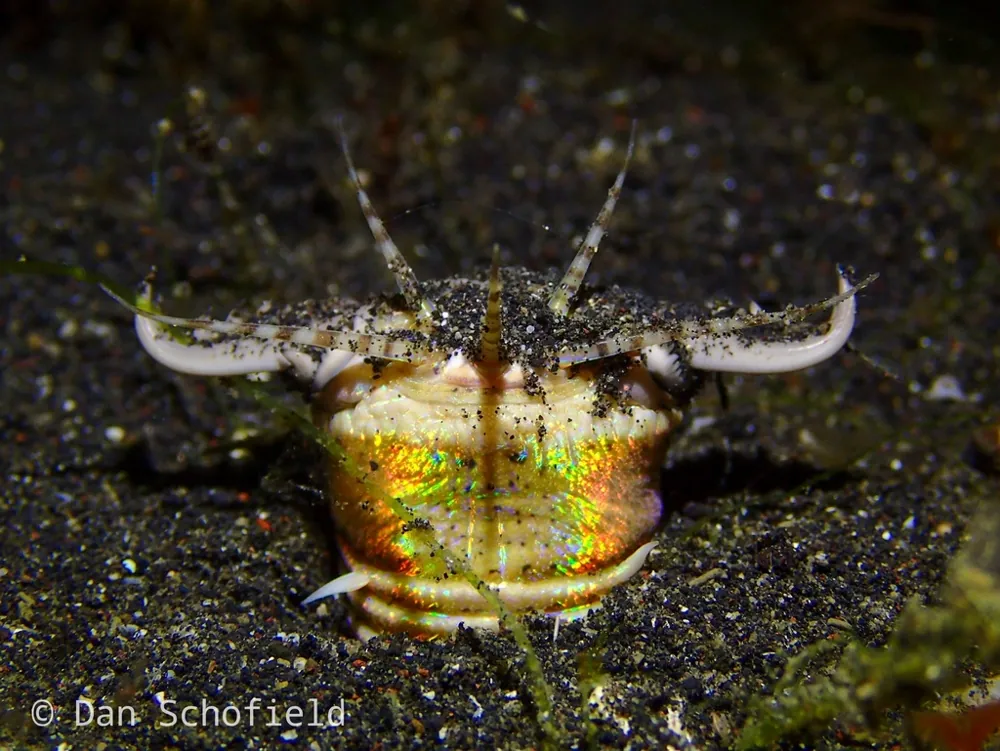
The bobbit worm is a long, slim sea worm that hides in the sand or mud on the ocean floor. It waits with its whole body buried, then strikes passing fish and other prey with sharp jaws. It lives in warm seas, mainly in the Atlantic and the Indo-Pacific, and can grow to nearly 3 metres long.1
 How to recognise it
Venom power
Venom comes out through its fangs or teeth when it bites.
How dangerous is it to people?
Danger to people: PainfulIt can really hurt, but it is almost never serious. If it bites
Call your emergency number at once if the person has trouble breathing, swelling of the face or throat, or feels faint.
- Put the wound in hot water, as hot as the person can stand without burning, and get medical help to remove spines. Do not dig for them yourself.
This is general first aid guidance, not medical advice. Based on the first aid guidelines of the World Health Organization and the Australian Resuscitation Council. Facts come from public sources and may contain mistakes. When in doubt, always get medical help. First aid basics
 Stay safe
- Never touch, catch or tease a wild animal, even a small one, and even if it looks asleep or dead.
- Give it space. If you meet one, stay calm, step back slowly and let it go its own way.
- If it hurts you: wash the spot, stay calm and get medical help if the pain is strong or spreads, or the person feels unwell.
It is not out to get you. It uses its venom to catch food or to protect itself, and it would much rather hide. More about staying safe
Where in the world?
How big is it?
How long is it?
 as long as 3 dogs nose to tail
 as long as 17 bananas end to end
How big is Bobbit worm compared to you?
Just maths in your browser. Nothing is saved or sent anywhere.
How fast is it?


Facts
It is the longest known member of the polychaete class of bristle worms, with the largest specimen on record reaching 299 cm.1
Some fish mob the worm by directing jets of water into its burrow to disorient it.1
It hunts by burrowing its whole body into soft sediment and waiting until its antennae detect prey.1
Fossil burrows from Miocene rocks in northeastern Taiwan, about 20 million years old, look like those of this species and were probably made by its ancestors.1
Despite its length, its body is only about 25.5 mm wide.1
Myth buster
Myth: The worm can reproduce by splitting into several pieces.
Truth: There is no scientific evidence that it reproduces this way. Reports of this appear to come from misreading movement in dead or injured worms. It can regenerate its rear segments, but it reproduces sexually.1
For venom experts
- Scientific name
- Eunice aphroditois
- Group
- Urchins, stars & worms
- Also called
- Sand Striker, Trap-jaw Worm, Bobbitt worm1
- Family
- Eunicidae2
- Order
- Eunicida
- Continents
- Pacific Ocean, Indian Ocean, Atlantic Ocean, Red Sea, Mediterranean Sea, Caribbean Sea, Timor & Arafura Sea, The oceans
- Babies
- It releases sperm and eggs into the water, where fertilisation happens outside the body, and the young drift as larvae before settling and growing into juvenile worms.1
- Danger to people
- 2 / 5: Painful3
Where the facts come from
- Eunice aphroditois (Wikipedia (CC BY-SA 4.0))
- Eunice aphroditois (iNaturalist): names and classification.
- Venom Wiki: the danger level, the typical size and the speed guess are our own. See how we work them out: How we rate danger.
Every fact on this page has a number that points to its source. If we got something wrong, sorry, we are animal fans, not a science journal. Tell us at [email protected] and we will fix it.
Get the Venom Wiki app
Every creature, every picture and the games in your pocket, even without internet.


 Support Venom Wiki Venom Wiki is a one-man project: free, with no ads and no cookies. A small tip helps keep it online.Feed the scorpion
More from the same group: Urchins, stars & worms
 Crown-of-thorns starfishUrchins, stars & wormsNeeds a doctorDo not touch
 Flower urchinUrchins, stars & wormsNeeds a doctor
 Bearded firewormUrchins, stars & wormsPainfulDo not touch
 Black long-spined urchinUrchins, stars & wormsPainfulDo not touch
 Fire urchinUrchins, stars & wormsPainfulDo not touch
 Long-spined sea urchinUrchins, stars & wormsPainfulDo not touch
Also lives in: Pacific Ocean
 Australian box jellyfishJellyfish & sea stingersDeadlyDo not touch
 Geography coneCone snails & octopusesDeadly
 Greater blue-ringed octopusCone snails & octopusesDeadly
 Japanese pufferfishOther poisonous animalsDeadly
 Southern blue-ringed octopusCone snails & octopusesDeadly
 Hawksbill sea turtleOther poisonous animalsCan kill