
 Bitten or stung?
 All animals
 Pick a continent
 Africa
 Asia
 Europe
 South America
 Australia & Oceania
 Antarctica
 Pacific Ocean
 Atlantic Ocean
 Indian Ocean
 Arctic Ocean
 Mediterranean Sea
 Red Sea
 Caribbean Sea
 Coral Sea
 South China Sea
 Philippine Sea
 Andaman Sea
 North Sea
 Timor & Arafura Sea
 Bay of Bengal
 Gulf of California
 Games
 Venom battle
 Animal race
 Field notebook
 Venom TOP lists
 Stay safe
 Surprise me

Collett's snake
 If it bitesDanger to people: Very dangerousIt can kill a person who gets no treatment.
 Bites
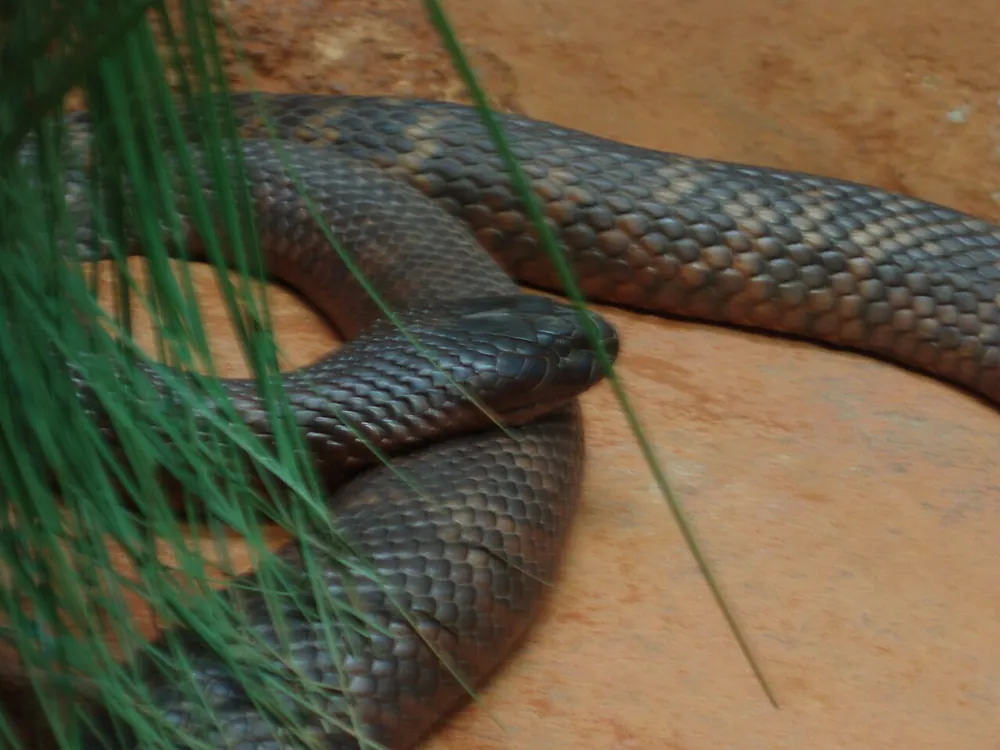
Collett's snake is a large, brightly marked venomous snake that lives in the dry plains of Australia. It is one of the most colourful black snakes in its genus. Its bite can be fatal, so it is important to know what it looks like and where it lives.1
 How to recognise it
- Dark brown to black upperparts with pink or cream banding and sides1
- Irregular cross-shaped bands that are usually orange-red1
- Pale yellow to orange underparts, often the same colour as the bands1
- Young snakes are usually the same colour as adults but with brighter shades and more contrast1
Often confused with: It has a similar body structure to the red-bellied black snake, but the two look quite different. Collett's snake is the most colourful of the black snakes in its genus.1
Venom power
Venom comes out through its fangs or teeth when it bites.
What does its venom do?
Its venom is cytotoxic, which means it damages cells, and it has haemolytic activity, which means it breaks down red blood cells. It may also contain neurotoxins, which attack the nerves. Early symptoms include nausea, vomiting, abdominal pain, diarrhoea and headache. Within 24 hours, severe cases can progress to rhabdomyolysis (muscle breakdown) and acute kidney injury if fluid replacement and antivenom are not given. One strike delivers about 30 milligrams of venom.1
How dangerous is it to people?
Danger to people: Very dangerousIt can kill a person who gets no treatment.Its bite can be fatal. It was once thought to be only moderately venomous to people, but it is now known to have caused severe envenomation. It is considered the nineteenth most venomous snake in the world.1
 Good news: doctors have a medicine (antivenom) or a treatment for this.1
If it bites
Always call your emergency number first (for example 112 in Europe, 911 in North America, 000 in Australia).
- Pressure immobilisation: wrap a firm elastic bandage over the bite and then up the whole limb, splint it, and keep the person completely still until help arrives.
- Do not wash the bite: hospitals can test the venom left on the skin to choose the right antivenom.
- Be ready to give rescue breaths or CPR if breathing gets weak or stops.
- Call 000 (or the local emergency number) at once. Keep the person still and calm, put a firm pressure bandage over the bite and wrap the whole limb, then splint it. Do not wash the bite, cut it or use a tourniquet. In hospital, black snake or tiger snake antivenom and fluids are given, because kidney damage can start within 24 hours.1
This is general first aid guidance, not medical advice. Based on the first aid guidelines of the World Health Organization and the Australian Resuscitation Council. Facts come from public sources and may contain mistakes. When in doubt, always get medical help. First aid basics
 Stay safe
- Never touch, catch or tease a wild animal, even a small one, and even if it looks asleep or dead.
- Give it space. If you meet one, stay calm, step back slowly and let it go its own way.
- If one bites you: stay calm, keep still, call your emergency number (for example 112 in Europe, 911 in North America, 000 in Australia) or get to a hospital fast. Remember what it looked like, a photo helps.
It is not out to get you. It uses its venom to catch food or to protect itself, and it would much rather hide. More about staying safe
Where in the world?
How big is it?
How long is it?
 as long as 2.5 dogs nose to tail
 as long as 14 bananas end to end
 could cover 100 metres in 46 seconds (the fastest human needs 9.6)
How big is Collett's snake compared to you?
Just maths in your browser. Nothing is saved or sent anywhere.
How fast is it?


Facts
Myth buster
Myth: It was once thought to be only moderately venomous to people.
Truth: Cases of severe envenomation, including muscle breakdown and kidney injury, are now known.1
Where the facts come from
- Collett's snake (Wikipedia (CC BY-SA 4.0))
- Pseudechis colletti (iNaturalist): names and classification.
- Venom Wiki: the danger level, the typical size and the speed guess are our own. See how we work them out: How we rate danger.
Every fact on this page has a number that points to its source. If we got something wrong, sorry, we are animal fans, not a science journal. Tell us at [email protected] and we will fix it.
Get the Venom Wiki app
Every creature, every picture and the games in your pocket, even without internet.


 Support Venom Wiki Venom Wiki is a one-man project: free, with no ads and no cookies. A small tip helps keep it online.Feed the scorpion
 Coastal taipan
 Common death adder
 Eastern brown snake
 Inland taipan
 Tiger snake
 Desert death adder
 Sydney funnel-web spider
 Cane toad
 Redback spider
 Brown tree snake
 Common wasp
 Hooded pitohui
