
 Bitten or stung?
 All animals
 Pick a continent
 Africa
 Asia
 Europe
 South America
 Australia & Oceania
 Antarctica
 Pacific Ocean
 Atlantic Ocean
 Indian Ocean
 Arctic Ocean
 Mediterranean Sea
 Red Sea
 Caribbean Sea
 Coral Sea
 South China Sea
 Philippine Sea
 Andaman Sea
 North Sea
 Timor & Arafura Sea
 Bay of Bengal
 Gulf of California
 Games
 Venom battle
 Animal race
 Field notebook
 Venom TOP lists
 Stay safe
 Surprise me

Tanzanian blue ringleg centipede
 Bites
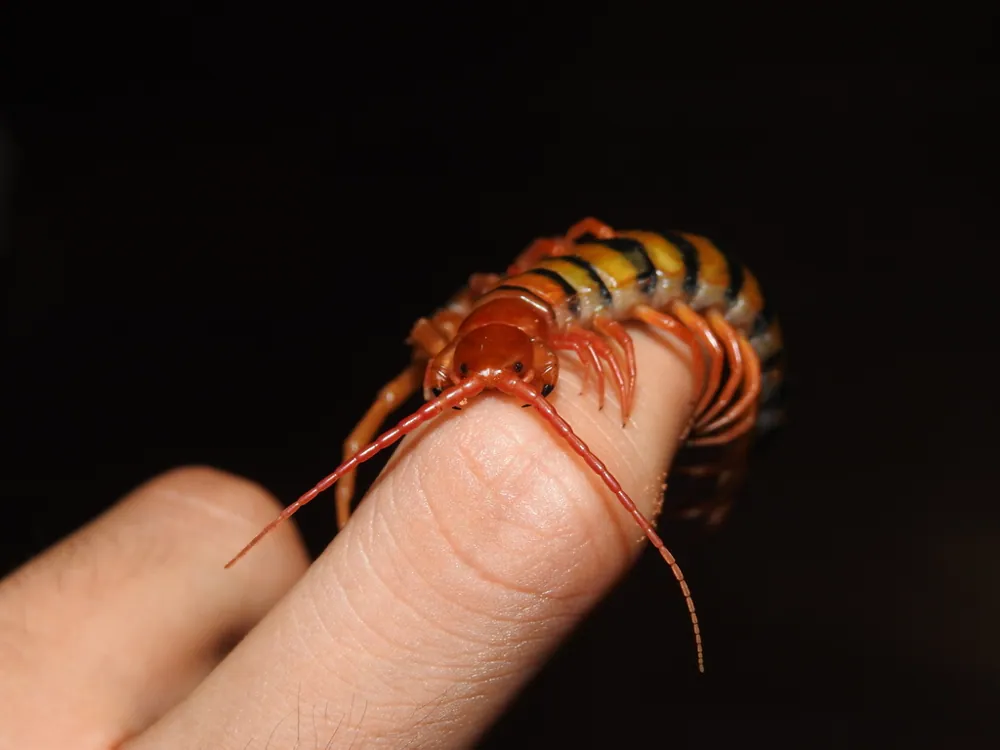
The Tanzanian blue ringleg is a centipede with a bright red head, though its colour varies from place to place. It lives in warm places across many parts of the world, including much of Australia, Africa, Asia and the Americas. It is a fast-hunting nocturnal predator, and its bite can be painful.1
 How to recognise it
- Adults are generally characterised by a bright red head and a brownish body.1
- Adults have distinct striations, or lines, between each body segment.1
- Juveniles lack clear stripes and often have a head that is a similar colour to their body.1
- Adults grow to around 13 cm, though colour varies widely between populations, so colour alone can be misleading.1
- In the field, the species can sometimes be told apart from other Scolopendras by its relatively thick rear legs, called ultimate legs.1
Often confused with: It is often confused with the giant red-headed centipede (Scolopendra heros), the Chinese red-headed centipede (Scolopendra subspinipes) and the Tanzanian blue ringleg centipede (Ethmostigmus trigonopodus), which have similar-sounding common names. Thick rear legs can help separate it from other Scolopendras.1
Venom power
Venom goes in through two fang-like front legs under the head, not through teeth.
What does its venom do?
Its venom is neurotoxic, meaning it attacks the nerves, and it rapidly paralyses and kills prey. The venom contains serotonin, which causes a pain response, along with proteins and enzymes. In humans, bites can cause redness, swelling and, in some cases, severe pain.1
How dangerous is it to people?
Danger to people: PainfulIt can really hurt, but it is almost never serious.Bites in humans cause redness, swelling and sometimes severe pain. Robust case studies of this species are limited, so its effects on people are not well documented.1
What does it do when it is scared?
When approached from behind, it raises its ultimate legs aggressively, which may confuse predators by disguising its vulnerable flanks as its fang-bearing head.1
 If it bites
Call your emergency number at once if the person has trouble breathing, swelling of the face or throat, or feels faint.
- Wash the bite, cool it or soak it in warm water for the pain, and get medical help if it gets worse.
This is general first aid guidance, not medical advice. Based on the first aid guidelines of the World Health Organization and the Australian Resuscitation Council. Facts come from public sources and may contain mistakes. When in doubt, always get medical help. First aid basics
 Stay safe
- Never touch, catch or tease a wild animal, even a small one, and even if it looks asleep or dead.
- Give it space. If you meet one, stay calm, step back slowly and let it go its own way.
- If it hurts you: wash the spot, stay calm and get medical help if the pain is strong or spreads, or the person feels unwell.
It is not out to get you. It uses its venom to catch food or to protect itself, and it would much rather hide. More about staying safe
Where in the world?
How big is it?
How long is it?
 about as long as a bank card
 could cover 100 metres in 240 seconds (the fastest human needs 9.6)
How big is Tanzanian blue ringleg centipede compared to you?
Just maths in your browser. Nothing is saved or sent anywhere.
How fast is it?


Facts
Centipedes are the only known animals whose venom partly comes from genes transferred horizontally from several other groups of organisms.1
Enzymes in its venom let it digest prey outside its body, sucking out the broken-down contents through the prey's exoskeleton.1
The venom of this species contained the first active enzymes ever found in any centipede venom, discovered at Ain Shams University in 1983.1
It is kept as a pet and traded internationally, with prices averaging around US$35 online.1
Myth buster
Myth: The species can be identified by its colour alone.
Truth: Colour varies widely across regional populations, so colour alone can be misleading.1
For venom experts
- Scientific name
- Scolopendra morsitans
- Group
- Centipedes
- Also called
- Red-headed centipede, Redhead centipede1
- Family
- Scolopendridae2
- Order
- Scolopendromorpha
- Continents
- Africa, Asia, Australia & Oceania
- Babies
- The female builds a brood chamber under the ground and lays 22 to 86 eggs, coiling around them and her young to guard them.1
- Lifespan
- about 4 years1
- Danger to people
- 2 / 5: Painful3
Where the facts come from
- Scolopendra morsitans (Wikipedia (CC BY-SA 4.0))
- Scolopendra morsitans (iNaturalist): names and classification.
- Venom Wiki: the danger level, the typical size and the speed guess are our own. See how we work them out: How we rate danger.
Every fact on this page has a number that points to its source. If we got something wrong, sorry, we are animal fans, not a science journal. Tell us at [email protected] and we will fix it.
Get the Venom Wiki app
Every creature, every picture and the games in your pocket, even without internet.


 Support Venom Wiki Venom Wiki is a one-man project: free, with no ads and no cookies. A small tip helps keep it online.Feed the scorpion
 Chinese red-headed centipede
 Giant Australian centipede
 Mediterranean banded centipede
 House centipede
 Vietnamese giant centipede
 African blue-ring centipede
 Black mamba
 Deathstalker
 Egyptian cobra
 Puff adder
 Boomslang
 Fat-tailed scorpion