
 Bitten or stung?
 All animals
 Pick a continent
 Africa
 Asia
 Europe
 South America
 Australia & Oceania
 Antarctica
 Pacific Ocean
 Atlantic Ocean
 Indian Ocean
 Arctic Ocean
 Mediterranean Sea
 Red Sea
 Caribbean Sea
 Coral Sea
 South China Sea
 Philippine Sea
 Andaman Sea
 North Sea
 Timor & Arafura Sea
 Bay of Bengal
 Gulf of California
 Games
 Venom battle
 Animal race
 Field notebook
 Venom TOP lists
 Stay safe
 Surprise me

White-spotted puffer
 If someone ate itDanger to people: Very dangerousIt can kill a person who gets no treatment.
 Poisonous to eat
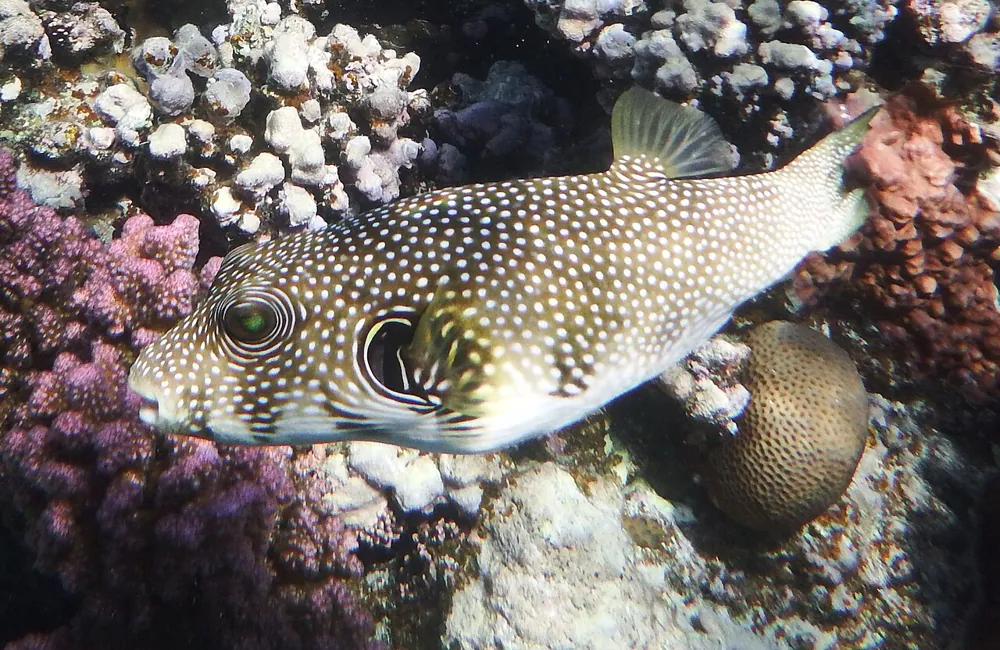
The white-spotted puffer is a medium to large fish that can grow to 50 cm long. It lives in warm seas across the Indo-Pacific, and it is poisonous to eat. Its skin is covered in white spots and it has patterned rings around its eyes.1

 How to recognise it
- Light grey, greyish or yellowish body, covered in white points1
- White spots form concentric white and dark grey lines that radiate around the eyes and pectoral fins1
- White belly1
- A dark 'shoulder' area around the pectoral fins1
- Adults show many white rings around the eyes; juveniles have incomplete rings1
Poison power
It is only harmful if something eats it.
How dangerous is it to people?
Danger to people: Very dangerousIt can kill a person who gets no treatment.It is poisonous to eat.1
If someone ate it
Always call your emergency number first (for example 112 in Europe, 911 in North America, 000 in Australia).
- If someone has eaten this fish, call the emergency number at once, even before any signs start. Watch for tingling or numbness of the lips, tongue or face. The poison can stop breathing, so give rescue breaths or CPR if needed until help arrives.1
- If someone ate it or has symptoms after eating it: call your emergency number or poison centre straight away.
This is general first aid guidance, not medical advice. Based on the first aid guidelines of the World Health Organization and the Australian Resuscitation Council. Facts come from public sources and may contain mistakes. When in doubt, always get medical help. First aid basics
 Stay safe
- Never touch, catch or tease a wild animal, even a small one, and even if it looks asleep or dead.
- Give it space. If you meet one, stay calm, step back slowly and let it go its own way.
- If someone ate it: call your emergency number or poison centre straight away.
It is not out to get you. Its poison is only there so that nothing eats it. More about staying safe
Where in the world?
How big is it?
How long is it?
 as long as 3 bananas end to end
 as long as 6 bank cards end to end
 could swim the length of a big swimming pool (50 m) in 45 seconds
How big is White-spotted puffer compared to you?
Just maths in your browser. Nothing is saved or sent anywhere.
How fast is it?
Facts
A single juvenile was recorded in the eastern Mediterranean off Cyprus in 2018, well outside its usual range.1
It feeds on a wide mix of plants and animals, from algae and corals to crabs and starfish.1
Adults live alone and are territorial, and they can become somewhat aggressive.1
Its rings around the eyes become more complete as it grows, so juveniles can be identified by their incomplete rings.1
Adults are nocturnal, which means they are most active at night.1
For venom experts
- Scientific name
- Arothron hispidus
- Group
- Other poisonous animals
- Also called
- Stripebelly Puffer, Stars-and-Stripes Puffer, Stars And Stripes Toado1
- Family
- Tetraodontidae2
- Order
- Tetraodontiformes
- Continents
- Pacific Ocean, Indian Ocean, Red Sea, Coral Sea, Philippine Sea, South China Sea, Timor & Arafura Sea, Bay of Bengal, Gulf of California, The oceans
- Danger to people
- 4 / 5: Very dangerous3
Where the facts come from
- White-spotted puffer (Wikipedia (CC BY-SA 4.0))
- Arothron hispidus (iNaturalist): names and classification.
- Venom Wiki: the danger level, the typical size and the speed guess are our own. See how we work them out: How we rate danger.
Every fact on this page has a number that points to its source. If we got something wrong, sorry, we are animal fans, not a science journal. Tell us at [email protected] and we will fix it.
Get the Venom Wiki app
Every creature, every picture and the games in your pocket, even without internet.


 Support Venom Wiki Venom Wiki is a one-man project: free, with no ads and no cookies. A small tip helps keep it online.Feed the scorpion
More from the same group: Other poisonous animals
 Japanese pufferfishOther poisonous animalsDeadly
 Hawksbill sea turtleOther poisonous animalsCan kill
 Greenland sharkOther poisonous animalsPainful
 Silver-cheeked toadfishOther poisonous animalsDeadly
 Blackspotted pufferOther poisonous animalsCan kill
 Long-spine porcupinefishOther poisonous animalsNeeds a doctor
Also lives in: Pacific Ocean
 Australian box jellyfishJellyfish & sea stingersDeadlyDo not touch
 Geography coneCone snails & octopusesDeadly
 Greater blue-ringed octopusCone snails & octopusesDeadly
 Southern blue-ringed octopusCone snails & octopusesDeadly
 Irukandji jellyfishJellyfish & sea stingersCan killDo not touch
 Reef stonefishVenomous fishCan killDo not touch