
 Afrika
 Asia
Asia Europa
 Hego Amerika
 Australia eta Ozeania
 Antartika
 Ozeano Barea
 Ozeano Atlantikoa
 Ozeano Indikoa
 Ozeano Artikoa
 Mediterraneo itsasoa
 Itsaso Gorria
 Karibe itsasoa
 Koralen itsasoa
 Hego Txinako itsasoa
 Filipinetako itsasoa
 Andaman itsasoa
 Ipar itsasoa
 Timor eta Arafura itsasoak
 Bengalako golkoa
 Kaliforniako golkoa
Green vine snake
 Koska
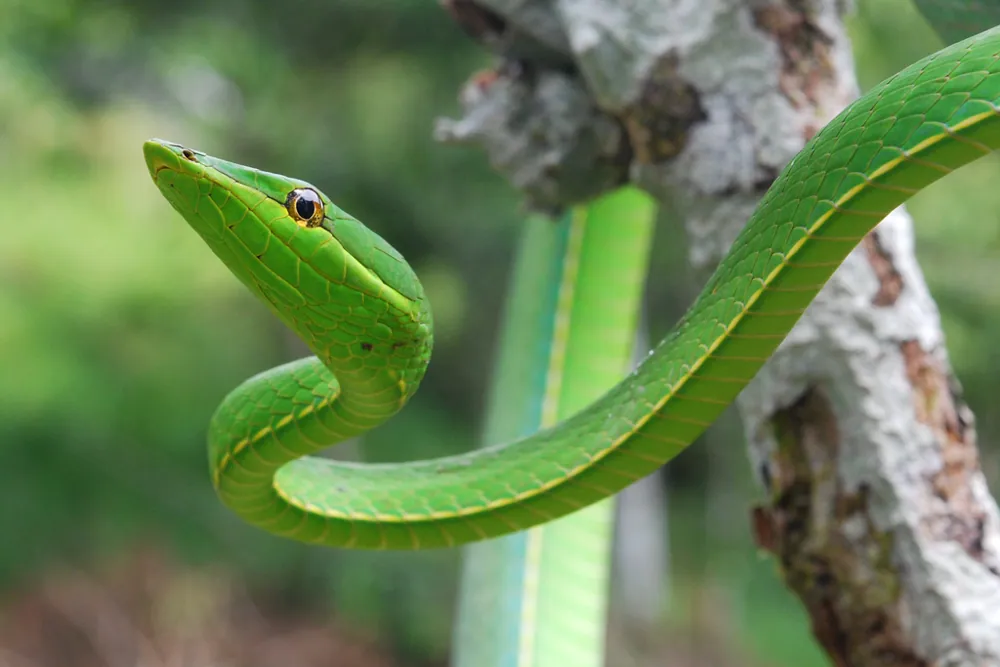
KoskaThe green vine snake is a slender, bright green snake that lives high in the trees of Central and northern South America. It hunts small animals from the branches, and it is rear-fanged, which means its venom is delivered from the back of the mouth.1



 Nola ezagutu
- Bright green on its back, with yellowish green underneath and on the upper lip1
- A narrow yellowish-white stripe runs along each side of the belly and tail1
- Very slender body with a long, pointed head and a very large mouth that reaches almost the whole length of the head1
- Long green tongue, kept outside the mouth and moved up and down1
- Long, delicate tail, used to hold on while reaching for prey1
Pozoi-ahalmena
Pozoia letaginetatik edo hortzetatik ateratzen da kosk egiten duenean.
Zer egiten du bere pozoiak?
Its saliva is toxic, and it works quickly on small animals, so they are stopped from fighting back. It has little to no effect on humans. In the rare reported bites, slight tingling or temporary numbness at the bite site has been reported.1
Zein arriskutsua da pertsonentzat?
Arriskua pertsonentzat: ArinaErle-ziztada bat bezala edo gutxiago. Ia kaltegabea pertsonentzat.Bites to people are rare, because the snake has to grab hold and chew its saliva into the skin, which most people will not allow. Serious allergic reactions are possible, as with any venomous animal, and most allergies are not known before a bite.1
 Kosk egiten badu
- Garbitu koska, eutsi pertsona lasai eta lortu mediku-laguntza. Espezie batzuk (boomslang-a, adibidez) hilgarriak izan daitezke ordu batzuk geroago.
Deitu beti lehenik zure larrialdi-zenbakira (112, 000, 911). Lehen sorospenei buruzko orientabide orokorra da hau, ez mediku-aholkua. Lehen sorospenen oinarriak
 Egon seguru
- Ez ukitu, ez harrapatu eta ez zirikatu inoiz animalia basati bat, txikia izan arren, eta lo edo hilda dagoela badirudi ere.
- Utzi tartea. Bat aurkitzen baduzu, egon lasai, egin atzera poliki eta utzi bere bidetik joaten.
- Batek kosk egiten badizu: egon lasai, egon geldi, deitu zure larrialdi-zenbakira (112, 000, 911) edo joan ospitalera azkar. Gogoratu nolakoa zen, argazki batek laguntzen du.
Ez dabil zure atzetik. Pozoia janaria harrapatzeko edo bere burua babesteko erabiltzen du, eta askoz nahiago du ezkutatu. Seguru egoteari buruz gehiago
Munduko zein tokitan?
Zein handia da?
Zein luzea da?
 4 etxeko katu muturretik buztanera jarrita bezain luzea
 11 banana bata bestearen atzetik jarrita bezain luzea
 100 metro 57 segundotan egin litzake (gizakirik azkarrenak 9,6 behar ditu)
Zein handia da Green vine snake ZUREKIN alderatuta?
Matematika hutsa zure nabigatzailean. Ez da ezer gordetzen, ezta inora bidaltzen ere.
Zein azkarra da?


Datuak
Its tongue is thought to work like a cat's whiskers, helping it sense its way through branches and brush as it moves quickly.1
After biting, it coils around its prey. It does not squeeze the prey the way a constrictor does, but the coil helps to hold it.1
It is rear-fanged, with two larger but blunted, peg-like teeth at the upper back of the mouth. These teeth have grooves on the sides that deliver its saliva.1
After swallowing a meal, it usually moves to the highest point of a tree to rest.1
In captivity it readily takes mice, and some are large enough to eat rats, which makes it a prized choice among reptile collectors.1
Mito-hauslea
Mitoa: That the bite of this snake is dangerous to people.
Egia: Its venom has little to no effect on humans. It is fast-acting on small animals, but bites to people are rare and usually cause only slight tingling or temporary numbness.1
Datuak nondik datozen
- Oxybelis fulgidus (Wikipedia (CC BY-SA 4.0))
- Oxybelis fulgidus (iNaturalist): izenak eta sailkapena.
- Venom Wiki: arrisku-maila, ohiko tamaina eta abiadura-kalkulua geureak dira. Ikusi nola kalkulatzen ditugun: Nola baloratzen dugun arriskua.
Orrialde honetako datu bakoitzak zenbaki bat du, bere iturrira eramaten zaituena. Zerbait gaizki badugu, barkatu, animalien zaleak gara, ez zientzia-aldizkari bat. Esaiguzu [email protected] helbidean eta konponduko dugu.
 Eskorpioia gose da! Venom Wiki pertsona bakar baten proiektua da: doakoa, iragarkirik eta jarraitzailerik gabe. Eskupeko txiki batek sarean mantentzen laguntzen du.Elikatu eskorpioia
Talde bereko gehiago: Atzeko letagineko sugeak
 Western hognose snakeAtzeko letagineko sugeakKaltegabea
 Baron's green racerAtzeko letagineko sugeakMin ematen du, besterik ez
 False water cobraAtzeko letagineko sugeakMin ematen du, besterik ez
 Brown vine snakeAtzeko letagineko sugeakKaltegabea
 Eastern hognose snakeAtzeko letagineko sugeakKaltegabea
 Lichtenstein's green racerAtzeko letagineko sugeakMedikua behar du
 Terciopelo
 Eastern coral snake
 Eastern diamondback rattlesnake
 Eyelash viper
 Timber rattlesnake
 Western diamondback rattlesnake