
 Afirik
 Aazi
Aazi Orop
Orop Amerik Sud
 Ostarali e Oseyani
 Antarktik
 Geeci Pasifik
 Geeci Atlantik
 Geeci Enndo
 Geeci Arktik
 Geeci Mediteraane
 Geeci Boɗeewi
 Geeci Karayib
 Geeci Korayl
 Geeci Siin Sud
 Geeci Filipiin
 Geeci Andaman
 Geeci Nord
 Geeci Timor e Arafura
 Gulf Bengal
 Gulf Kaliforni
Red-bellied newt
 Tooke nder nguru mum
The red-bellied newt is a small amphibian with a brownish-black back and a bright red belly. It lives in coastal woodlands in northern California, mostly on land. Its skin is poisonous, so it is important to leave it alone.1
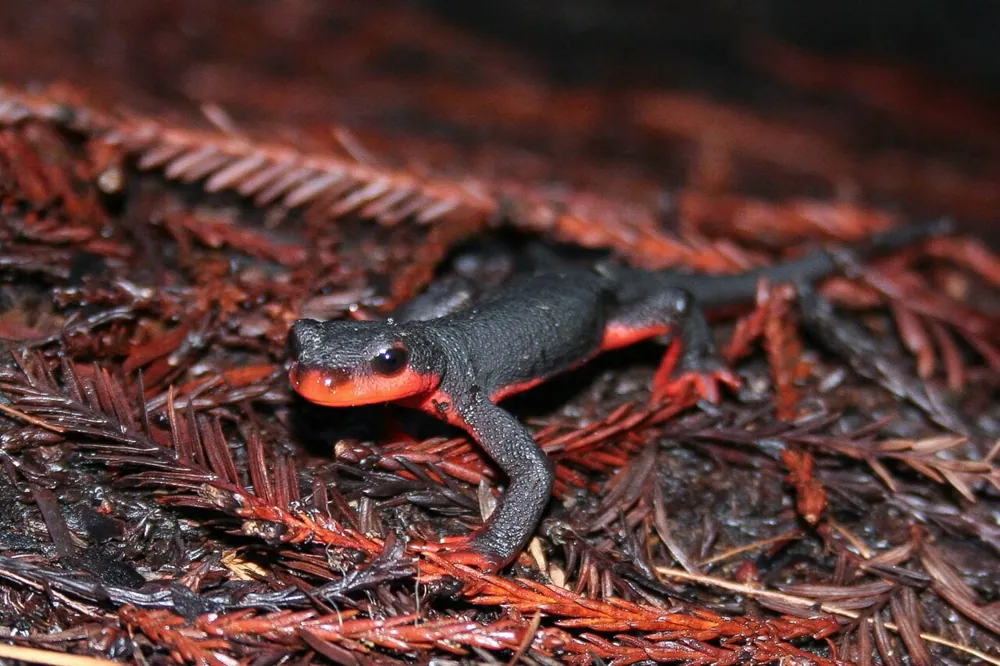
 Hono anndirtee ngal
- Brownish-black upper body with grainy skin1
- Tomato-red underbelly1
- Length of about 7 to 9 cm from nose to vent, and 14 to 19 cm including the tail1
- Males often have a dark, broad patch across the vent; females do not1
- Breeding males have smooth skin and a flattened tail1
No jiibondiree e: Other coastal newts are similar in shape. The red-bellied newt can be told apart by its red belly and by the lack of yellow in its eyes.1
Doole tooke
Nguru mum ko tooke. No musiiba meemugol ngal, meemugol ngal e ɗemngal walla ñaamugol ngal.
Ko honɗun tooke ɓanndu mum waɗata?
The red-bellied newt is poisonous rather than venomous, so it does not bite or sting. Its skin, eggs and embryos contain tetrodotoxin, a neurotoxin, which is a poison that attacks the nerves. There is enough of it to potentially kill an adult human.1
Hono musiiba mum heewiri e yimɓe?
Musiiba e yimɓe: Musiiba mawɗoSi neɗɗo meemii walla ñaamii ngal, yahu ka doktoro. Maayde no famɗi sanne.The newt's skin is poisonous to touch and to eat. Its toxin is strong enough to potentially kill an adult human. It is also nearly inedible, and few animals eat it.1
Ko honɗun ngal waɗata si ngal hulii?
When disturbed, it pulls its head and tail back to show its bright-red underside, which warns predators that it is poisonous.1
 Si neɗɗo meemii walla ñaamii ngal
- Si neɗɗo meemii gooto e majji: loot juuɗe ɗen no moƴƴi, wota meem gite walla hunuko. Si paykun walla kullal suudu meemii gooto e ɗemngal walla ñaamii gooto: noddu centre antipoison walla nimero ballal.
Adii fow noddu nimero ballal (112, 000, 911). Ɗum ko anndinal ballal adiingal, wanaa saaraangal doktoro. Ko adii nder ballal adiingal
 Reen hoore maa
- Wota a meem, wota a nanngu, wota a jalnu kullal ladde haa abada, hay si ko tokooso, hay si no yi'ee no ɗaanii walla maayii.
- Accu ngal nokku. Si a fotti e ngal, deeƴu, ruttu ɓaawo seeɗa seeɗa, accu ngal yaha laawol mum.
- Si a meemii walla a ñaamii ngal: wota a moomtu gite maa walla hunuko maa, loot juuɗe maa, heɓu ballal doktoro.
Ngal faalaaka gaañugol ma. Tooke mum woodi tun ngam wota huunde ñaam ngal. Ko ɓeydi fii reenugol hoore maa
Hoto nder aduna?
Hono mawniri?
Hono juutiri?
 juuti no kaaɗe mahirɗe 6 e diisa gooto
Hono Red-bellied newt mawniri, si fooɗondiraama e AN?
Ko limoore tun nder navigateur maa. Alaa ko danndetee walla ko neldetee ka nokku woo.
Hono yaawiri?


Humpito
Like other newts, they can regrow several body parts, including their limbs, eyes, hearts, intestines, jaws and damaged spinal cords.1
They can find their way back to the same spot in a stream over several miles of rugged terrain, probably by using their sense of smell.1
Red-bellied newts can live for 20 to 30 years.1
Adults leave the water and live underground until they are ready to breed, which usually happens after four to six years.1
Females do not breed every year, unlike the males.1
Ngam ganduɓe tooke
- Innde ganndal
- Taricha rivularis
- Fedde
- Paaɓe tooke, krapooji e tritonuuji
- Ɓesngu
- Salamandridae2
- Ordre
- Caudata
- Leyɗe mawɗe
- Amerik Nord
- Ɓiɓɓe tokosɓe
- Newts start life as aquatic larvae, similar to tadpoles, with external gills. Females lay their eggs in about 12 clusters, with six to 16 eggs in each cluster.1
- Duuɓi nguurndam
- wona duuɓi 301
- Musiiba e yimɓe
- 3 / 5: Musiiba mawɗo3
Ɗo humpitooji ɗin iwri
- Red-bellied newt (Wikipedia (CC BY-SA 4.0))
- Taricha rivularis (iNaturalist): inɗe e ŋoordingol (classification).
- Venom Wiki: tolno musiiba, mawnugol aadaajo e miijo yaawugol ko amen. Ndaar no min ƴeewtirta ɗum: Hono min tolnirta musiiba.
Kala humpito nder ngoo hello no jogii limoore hollirnde iwdi mum. Si min juumii, yaafo, min ko yiɗɓe kulle, wanaa jaaynde ganndal. Haalan min e [email protected], min feewnitan.
 Yaare nden no weelaa! Venom Wiki ko golle neɗɗo gooto: ko yoɓetaake, alaa piiblisite, alaa reweteeɓe. Kopporde tokooso no walla heddingol ɗum e enternet.Ñaamnu yaare nden
Ko ɓeydi e fedde wootere: Paaɓe tooke, krapooji e tritonuuji
 Cane toadPaaɓe tooke, krapooji e tritonuujiNo sokli doktoroWota a meem
 Strawberry poison-dart frogPaaɓe tooke, krapooji e tritonuujiNo muusi tunWota a meem
 California newtPaaɓe tooke, krapooji e tritonuujiNo waawi warugolWota a meem
 Rough-skinned newtPaaɓe tooke, krapooji e tritonuujiNo waawi warugolWota a meem
 Colorado River toadPaaɓe tooke, krapooji e tritonuujiNo sokli doktoroWota a meem
 Panamanian golden frogPaaɓe tooke, krapooji e tritonuujiNo sokli doktoroWota a meem
 Terciopelo
 Eastern coral snake
 Eastern diamondback rattlesnake
 Eyelash viper
 Timber rattlesnake
 Western diamondback rattlesnake
.jpg)