
 Afirik
 Asiya
Asiya Turai
Turai Amerik Worgo
 Australiya e Oseaniya
 Antarktika
 Baharu Pasifik
 Baharu Atlantik
 Baharu Indiya
 Baharu Arktik
 Baharu Mediterane
 Baharu Boɗeeru
 Baharu Karibiya
 Baharu Koral
 Baharu Ciina Worgo
 Baharu Filipin
 Baharu Andaman
 Baharu Rewo
 Baharu Timor e Arafura
 Baharu Bengal
 Baharu Kaliforniya
Mount Kenya bush viper
 Ina ŋata
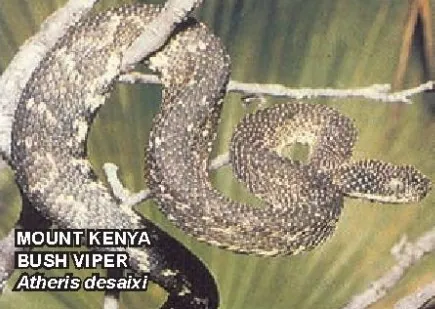
The Mount Kenya bush viper is a venomous snake with a striking black and yellow pattern. It lives only in Kenya, in two small, separate areas of forest. Its bite can cause serious swelling and bleeding problems, so it is important to know it.1



 No anndirto nde
- Ground colour is greenish-black to charcoal-black, with each scale tipped in yellow or yellowish-green, giving a speckled look.1
- Some scales form a series of loops along the sides, which may join into zigzag patterns towards the back.1
- The underside is yellow near the front, fading to purplish-black towards the rear and under the tail.1
- Young snakes are mainly yellow with a white-tipped tail. They darken as they grow and reach adult colours at about 30 cm.1
- Adults are usually 40 to 60 cm long, including the tail.1
Doole tooke
Tooke ina yalta e ñiiƴe mum si nde ŋatii.
Hol ko tooke mum (ŋatol walla fiɗol) waɗata?
Its venom contains powerful anticoagulants, which are substances that stop blood from clotting properly. A bite causes significant swelling and pain. Poor clotting may be severe enough to need blood transfusions.1
Hol no nde woni bone e yimɓe?
Bone e yimɓe: Bone mawɗoŊatol ina haani doktaa. Maayde ina woodi seeɗa sanne.In the one recorded bite, a Kenyan collector was bitten on a finger by an adult snake. The bite caused significant swelling and pain, and he made a full recovery. The snakes are relatively large for their genus, so a bite should be taken seriously.1
Hol ko nde waɗata si nde hulii?
When captured, it strikes readily and struggles vigorously. It may also give a threat display, rubbing its coils and keeled scales together to make a loud hiss.1
 Si nde ŋatii
- Because the venom can stop blood clotting, any bite should be treated as serious and needs urgent medical care. In the one recorded bite, a tourniquet was applied and an unknown antivenin was given, but the antivenin probably made no difference.1
- Deeƴin neɗɗo oo, taa o dilla, waɗu koyngal walla junngo ŋataangal e toowal ɓernde, ittu zoobe e geɗe ɗigginiiɗe, yahra mo asibiti law.
Sahaa fof, noddu lamba ballal yaawngal (112, 000, 911) ko adii. Ɗum ko ballal arano kuuɓal, wonaa wasiyya doktaa. Aslu ballal arano
 Reen hoore maa
- Taa memu, taa nanngu, taa aaɓnu dabbaare ladde abada, hay pamaro, hay si ina wayi no ɗaanii walla maayii.
- Accu nde nokku. Si a fottii e gooto, deeƴu, ruttu caggal seeɗa seeɗa, accu nde yaha laawol mum.
- Si gooto e majji ŋatii ma: deeƴu, taa dillu, noddu lamba ballal yaawngal (112, 000, 911) walla yah asibiti law. Siftor no nde wayri, foto ina walla.
Nde ɗaɓɓaaki ma. Nde huutora tooke mum ngam nanngude ñaamdu walla reende hoore mum, nde ɓuri yiɗde suuɗaade. Ɓeydu anndude no reentorto
Hol to e aduna?
Hol no nde mawni?
Hol no nde juuti?
 juuti no ayaba 4 jokkondiraaɗi
 ina waawi dogde meeter 100 nder sakan 110 (neɗɗo ɓurɗo yaawde ina haani 9,6)
Hol no Mount Kenya bush viper mawni, fottindaade e AAN?
Hiisa tan nder browser maa. Alaa ko mooftetee walla ko neletee.
Hol no nde yaawi?


Anndal
Its coloration gives it excellent camouflage in the forest, so it is very hard to spot.1
Its speckled, looped pattern changes from juvenile yellow to adult black and yellow as it grows.1
It is arboreal, which means it lives in trees and bushes, moving slowly and deliberately among the branches.1
Captive snakes soon calm down, and their threat display disappears.1
Ngam ganduɓe tooke
- Innde ganndal
- Atheris desaixi
- Fedde
- Viper e adder
- Besngu
- Viperidae2
- Tolno
- Squamata
- Nahiyaaji
- Afirik
- Ɓikkoy
- It gives birth to live young. One recorded female gave birth to 13 offspring in August, each measuring 17 to 21 cm.1
- Hol no nde wonata e ladde
- Endangered on the IUCN Red List (as of 2019). Listed in Appendix II of CITES, so international trade is regulated by permit.1
- Bone e yimɓe
- 3 / 5: Bone mawɗo3
Ɗo anndal iwi
- Atheris desaixi (Wikipedia (CC BY-SA 4.0))
- Atheris desaixi (iNaturalist): inɗe e tolnugol.
- Venom Wiki: darja bone, mawnude woowaaɗo e miijo yaawre ko amen. Ndaar no min hiisirta ɗum: No min betiri bone.
Kala anndal e ngoo hello ina jogii limre hollirnde iwdi mum. Si min juumii, accu min, min yiɗɓe dabbaaji, wonaa jaridaa ganndal. Wiy min e [email protected] min feewnitay.
 Yaare nden ina heege! Venom Wiki ko golle neɗɗo gooto: meere, tawa tallaaji alaa, trackers alaa. Ballal pamarngal ina walla heddinde ɗum e internet.Ñaamnu yaare nden
 Puff adder
 Gaboon viper
 Northeast African carpet viper
 West African carpet viper
 Rhinoceros viper
 West African Gaboon viper
 Mamba ɓaleendi
 Yaare deathstalker
 Cobra Masar
 Boomslang
 Fat-tailed scorpion
 Western honey bee