
 Afirik
 Asiya
Asiya Turai
Turai Amerik Worgo
 Australiya e Oseaniya
 Antarktika
 Baharu Pasifik
 Baharu Atlantik
 Baharu Indiya
 Baharu Arktik
 Baharu Mediterane
 Baharu Boɗeeru
 Baharu Karibiya
 Baharu Koral
 Baharu Ciina Worgo
 Baharu Filipin
 Baharu Andaman
 Baharu Rewo
 Baharu Timor e Arafura
 Baharu Bengal
 Baharu Kaliforniya
South American coral snake
 Ina ŋata
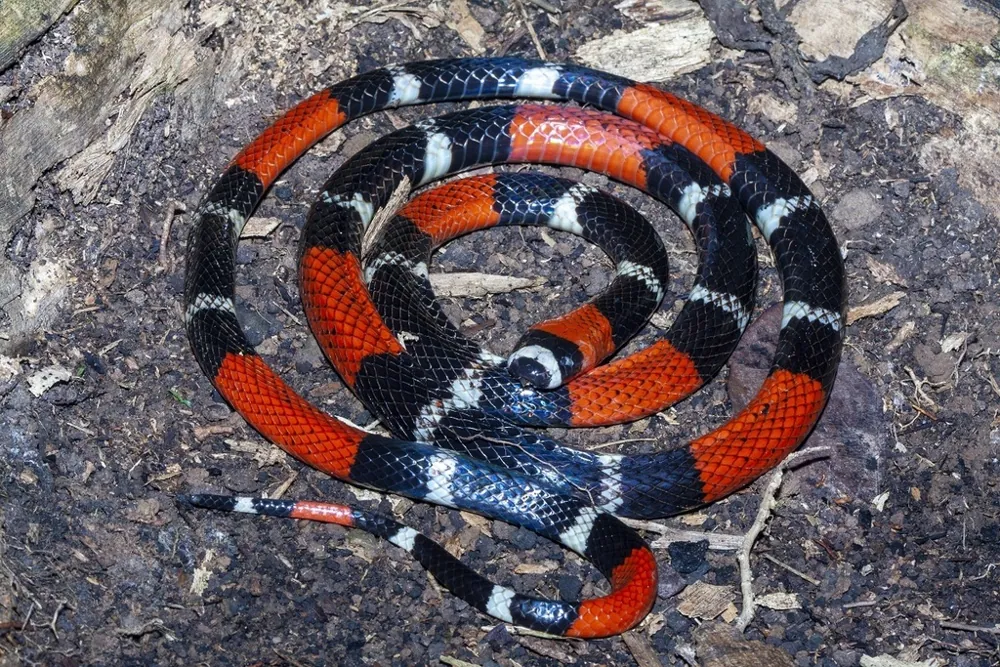
The South American coral snake is a thin, brightly coloured venomous snake. It lives only in South America, from Argentina to Venezuela. It is nocturnal, so it is most active at night, and its venom is strong enough to be dangerous to people.1



 No anndirto nde
- The snout is black, followed by a narrow white band in front of the eyes and a wider black band across the eyes.1
- The rest of the head is red, and the body has broad red rings.1
- Between the red rings are 7 to 17 groups of three black and two white rings.1
- The tail has two of these black and white groups.1
- It is thin, and adults are usually 60 to 90 cm long, tail included.1
Doole tooke
Tooke ina yalta e ñiiƴe mum si nde ŋatii.
Hol ko tooke mum (ŋatol walla fiɗol) waɗata?
Its venom is a strong neurotoxin, which attacks the nerves. It acts both before and after the nerve connects to the muscle, and it causes a strong, permanent block of nerve signals to the muscles in vertebrates. A muscle-damaging toxin called lemnitoxin has also been isolated from the venom.1
Hol no nde woni bone e yimɓe?
Bone e yimɓe: Bone sanneIna waawi warde neɗɗo mo heɓaali safaara.It is not aggressive towards people, but it can bite to defend itself. The estimated lethal dose for an adult human is 5 to 7 mg of venom (dry weight). In laboratory milking, the average venom yield was 8 to 10 mg and the largest was 27 mg.1
Hol ko nde waɗata si nde hulii?
It is not aggressive, but it can attack to defend itself when threatened.1
 Si nde ŋatii
- Deeƴin neɗɗo oo, taa o dilla, yahra mo asibiti law, hay si ŋatol ngol ina famɗi: alaamaaji ñawu ina mbaawi fuɗɗaade caggal awaaji.
Sahaa fof, noddu lamba ballal yaawngal (112, 000, 911) ko adii. Ɗum ko ballal arano kuuɓal, wonaa wasiyya doktaa. Aslu ballal arano
 Reen hoore maa
- Taa memu, taa nanngu, taa aaɓnu dabbaare ladde abada, hay pamaro, hay si ina wayi no ɗaanii walla maayii.
- Accu nde nokku. Si a fottii e gooto, deeƴu, ruttu caggal seeɗa seeɗa, accu nde yaha laawol mum.
- Si gooto e majji ŋatii ma: deeƴu, taa dillu, noddu lamba ballal yaawngal (112, 000, 911) walla yah asibiti law. Siftor no nde wayri, foto ina walla.
Nde ɗaɓɓaaki ma. Nde huutora tooke mum ngam nanngude ñaamdu walla reende hoore mum, nde ɓuri yiɗde suuɗaade. Ɓeydu anndude no reentorto
Hol to e aduna?
Hol no nde mawni?
Hol no nde juuti?
 juuti no ullundi galle 3, hinere haa laaci
 juuti no ayaba 8 jokkondiraaɗi
 ina waawi dogde meeter 100 nder sakan 71 (neɗɗo ɓurɗo yaawde ina haani 9,6)
Hol no South American coral snake mawni, fottindaade e AAN?
Hiisa tan nder browser maa. Alaa ko mooftetee walla ko neletee.
Hol no nde yaawi?


Anndal
The venom of this snake is strong enough to cause paralysis, because it blocks nerve signals to the muscles.1
It is one of the few snakes whose diet includes freshwater eels and gymnotiform fishes.1
It is nocturnal and digs in loose soil or leaf litter, so it spends much of its time hidden underground.1
It can live in disturbed land and near human homes, not only in deep forest.1
Feññinoowo goonga
Fenaande: Coral snakes are aggressive and will attack people.
Goonga: This snake is not aggressive towards people. It only bites to defend itself.1
Ɗo anndal iwi
- Micrurus lemniscatus (Wikipedia (CC BY-SA 4.0))
- Micrurus lemniscatus (iNaturalist): inɗe e tolnugol.
- Venom Wiki: darja bone, mawnude woowaaɗo e miijo yaawre ko amen. Ndaar no min hiisirta ɗum: No min betiri bone.
Kala anndal e ngoo hello ina jogii limre hollirnde iwdi mum. Si min juumii, accu min, min yiɗɓe dabbaaji, wonaa jaridaa ganndal. Wiy min e [email protected] min feewnitay.
 Yaare nden ina heege! Venom Wiki ko golle neɗɗo gooto: meere, tawa tallaaji alaa, trackers alaa. Ballal pamarngal ina walla heddinde ɗum e internet.Ñaamnu yaare nden
 Central American coral snake
 Amazonian coral snake
 Aquatic coral snake
 Argentinian coral snake
 Caatinga coral snake
 Dumeril's coral snake
 Paaɓi tooke kaŋŋe
 Terciopelo
 Brazilian wandering spider
 Eyelash viper
 Golden lancehead
 South American bushmaster