
 Afirik
 Asiya
Asiya Turai
Turai Amerik Worgo
 Australiya e Oseaniya
 Antarktika
 Baharu Pasifik
 Baharu Atlantik
 Baharu Indiya
 Baharu Arktik
 Baharu Mediterane
 Baharu Boɗeeru
 Baharu Karibiya
 Baharu Koral
 Baharu Ciina Worgo
 Baharu Filipin
 Baharu Andaman
 Baharu Rewo
 Baharu Timor e Arafura
 Baharu Bengal
 Baharu Kaliforniya
Walking catfish
 Gi'e tooke
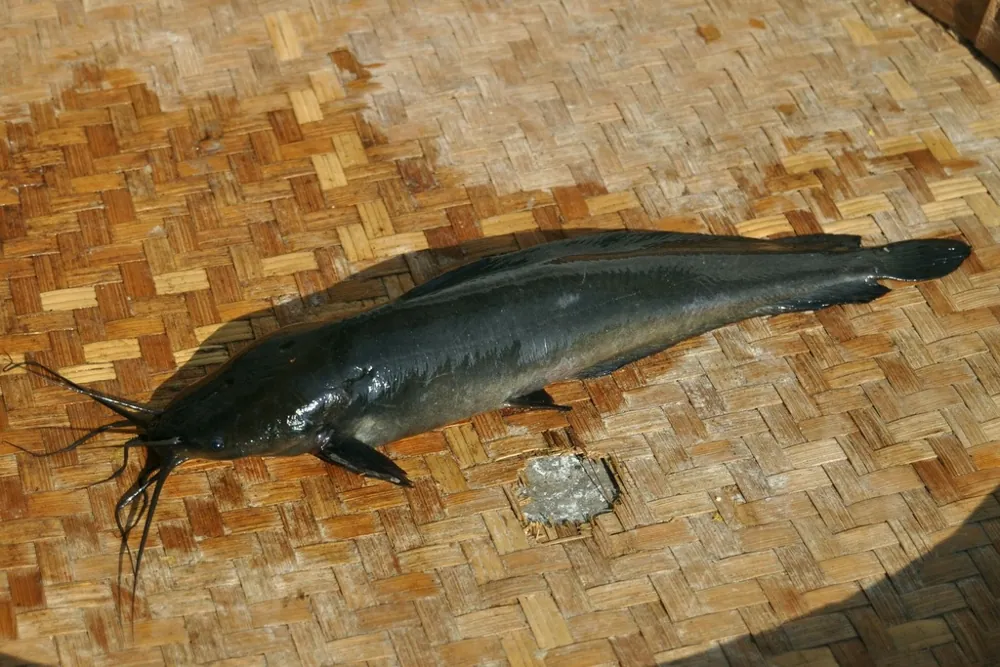
The walking catfish is a freshwater fish that can crawl across wet land to reach new water. It lives in Southeast Asia and has also been introduced to places such as Florida. Its spiny defence is the reason it needs careful handling.1


 No anndirto nde
- Elongated body, grey or grey-brown in colour1
- Often covered on its sides with small white spots1
- Long dorsal and anal fins, and several pairs of sensory barbels1
- Scaleless skin covered in mucus1
- No adipose fin, a small fleshy fin on the back near the tail1
Ina jiiɓindiree e: It is often confused with North American ictalurid catfish and with close relatives such as C. magur. The walking catfish can be told apart from the North American ictalurid catfish because it lacks an adipose fin.1
Doole tooke
Gi'e ceeɓɗe ina njogii tooke. Yaabude nde walla nanngude nde ina muusa.
Hol no nde woni bone e yimɓe?
Bone e yimɓe: Ina muusaIna waawi muusude sanne, kono ɓadii abada wonaa bone mawɗo.It must be handled carefully when fished because of its embedded sting or thorn-like spines. It is also harmful as an invasive species, because it eats the food of native fish, preys on their young and can destroy fish farms.1
Hol ko nde waɗata si nde hulii?
It has a sting or thorn-like spine hidden behind its fins, which it uses to defend itself.1
 Si gi'e mum naatii e ɓanndu maa
- Naatnu barme e ndiyam wulɗam, wulɗam no neɗɗo oo waawi muñde tawa sumataa (ƴeewu ɗam e junngo maa), hakkunde minti 30 e minti 90. Heɓu ballal doktaa, haa teeŋti e stonefish e stingray.
Sahaa fof, noddu lamba ballal yaawngal (112, 000, 911) ko adii. Ɗum ko ballal arano kuuɓal, wonaa wasiyya doktaa. Aslu ballal arano
 Reen hoore maa
- Taa memu, taa nanngu, taa aaɓnu dabbaare ladde abada, hay pamaro, hay si ina wayi no ɗaanii walla maayii.
- Accu nde nokku. Si a fottii e gooto, deeƴu, ruttu caggal seeɗa seeɗa, accu nde yaha laawol mum.
- Si gi'e mum naatii e ɓanndu maa: deeƴu, taa dillu, noddu lamba ballal yaawngal (112, 000, 911) walla yah asibiti law. Siftor no nde wayri, foto ina walla.
Nde ɗaɓɓaaki ma. Nde huutora tooke mum ngam nanngude ñaamdu walla reende hoore mum, nde ɓuri yiɗde suuɗaade. Ɓeydu anndude no reentorto
Hol to e aduna?
Hol no nde mawni?
Hol no nde juuti?
Hol no nde teddi?
 juuti no ayaba 3 jokkondiraaɗi
 juuti no bulok fijo 16 jokkondiraaɗi
 ina waawi lumbaade njuuteendi pisin mawɗo (50 m) nder sakan 30
Hol no Walking catfish mawni, fottindaade e AAN?
Hiisa tan nder browser maa. Alaa ko mooftetee walla ko neletee.
Hol no nde yaawi?
Anndal
It can survive 18 hours out of water.1
It moves over land with snake-like wiggles, using its pectoral fins to stay upright.1
In Florida, fish farmers have had to put up fences to protect their ponds from them.1
It often rises to the surface to gulp air, because it breathes air as well as using water.1
Walking catfish were imported to Florida in the early 1960s for aquaculture, and escapes led to wild populations.1
In Indonesia it is known as lele and is the main ingredient in dishes such as pecel lele.1
Feññinoowo goonga
Fenaande: The walking catfish truly walks on land like a four-legged or two-legged animal.
Goonga: It does not walk in that way. It uses its pectoral fins to stay upright while it wiggles its body in snake-like movements.1
Ɗo anndal iwi
- Walking catfish (Wikipedia (CC BY-SA 4.0))
- Clarias batrachus (iNaturalist): inɗe e tolnugol.
- Venom Wiki: darja bone, mawnude woowaaɗo e miijo yaawre ko amen. Ndaar no min hiisirta ɗum: No min betiri bone.
Kala anndal e ngoo hello ina jogii limre hollirnde iwdi mum. Si min juumii, accu min, min yiɗɓe dabbaaji, wonaa jaridaa ganndal. Wiy min e [email protected] min feewnitay.
 Yaare nden ina heege! Venom Wiki ko golle neɗɗo gooto: meere, tawa tallaaji alaa, trackers alaa. Ballal pamarngal ina walla heddinde ɗum e internet.Ñaamnu yaare nden
Goɗɗi e fedde wootere: Liddi tooke
 Giant freshwater stingrayLiddi tookeIna haani doktaa
 Asian stinging catfishLiddi tookeIna haani doktaaTaa memu
 Reef stonefishLiddi tookeIna waawi wardeTaa memu
 Red lionfishLiddi tookeIna haani doktaaTaa memu
 Estuarine stonefishLiddi tookeIna waawi wardeTaa memu
 Short-tail stingrayLiddi tookeIna waawi warde
 Deathstalker
 Indian cobra
 Indian saw-scaled viper
 King cobra
 Puff adder
 Mboddi Russell