
 Afirik
 Asiya
Asiya Turai
Turai Amerik Worgo
 Australiya e Oseaniya
 Antarktika
 Baharu Pasifik
 Baharu Atlantik
 Baharu Indiya
 Baharu Arktik
 Baharu Mediterane
 Baharu Boɗeeru
 Baharu Karibiya
 Baharu Koral
 Baharu Ciina Worgo
 Baharu Filipin
 Baharu Andaman
 Baharu Rewo
 Baharu Timor e Arafura
 Baharu Bengal
 Baharu Kaliforniya
Yellow-banded poison dart frog
 Tooke nder nguru mumIna ñaama: TeewuTooke memde walla ñaamde, wonaa tooke ŋatol walla fiɗol
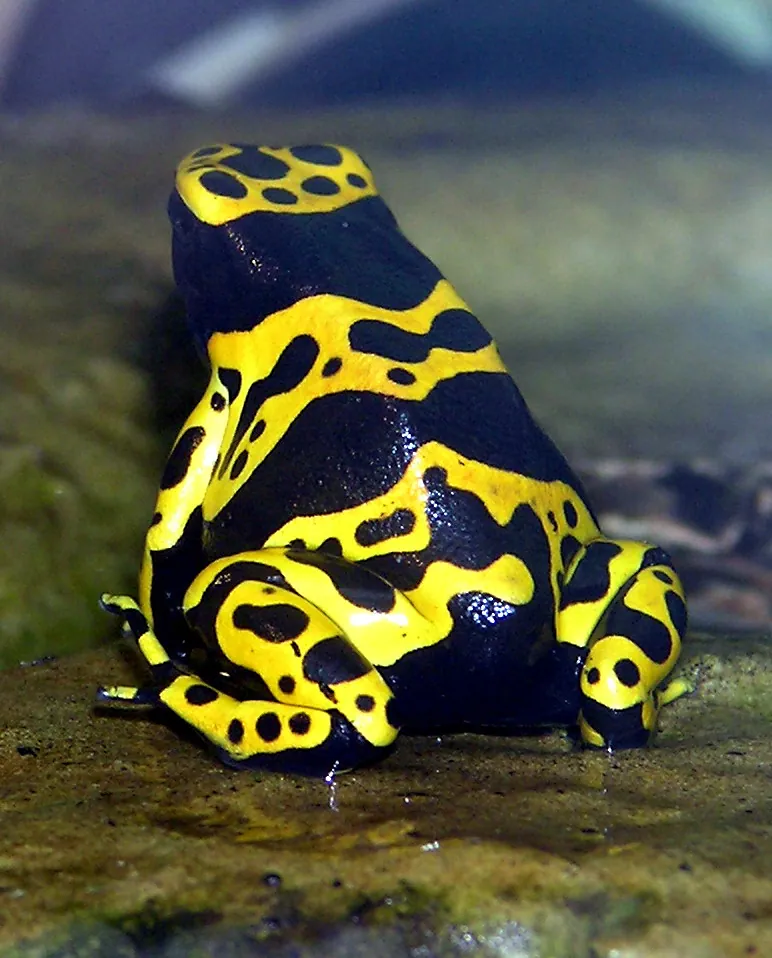
The yellow-banded poison dart frog is a small, brightly coloured frog from the northern part of South America. It lives in wet tropical rainforests, close to fresh water. Its bright warning colours show that its skin is toxic to eat or touch.1

 No anndirto nde
- Predominantly bright yellow, with varying numbers of broad black stripes or spots over the whole body1
- Some individuals are orange instead of yellow1
- Markings range from fine spots to thick, unbroken bands1
- Small, with an average adult length rarely above 4 cm1
- Active during the day and lives in small groups1
Doole tooke
Nguru mum ko tooke. Ina bone memde nde, memde nde e ɗemngal walla ñaamde nde.
Hol ko tooke mum (memde walla ñaamde) waɗata?
This frog is poisonous rather than venomous, so it does not inject venom. Its skin secretes alkaloid toxins. Some of these are extremely potent neurotoxins, which attack the nerves, and they interfere with nerve impulses. This can lead to heart failure or fibrillation, which is an irregular heartbeat.1
Hol no nde woni bone e yimɓe?
Bone e yimɓe: Ina muusaIna waawi muusude sanne, kono ɓadii abada wonaa bone mawɗo.Hol ko nde waɗata si nde hulii?
Its bright yellow and black colouring is aposematic, a warning to predators that it is unpalatable or toxic to eat.1
 Si neɗɗo memii nde walla ñaamii nde
- Si neɗɗo memii gooto: lootu juuɗe moƴƴa, taa memu gite walla hunnduko. Si ɓiɗɗo walla dabbaare galle memii gooto e ɗemngal walla ñaamii nde: noddu nokku ballal tooke walla lamba ballal yaawngal.
Sahaa fof, noddu lamba ballal yaawngal (112, 000, 911) ko adii. Ɗum ko ballal arano kuuɓal, wonaa wasiyya doktaa. Aslu ballal arano
 Reen hoore maa
- Taa memu, taa nanngu, taa aaɓnu dabbaare ladde abada, hay pamaro, hay si ina wayi no ɗaanii walla maayii.
- Accu nde nokku. Si a fottii e gooto, deeƴu, ruttu caggal seeɗa seeɗa, accu nde yaha laawol mum.
- Si a memii nde walla a ñaamii nde: taa momtu gite maa walla hunnduko maa, lootu juuɗe maa, heɓu ballal doktaa.
Nde ɗaɓɓaaki ma. Tooke mum ina woodi tan ngam taa huunde ñaama nde. Ɓeydu anndude no reentorto
Hol to e aduna?
Hol no nde mawni?
Hol no nde juuti?
 ɓuri famɗude njuuteendi feɗeendu maa pamaru
 ina waawi dogde meeter 100 nder sakan 97 (neɗɗo ɓurɗo yaawde ina haani 9,6)
Hol no Yellow-banded poison dart frog mawni, fottindaade e AAN?
Hiisa tan nder browser maa. Alaa ko mooftetee walla ko neletee.
Hol no nde yaawi?


Anndal
It is the only poison dart frog known to estivate, which means going into a dormant state, during dry spells.1
Its toxins come from the arthropods it eats, so the frog's poison depends on its diet.1
It can cope with lower humidity better than other species in its genus, although it still prefers humid conditions.1
It is easy to breed in captivity, which has helped lower prices in the pet trade.1
It is one of the largest species in its genus, Dendrobates.1
Ɗo anndal iwi
- Yellow-banded poison dart frog (Wikipedia (CC BY-SA 4.0))
- Dendrobates leucomelas (iNaturalist): inɗe e tolnugol.
- Venom Wiki: darja bone, mawnude woowaaɗo e miijo yaawre ko amen. Ndaar no min hiisirta ɗum: No min betiri bone.
Kala anndal e ngoo hello ina jogii limre hollirnde iwdi mum. Si min juumii, accu min, min yiɗɓe dabbaaji, wonaa jaridaa ganndal. Wiy min e [email protected] min feewnitay.
 Yaare nden ina heege! Venom Wiki ko golle neɗɗo gooto: meere, tawa tallaaji alaa, trackers alaa. Ballal pamarngal ina walla heddinde ɗum e internet.Ñaamnu yaare nden
Goɗɗi e fedde wootere: Kwaɗoji tooke, kwaɗoji mawɗi e newt
 Paaɓi tooke kaŋŋeKwaɗoji tooke, kwaɗoji mawɗi e newtWarooɗoTaa memu
 Cane toadKwaɗoji tooke, kwaɗoji mawɗi e newtIna haani doktaaTaa memu
 Dyeing poison dart frogKwaɗoji tooke, kwaɗoji mawɗi e newtIna muusa tanTaa memu
 Black-legged poison frogKwaɗoji tooke, kwaɗoji mawɗi e newtIna waawi wardeTaa memu
 Bruno's casque-headed frogKwaɗoji tooke, kwaɗoji mawɗi e newtIna haani doktaaTaa memu
 Harlequin poison frogKwaɗoji tooke, kwaɗoji mawɗi e newtIna haani doktaaTaa memu
 Terciopelo
 Brazilian wandering spider
 Eyelash viper
 Golden lancehead
 South American bushmaster
 Peruvian giant centipede