
 Afirik
 Asiya
Asiya Turai
Turai Amerik Worgo
 Australiya e Oseaniya
 Antarktika
 Baharu Pasifik
 Baharu Atlantik
 Baharu Indiya
 Baharu Arktik
 Baharu Mediterane
 Baharu Boɗeeru
 Baharu Karibiya
 Baharu Koral
 Baharu Ciina Worgo
 Baharu Filipin
 Baharu Andaman
 Baharu Rewo
 Baharu Timor e Arafura
 Baharu Bengal
 Baharu Kaliforniya
Yellow-spotted monitor
 Ina ŋata
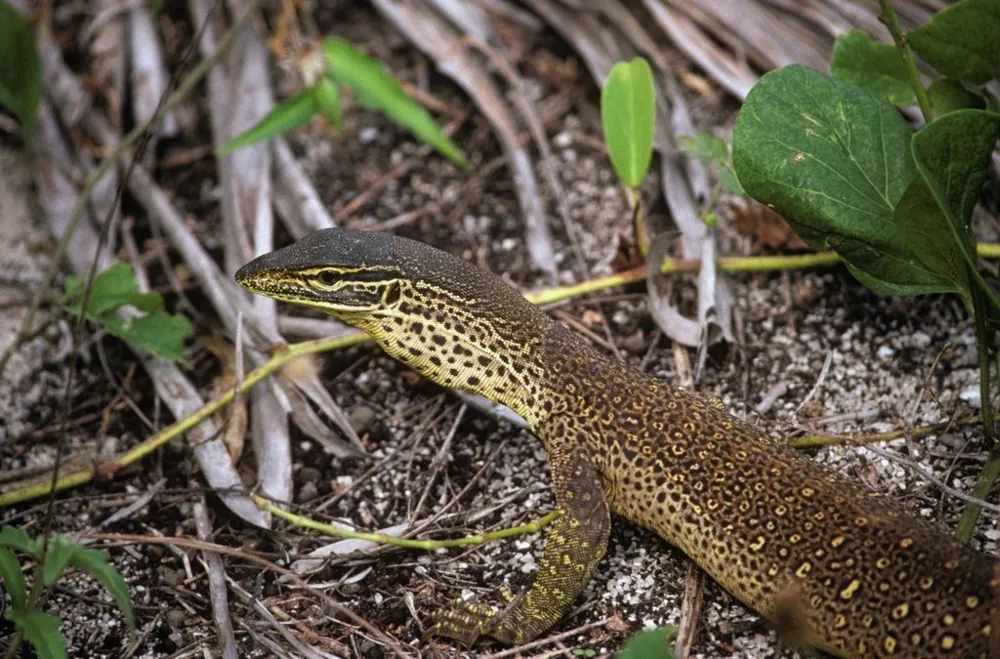
The yellow-spotted monitor is a large, fast lizard that lives in northern and western Australia and southern New Guinea. It is one of Australia's biggest lizards, and it plays an important part in its ecosystem as a predator. It can give a painful bite if it feels threatened.1



 No anndirto nde
- Most individuals are yellow, with a brown or dark tan background.1
- Large, dark spots form rows along the back, and they are most distinct in the middle of the back.1
- Bands of colour appear toward the tip of the tail.1
- Adults are large: females average about 90 cm long and males about 120 to 150 cm.1
- Colour varies between individuals and places. The subspecies rubidus is reddish rather than brown.1
Ina jiiɓindiree e: The sand goanna (Varanus gouldii) somewhat resembles the yellow-spotted monitor.1
Doole tooke
Tooke ina yalta e ñiiƴe mum si nde ŋatii.
Hol no nde woni bone e yimɓe?
Bone e yimɓe: Ina muusaIna waawi muusude sanne, kono ɓadii abada wonaa bone mawɗo.Hol ko nde waɗata si nde hulii?
When threatened, it raises itself up on its hind legs and supports itself with its tail, which lets it watch for danger. It can also run up to 100 metres to a tree or burrow.1
 Si nde ŋatii
- Lootu barme, deeƴin neɗɗo oo, heɓu ballal doktaa.
Sahaa fof, noddu lamba ballal yaawngal (112, 000, 911) ko adii. Ɗum ko ballal arano kuuɓal, wonaa wasiyya doktaa. Aslu ballal arano
 Reen hoore maa
- Taa memu, taa nanngu, taa aaɓnu dabbaare ladde abada, hay pamaro, hay si ina wayi no ɗaanii walla maayii.
- Accu nde nokku. Si a fottii e gooto, deeƴu, ruttu caggal seeɗa seeɗa, accu nde yaha laawol mum.
- Si gooto e majji ŋatii ma: deeƴu, taa dillu, noddu lamba ballal yaawngal (112, 000, 911) walla yah asibiti law. Siftor no nde wayri, foto ina walla.
Nde ɗaɓɓaaki ma. Nde huutora tooke mum ngam nanngude ñaamdu walla reende hoore mum, nde ɓuri yiɗde suuɗaade. Ɓeydu anndude no reentorto
Hol to e aduna?
Hol no nde mawni?
Hol no nde juuti?
Hol no nde teddi?
 juuti no ullundi galle 3, hinere haa laaci
 juuti no ayaba 9 jokkondiraaɗiteddi ɓadii no ullundu galle
 ina waawi dogde meeter 100 nder sakan 24 (neɗɗo ɓurɗo yaawde ina haani 9,6)
Hol no Yellow-spotted monitor mawni, fottindaade e AAN?
Hiisa tan nder browser maa. Alaa ko mooftetee walla ko neletee.
Hol no nde yaawi?

Anndal
The yellow-spotted monitor digs some of the deepest burrows known for any vertebrate, with an average depth of 2.6 m as of 2015.1
During the dry season, it has been recorded diving underwater to feed on freshwater mussels.1
Argus monitors can mature sexually in less than a year, which is much faster than most other large monitors, which usually take 2 or more years.1
Several individuals may share one interconnected system of burrows, called a warren. One study found at least 6 individuals using the same warren.1
It is the third largest lizard in Australia, after the perentie and the lace monitor.1
Its sense of smell is its sharpest sense, and it flicks its forked tongue to search for food, much as snakes do.1
Ɗo anndal iwi
- Yellow-spotted monitor (Wikipedia (CC BY-SA 4.0))
- Varanus panoptes (iNaturalist): inɗe e tolnugol.
- Venom Wiki: darja bone, mawnude woowaaɗo e miijo yaawre ko amen. Ndaar no min hiisirta ɗum: No min betiri bone.
Kala anndal e ngoo hello ina jogii limre hollirnde iwdi mum. Si min juumii, accu min, min yiɗɓe dabbaaji, wonaa jaridaa ganndal. Wiy min e [email protected] min feewnitay.
 Yaare nden ina heege! Venom Wiki ko golle neɗɗo gooto: meere, tawa tallaaji alaa, trackers alaa. Ballal pamarngal ina walla heddinde ɗum e internet.Ñaamnu yaare nden
 Lace monitor
 Perentie
 Spiny-tailed monitor
 Mitchell's water monitor
 Komodo dragon
 Gila monster
 Taipan takko baharu
 Death adder
 Brown snake fuɗnaange
 Taayipan joornde (Inland taipan)
 Gizo-gizo funnel-web Sydney
 Mboddi Cewngu