
 Afrik
Afrik Aazi
Aazi Orop
Orop Amerik Worgo
 Ostaraali e Oseyaani
 Antarktik
 Geec Pasifik
 Geec Atlantik
 Geec Enndo
 Geec Arktik
 Geec Mediteraane
 Geec Boɗeejo
 Geec Karayib
 Geec Korayl
 Geec Siin Worgo
 Geec Filipiin
 Geec Andaman
 Geec Rewo
 Geec Timor e Arafura
 Gulf Bengal
 Gulf Kaliforni
Golfodulcean poison frog
 Tooke e nguru mum
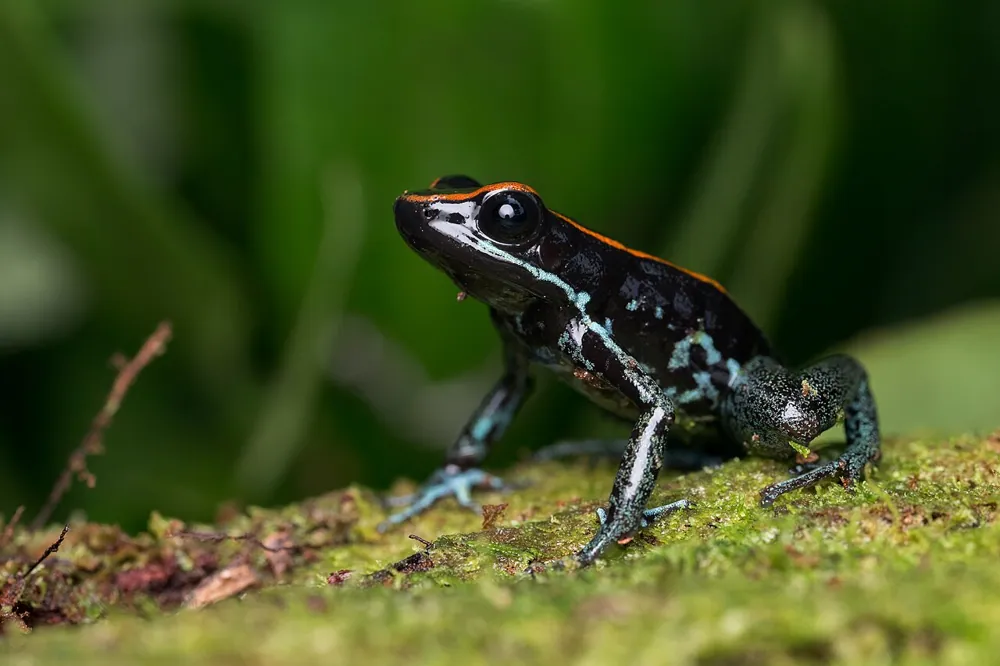
The Golfodulcean poison frog is a small, brightly marked frog that lives only in Costa Rica. Its skin contains a strong nerve poison, so it is one of the most toxic frogs in its genus, and it is a reminder that bright colours can be a warning. It lives in wet forests near streams.1

 No anndirte ngal
- The body is black, but it can look glittery because of pigments in the skin.1
- Two stripes run down the back from just above the vent to the tip of the nose. They are usually fire orange, but can be golden, yellow or green.1
- The legs are mottled blue, and the sides often have a blue or green marble pattern.1
- It is a fairly large poison frog for its genus, with a smooth, sloping back. Its shoulder blades are usually hidden under the skin, so it can look a little plump.1
- Females are typically larger than males. Adults reach about 3.5 cm long.1
Ina heewi waylondireede e: The related P. bicolor and P. terribilis have visible shoulder blades under the skin, which the Golfodulcean poison frog usually lacks, so it looks smoother and rounder.1
Doole tooke ɓanndu
Nguru mum ina jogii tooke. Ina bonna so meemaama, lakkaama walla ñaamaama.
Hol ko tooke ɓanndu mum waɗata?
Its skin contains batrachotoxin, a neurotoxic alkaloid poison, which attacks the nerves. A large enough dose causes severe pain, then tonic-clonic seizures (violent convulsions) and paralysis.1
Hol no bone mum heewiri e yimɓe?
Bone e yimɓe: MuusɗoIna waawi muusde sanne, kono hertaani wonde huunde mawnde.It is highly toxic, though it is only the fourth most toxic species in the genus Phyllobates. The poison is in the skin, so the risk comes from handling the frog or getting the poison from its skin into the body.1
Hol ko ngal waɗata so ina hula?
Its bright, multi-coloured body advertises its toxin as a warning to predators.1
 So neɗɗo meemii ngal walla ñaamii ngal
- So neɗɗo meemii gooto: loot juuɗe ɗee no moƴƴiri, wota a meem gite walla hunduko. So cukalel walla kullal galle lakkii walla ñaamii gooto: noddu centre antipoison walla nimero urgence.
Adii fof noddu nimero urgence (112, 000, 911). Ɗum ko anndinal ballal adiingal, wonaa saaraangal doktoor. Ko adii e ballal adiingal
 Reen hoore maa
- Wota a meem, wota a nanngu, wota a ñiŋŋu kullal ladde haa abada, hay so ngal ina famɗi, hay so ina nanndi e ɗaaniingal walla maayngal.
- Accu ngal nokku. So a fotti e ngal, deƴƴu, ruttu ɓaawo seeɗa seeɗa, accu ngal yaha laawol mum.
- So a meemii ngal walla a ñaamii ngal: wota a moomtu gite maa walla hunduko maa, loot juuɗe maa, heɓ ballal cafrol.
Ngal faalaaka gaañde ma. Tooke mum woni tan ngam wota huunde ñaam ngal. Ɓeydu anndude no reentortoo
Hol to e aduna?
Hol no mawniri?
Hol no juutiri?
 hedde juutde no ñippirde kaayitaaje
 ina waawi taƴde 100 meeteer e segonde 100 (neɗɗo ɓurɗo yaawde ina sokli 9,6)
Hol no Golfodulcean poison frog mawniri, so fooɗondiraama e AN?
Limgal tan e navigatoor maa. Alaa ko danndetee walla ko neldetee.
Hol no yaawiri?


Humpito
It is one of the few frogs whose poison is named batrachotoxin, a potent nerve toxin.1
Its climbing toe pads stick to leaves in a similar way to geckos, and it can climb out of an unsealed container.1
Male frogs carry their tadpoles on their backs, often for 1 to 2 days, to puddles, pools in palm leaves, or water-filled tree holes.1
Frogs in captivity have no toxin, which shows that their poison comes from what they eat.1
Its skin holds a large amount of poison, because it is comparatively large for a poison dart frog.1
The tadpoles become frogs after about 45 days, and the young frogs become sexually mature after ten months.1
Ngam ganduɓe tooke
- Innde ganndal
- Phyllobates vittatus
- Fedde
- Ñaari tooke, ñaari e newts
- Ɓesngu
- Dendrobatidae2
- Ordre
- Anura
- Leyɗe mawɗe
- Amerik Rewo
- Ɓiɓɓe tokooso
- During the breeding season, the female lays 7 to 21 eggs per clutch on leaves, about every one or two weeks, and the male guards the eggs and carries the hatched tadpoles on his back to water.1
- Bone e yimɓe
- 2 / 5: Muusɗo3
Ɗo humpito iwri
- Golfodulcean poison frog (Wikipedia (CC BY-SA 4.0))
- Phyllobates vittatus (iNaturalist): inɗe e ceergal.
- Venom Wiki: tolno bone, mawnude heewnde e miijo yaawde ko amen. Yiy no men keɓirta ɗum: No men tolnirta bone.
Kala humpito e ngoo hello ina jogii limoore hollirnde iwdi mum. So men juumii, yaafo, men ko yiɗɓe kulle, wonaa jaaynde ganndal. Wiy men e [email protected], men feewnita.
 Yaare nden ina weelaa! Venom Wiki ko golle neɗɗo gooto: yoɓetaake, alaa ko jeeyetee, alaa rewɓe. Ndokkal seeɗa ina walla ngam heddude e enternet.Ñaam yaare nden
Goɗɗe e nder fedde wootere: Ñaari tooke, ñaari e newts
 Cane toadÑaari tooke, ñaari e newtsIna sokli doktoorWota a meem
 Strawberry poison-dart frogÑaari tooke, ñaari e newtsIna muusi tanWota a meem
 California newtÑaari tooke, ñaari e newtsIna waawi wardeWota a meem
 Rough-skinned newtÑaari tooke, ñaari e newtsIna waawi wardeWota a meem
 Colorado River toadÑaari tooke, ñaari e newtsIna sokli doktoorWota a meem
 Panamanian golden frogÑaari tooke, ñaari e newtsIna sokli doktoorWota a meem
 Terciopelo
 Eastern coral snake
 Eastern diamondback rattlesnake
 Eyelash viper
 Timber rattlesnake
 Western diamondback rattlesnake