
 Afrik
Afrik Aazi
Aazi Orop
Orop Amerik Worgo
 Ostaraali e Oseyaani
 Antarktik
 Geec Pasifik
 Geec Atlantik
 Geec Enndo
 Geec Arktik
 Geec Mediteraane
 Geec Boɗeejo
 Geec Karayib
 Geec Korayl
 Geec Siin Worgo
 Geec Filipiin
 Geec Andaman
 Geec Rewo
 Geec Timor e Arafura
 Gulf Bengal
 Gulf Kaliforni
Spotted ratfish
 Gaaɗe tooke
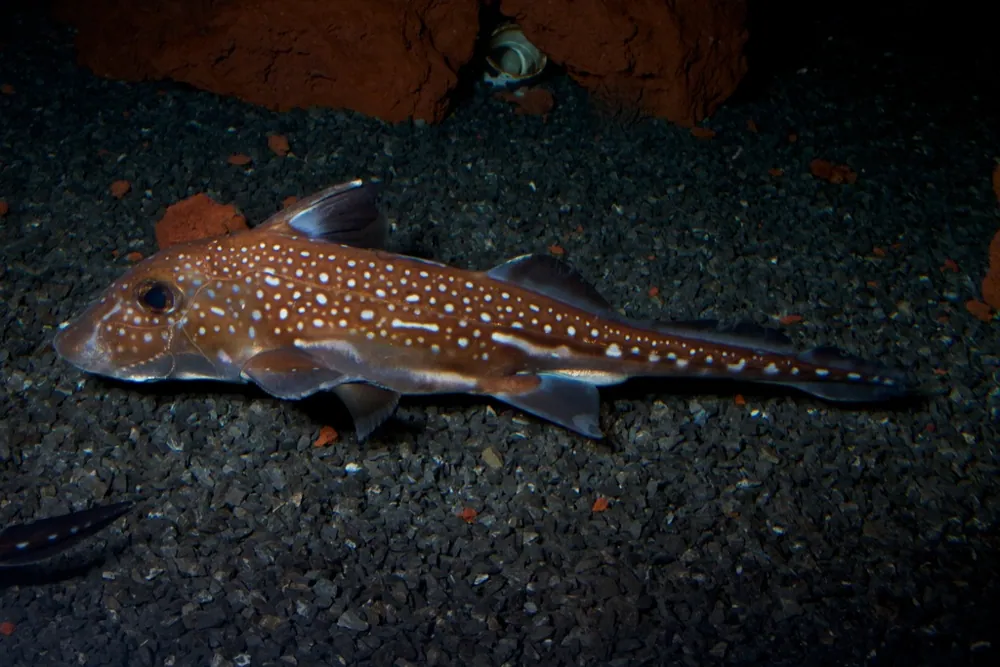
The spotted ratfish is a chimaera, a cartilage fish related to sharks and rays. It lives in the northeastern Pacific Ocean, and divers often see it at night in the Pacific Northwest. It gets its name from its pointed, rat-like tail.1



 No anndirte ngal
- Smooth, scaleless skin that is silvery-bronze, often with gold, blue and green shine1
- Speckled white spots along the back1
- Large, triangular pectoral fins that stick straight out from the sides, like airplane wings1
- A pointed, rat-like tail that makes up almost half of its total length1
- Large emerald green eyes and a duckbill-shaped snout1
Doole tooke
Gaaɗe ceeɓɗe ina ndondii tooke. Yaabde e mum walla nanngude ɗum ina muusi.
Hol ko tooke ŋatgol mum waɗata?
The spine on the leading edge of its dorsal fin is grooved and connected to a venom gland at its base. The venom is mildly toxic. A sting from the spine causes a painful wound.1
Hol no bone mum heewiri e yimɓe?
Bone e yimɓe: MuusɗoIna waawi muusde sanne, kono hertaani wonde huunde mawnde.It does not present a serious danger to humans, but its spines can cause painful wounds. Harbor seals have been known to die after swallowing spotted ratfish, when a spine pierced the stomach or esophagus.1
Hol ko ngal waɗata so ina hula?
It usually keeps a safe distance from divers and is not aggressive, but it will defend its territory with the spine on its dorsal fin if it feels invaded.1
 So gaaɗe mum tuƴii ma
- Naatnu gaañande nden e ndiyam guleeɗam, guleeɗam no neɗɗo oo waawi muññude tawa sumaani (ƴeewr ɗum e jungo maa), hojomaaji 30 haa 90. Heɓ ballal cafrol, ɓuri noon ngam liƴƴi kaaƴe e liƴƴi raay.
Adii fof noddu nimero urgence (112, 000, 911). Ɗum ko anndinal ballal adiingal, wonaa saaraangal doktoor. Ko adii e ballal adiingal
 Reen hoore maa
- Wota a meem, wota a nanngu, wota a ñiŋŋu kullal ladde haa abada, hay so ngal ina famɗi, hay so ina nanndi e ɗaaniingal walla maayngal.
- Accu ngal nokku. So a fotti e ngal, deƴƴu, ruttu ɓaawo seeɗa seeɗa, accu ngal yaha laawol mum.
- So gaaɗe mum tuƴii ma: deƴƴu, wota a dillu, noddu nimero urgence (112, 000, 911) walla yahu opitaal law. Jogo e hakkille no ngal nanndi, natal ina walla.
Ngal faalaaka gaañde ma. Ina huutoroo tooke mum ngam nanngude ñaamdu walla reenaade, ina ɓuri yiɗde suuɗaade. Ɓeydu anndude no reentortoo
Hol no mawniri?
Hol no juutiri?
 juutde no ulluuɗi galle 2, hinere haa lawol
 juutde no banaanaaji 5 sammondiraaɗi
 ina waawi yoowde juuteendi pisin mawɗo (50 m) e segonde 12
Hol no Spotted ratfish mawniri, so fooɗondiraama e AN?
Limgal tan e navigatoor maa. Alaa ko danndetee walla ko neldetee.
Hol no yaawiri?

Humpito
Adult males have a club-like cephalic clasper on the head, an organ not found in any other vertebrate, which they use to hold on to females during courtship.1
Its large eyes reflect light, much like the eyes of a cat.1
It swims with its large pectoral fins, and its barrel rolls and corkscrew turns have been described as aquatic flight.1
Its teeth are plate-shaped, mineralised and permanent, unlike the easily replaced teeth of sharks, and they help it grind prey.1
Its ampullary organs on the head detect electric fields, and they are homologous to the ampullae of Lorenzini found in sharks and rays.1
Its meat is not typically eaten by humans and it is not commercially caught.1
Ngam ganduɓe tooke
- Innde ganndal
- Hydrolagus colliei
- Fedde
- Liƴƴi jogiiɗi tooke
- Ɓesngu
- Chimaeridae2
- Ordre
- Chimaeriformes
- Leyɗe mawɗe
- Geec Pasifik, Gulf Kaliforni, Geece mawɗe
- Ɓiɓɓe tokooso
- Like some sharks, it lays eggs; the female releases up to two fertilised eggs every 10–14 days in spring to autumn, and development can take up to a year.1
- Bone e yimɓe
- 2 / 5: Muusɗo3
Ɗo humpito iwri
- Spotted ratfish (Wikipedia (CC BY-SA 4.0))
- Hydrolagus colliei (iNaturalist): inɗe e ceergal.
- Venom Wiki: tolno bone, mawnude heewnde e miijo yaawde ko amen. Yiy no men keɓirta ɗum: No men tolnirta bone.
Kala humpito e ngoo hello ina jogii limoore hollirnde iwdi mum. So men juumii, yaafo, men ko yiɗɓe kulle, wonaa jaaynde ganndal. Wiy men e [email protected], men feewnita.
 Yaare nden ina weelaa! Venom Wiki ko golle neɗɗo gooto: yoɓetaake, alaa ko jeeyetee, alaa rewɓe. Ndokkal seeɗa ina walla ngam heddude e enternet.Ñaam yaare nden
Goɗɗe e nder fedde wootere: Liƴƴi jogiiɗi tooke
 Reef stonefishLiƴƴi jogiiɗi tookeIna waawi wardeWota a meem
 Red lionfishLiƴƴi jogiiɗi tookeIna sokli doktoorWota a meem
 Estuarine stonefishLiƴƴi jogiiɗi tookeIna waawi wardeWota a meem
 Short-tail stingrayLiƴƴi jogiiɗi tookeIna waawi warde
 Striped eel catfishLiƴƴi jogiiɗi tookeIna waawi wardeWota a meem
 Bluespotted ribbontail rayLiƴƴi jogiiɗi tookeIna sokli doktoor
Ina wuuri kadi e: Geec Pasifik
 Australian box jellyfishMeduusaaji e kulle geec jukkoojeBareejoWota a meem
 Geography coneKokiyaas kone e pulpuujiBareejo
 Greater blue-ringed octopusKokiyaas kone e pulpuujiBareejo
 Japanese pufferfishKulle goɗɗe jogiiɗe tooke ɓannduBareejo
 Southern blue-ringed octopusKokiyaas kone e pulpuujiBareejo
 Hawksbill sea turtleKulle goɗɗe jogiiɗe tooke ɓannduIna waawi warde