
 Africa
 Asia
Asia Ulaya
Ulaya Amereka ya Kumwera
 Australia ndi Oceania
 Antarctica
 Nyanja ya Pacific
 Nyanja ya Atlantic
 Nyanja ya Indian
 Nyanja ya Arctic
 Nyanja ya Mediterranean
 Nyanja Yofiira
 Nyanja ya Caribbean
 Nyanja ya Coral
 Nyanja ya South China
 Nyanja ya Philippine
 Nyanja ya Andaman
 Nyanja ya Kumpoto (North Sea)
 Nyanja ya Timor ndi Arafura
 Nyanja ya Bengal
 Gulf ya California
Black-banded jumper ant
 Imalasa
The black-banded jumper ant is a large ant that can leap up to 10 centimetres, which is far above its own body length. It lives in eastern Australia, including suburbs of Sydney and Brisbane. Its sting is painful and can cause serious allergic reactions in some people, so it is worth knowing how to recognise it.1



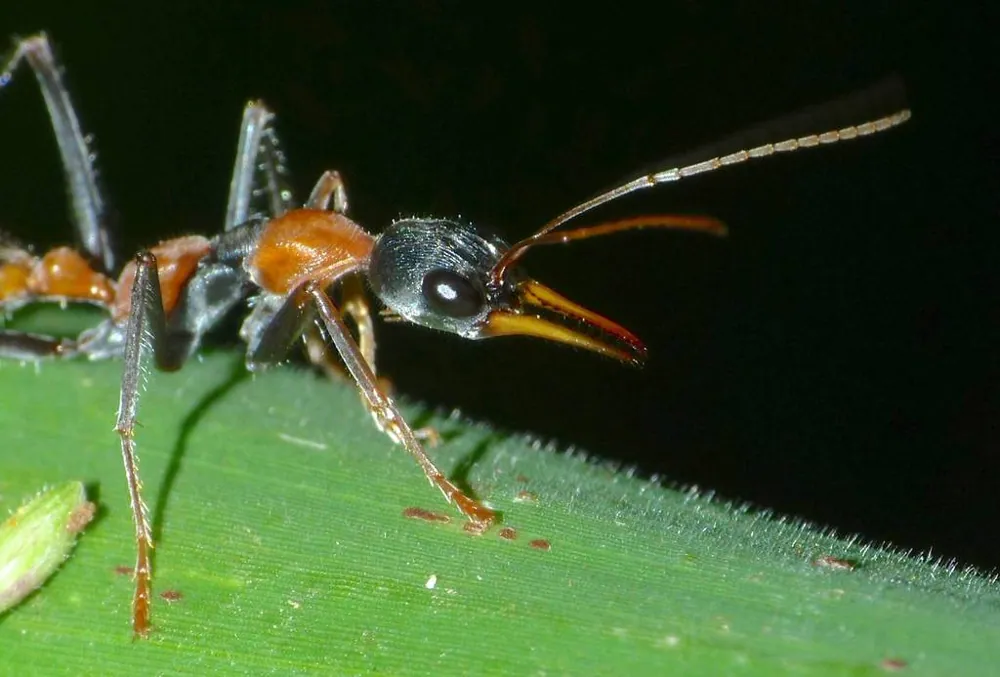
 Mmene ungaizindikirire
- Mostly black and orange-red in colour.1
- The gaster (rear body), head, legs and mesonotum (middle back) are black, while the pronotum, propodeum, petiole and post-petiole are red.1
- Mandibles (jaws) are either black or yellow, depending on where the ant lives.1
- Workers are 13 to 15 mm long, males 16 to 17 mm, and queens 17 to 19 mm.1
- It can leap 76 to 102 mm by suddenly extending its middle and hind legs.1
Nthawi zambiri imasokonezedwa ndi: It is often confused with other Myrmecia species. It can be told apart by its bi-coloured thorax and post-petiole, which are yellowish-red and black, and by its yellowish-red node.1
Mphamvu ya ululu
Ululu umatuluka kudzera mu mbola.
Ululu wake umachita chiyani?
Its sting is highly venomous and causes intense burning pain. The burning can last for many days, and the sting itches. If the sting is left untreated, it may develop into an ulcer (an open sore). The venom of a close relative, M. pilosula, is among the strongest of all ants and contains acids, enzymes and phospholipases.1
Ndi yoopsa bwanji kwa anthu?
Ngozi kwa anthu: YopwetekaIngathe kupweteka kwambiri, koma pafupifupi nthawi zonse si vuto lalikulu.A 2011 study of Australian ant allergies found that 265 of 376 participants reacted to the stings of several Myrmecia species, which can cause anaphylaxis (a severe, whole-body allergic reaction). Of these, 15 reacted to this species, while 176 reacted to M. pilosula. The study concluded that Myrmecia species were among four main groups of Australian ants responsible for anaphylaxis.1
Imachita chiyani ikachita mantha?
When threatened, workers and scouts quickly defend the nest and may react aggressively even to a shadow crossing it, bursting out in short hops to attack.1
 Ikalasa
- Sambitsa ndi kuziziritsa pamene walasidwa.
- Ngati munthuyo akuvutika kupuma, nkhope kapena khosi zikutupa, kapena akumva ngati akomoka, ndi vuto ladzidzidzi la ziwengo (allergy): imbira nambala yadzidzidzi.
Nthawi zonse yamba wayimbira nambala yadzidzidzi (112, 000, 911). Awa ndi malangizo wamba a chithandizo choyamba, osati malangizo a dokotala. Zoyambira za chithandizo choyamba
 Khala wotetezeka
- Usakhudze, kugwira kapena kuseweretsa nyama yakuthengo, ngakhale yaing'ono, ndipo ngakhale ikuoneka ngati yagona kapena yafa.
- Ipatse malo. Ukakumana nayo, khala chete, bwerera m'mbuyo pang'onopang'ono ndipo uilole ipite njira yake.
- Ikakulasa: khala chete, usasunthe, imbira nambala yadzidzidzi (112, 000, 911) kapena pita kuchipatala mwachangu. Kumbukira m'mene inkaonekera, chithunzi chimathandiza.
Sikufuna kukuvulaza. Imagwiritsa ntchito ululu wake kugwira chakudya kapena kudziteteza, ndipo imakonda kwambiri kubisala. Zambiri za kukhala wotetezeka
Kuti padziko lapansi?
Ndi yaikulu bwanji?
Ndi yaitali bwanji?
 yaifupi kuposa chala chako chaching'ono
Black-banded jumper ant ndi yaikulu bwanji poyerekeza ndi IWE?
Ndi masamu chabe mu msakatuli wako. Palibe chomwe chimasungidwa kapena kutumizidwa kwina.
Imathamanga bwanji?


Mfundo
It can jump between 76 and 102 mm, which is far more than its own body length.1
Colonies can continue without a queen, because workers can lay fertile eggs.1
It often forages in trees, where it visits the flowers of some eucalyptus and senna plants and may help pollinate them.1
A worker can live for over a year, with a maximum of about 1.3 years.1
Its nests are camouflaged with twigs, leaves, gravel and other plant material.1
Za akatswiri a ululu
- Dzina la sayansi
- Myrmecia nigrocincta
- Gulu
- Nyerere
- Banja
- Formicidae2
- Dongosolo
- Hymenoptera
- Makontinenti
- Australia ndi Oceania
- Ana akhanda
- Worker-laid eggs can be reared into males in colonies with no queen. Colonies typically have between 400 and 1200 individuals.1
- Kutalika kwa moyo
- pafupifupi zaka 1,31
- Ngozi kwa anthu
- 2 / 5: Yopweteka3
Kumene mfundo zimachokera
- Myrmecia nigrocincta (Wikipedia (CC BY-SA 4.0))
- Myrmecia nigrocincta (iNaturalist): mayina ndi magulu a sayansi.
- Venom Wiki: mlingo wa ngozi, kukula wamba ndi kuyerekeza kwa liwiro ndi zathu. Ona mmene timazipezera: Mmene timayezera ngozi.
Mfundo iliyonse patsamba lino ili ndi nambala yosonyeza kochokera. Ngati talakwitsa, pepani, ndife okonda nyama, osati magazini a sayansi. Tiuze pa [email protected] ndipo tikonza.
 Chinkhanira chili ndi njala! Venom Wiki ndi ntchito ya munthu mmodzi: yaulere, yopanda zotsatsa ndi zokutsatira. Mphatso yaing'ono imathandiza kuti ikhalebe pa intaneti.Dyetsa chinkhanira
 Bulldog ant
 Jack jumper ant
 Green weaver ant
 Giant bull ant
 Green-head ant
 Inchman ant
 Coastal taipan
 Common death adder
 Eastern brown snake
 Taipani wa kumtunda
 Sydney funnel-web spider
 Njoka ya mizere ngati nyalugwe