
 Africa
 Asia
Asia Ulaya
Ulaya Amereka ya Kumwera
 Australia ndi Oceania
 Antarctica
 Nyanja ya Pacific
 Nyanja ya Atlantic
 Nyanja ya Indian
 Nyanja ya Arctic
 Nyanja ya Mediterranean
 Nyanja Yofiira
 Nyanja ya Caribbean
 Nyanja ya Coral
 Nyanja ya South China
 Nyanja ya Philippine
 Nyanja ya Andaman
 Nyanja ya Kumpoto (North Sea)
 Nyanja ya Timor ndi Arafura
 Nyanja ya Bengal
 Gulf ya California
Brazilian wandering spider
 Imaluma
The Brazilian wandering spider is a large, hairy spider whose bite is medically significant. It lives in parts of South America, including Brazil, Uruguay, Paraguay and Argentina, and it is often found near homes. Its bite can cause severe pain and dangerous effects on the heart and breathing.1



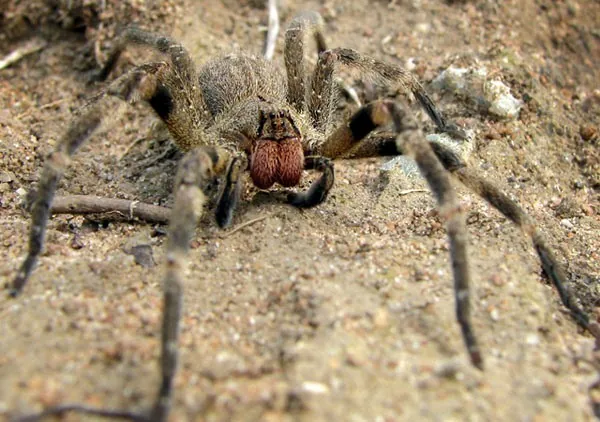
 Mmene ungaizindikirire
Mphamvu ya ululu
Ululu umatuluka kudzera m'mano ake ikaluma.
Ululu wake umachita chiyani?
The venom contains neurotoxic peptides, which attack the nerves. These act as calcium channel blockers that disrupt how nerve cells send signals. The venom also causes intense pain and inflammation. At deadly concentrations it causes loss of muscle control, breathing problems, paralysis and eventual asphyxiation. Other symptoms reported include priapism, a rapid heartbeat, irregular heartbeat, cardiogenic shock, fluid in the lungs and convulsions.1
Ndi yoopsa bwanji kwa anthu?
Ngozi kwa anthu: Yoopsa kwambiriIngathe kupha munthu amene sanalandire chithandizo.Its bite can be life-threatening, and several deaths are documented. Between 1925 and 1945, 415 bites by this species were recorded, and 400 of those people needed antivenom. The spider can give a dry bite with no venom, or a bite with only a small dose.1
 Nkhani yabwino: madokotala ali ndi mankhwala (antivenom) kapena chithandizo cha ichi.1
Imachita chiyani ikachita mantha?
When threatened, it raises its first two pairs of legs as a warning.1
 Ikaluma
- In the documented cases, victims were treated in hospital with anaesthetics, tetanus prophylaxis, antivenom and fluid replacement. Recovery could take about 36 hours after a bite.1
- Sambitsa polumidwapo ndipo ikapo paketi ya ayezi kuti uchepetse kupweteka. Peza thandizo la dokotala ngati kupweteka kuli kwakukulu, kukufalikira kapena munthuyo sakumva bwino.
Nthawi zonse yamba wayimbira nambala yadzidzidzi (112, 000, 911). Awa ndi malangizo wamba a chithandizo choyamba, osati malangizo a dokotala. Zoyambira za chithandizo choyamba
 Khala wotetezeka
- Usakhudze, kugwira kapena kuseweretsa nyama yakuthengo, ngakhale yaing'ono, ndipo ngakhale ikuoneka ngati yagona kapena yafa.
- Ipatse malo. Ukakumana nayo, khala chete, bwerera m'mbuyo pang'onopang'ono ndipo uilole ipite njira yake.
- Ikakuluma: khala chete, usasunthe, imbira nambala yadzidzidzi (112, 000, 911) kapena pita kuchipatala mwachangu. Kumbukira m'mene inkaonekera, chithunzi chimathandiza.
Sikufuna kukuvulaza. Imagwiritsa ntchito ululu wake kugwira chakudya kapena kudziteteza, ndipo imakonda kwambiri kubisala. Zambiri za kukhala wotetezeka
Kuti padziko lapansi?
Ndi yaikulu bwanji?
Ndi yaitali bwanji?
 yaifupi kuposa chala chako chaching'ono
 ingathamange mamita 100 m'masekondi 170 (munthu wothamanga kwambiri amafunika 9.6)
Brazilian wandering spider ndi yaikulu bwanji poyerekeza ndi IWE?
Ndi masamu chabe mu msakatuli wako. Palibe chomwe chimasungidwa kapena kutumizidwa kwina.
Imathamanga bwanji?


Mfundo
A venom component called Tx2-6 is being studied for use in treatments for erectile dysfunction.1
Humans may be about ten times more sensitive to the venom than mice.1
Females may attack males after mating.1
Males perform a dance to attract females, and males may fight each other during courtship.1
Females can store sperm in a separate chamber until they are ready to fertilise their eggs.1
The average venom yield is 1.25 mg, and 0.4 mg in winter.1
Kumene mfundo zimachokera
- Phoneutria nigriventer (Wikipedia (CC BY-SA 4.0))
- Phoneutria nigriventer (iNaturalist): mayina ndi magulu a sayansi.
- Venom Wiki: mlingo wa ngozi, kukula wamba ndi kuyerekeza kwa liwiro ndi zathu. Ona mmene timazipezera: Mmene timayezera ngozi.
Mfundo iliyonse patsamba lino ili ndi nambala yosonyeza kochokera. Ngati talakwitsa, pepani, ndife okonda nyama, osati magazini a sayansi. Tiuze pa [email protected] ndipo tikonza.
 Chinkhanira chili ndi njala! Venom Wiki ndi ntchito ya munthu mmodzi: yaulere, yopanda zotsatsa ndi zokutsatira. Mphatso yaing'ono imathandiza kuti ikhalebe pa intaneti.Dyetsa chinkhanira
Zina za gulu lomwelo: Akangaude
 Amazon wandering spider
 Chilean recluse
 Golden silk orb-weaver
 Keyserling's wandering spider
 Argentine black widow
 Bahia wandering spider
Imakhalanso ku: Amereka ya Kumwera
 Golden poison frogAchule a poizoni, achule a mphini (toads) ndi ma newtYakuphaUsakhudze
 TerciopeloNjoka za pit viperYakupha
 Eyelash viperNjoka za pit viperIngathe kupha
 Golden lanceheadNjoka za pit viperIngathe kupha
 South American bushmasterNjoka za pit viperIngathe kupha
 Cane toadAchule a poizoni, achule a mphini (toads) ndi ma newtIkufuna dokotalaUsakhudze