
 Africa
 Asia
Asia Ulaya
Ulaya Amereka ya Kumwera
 Australia ndi Oceania
 Antarctica
 Nyanja ya Pacific
 Nyanja ya Atlantic
 Nyanja ya Indian
 Nyanja ya Arctic
 Nyanja ya Mediterranean
 Nyanja Yofiira
 Nyanja ya Caribbean
 Nyanja ya Coral
 Nyanja ya South China
 Nyanja ya Philippine
 Nyanja ya Andaman
 Nyanja ya Kumpoto (North Sea)
 Nyanja ya Timor ndi Arafura
 Nyanja ya Bengal
 Gulf ya California
Filament-finned stinger
 Minga yaululu
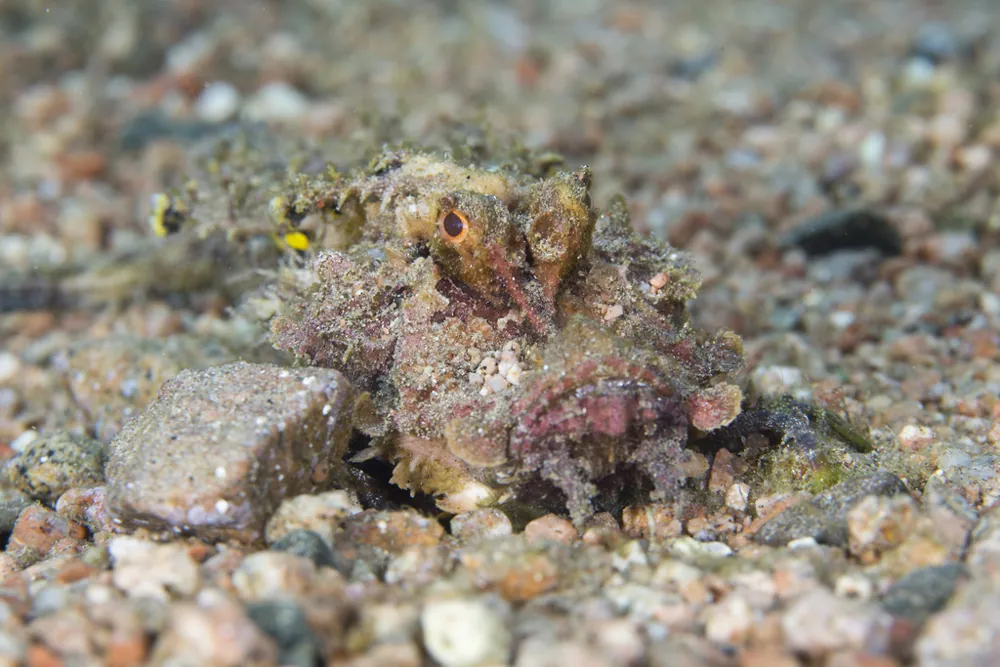
The filament-finned stinger is a well-camouflaged fish with venomous spines on its skin. It lives on sandy and silty seabeds in warm coastal waters, from the Red Sea and East Africa to the Maldives. It is easy to step on or touch by accident, so it is worth knowing what it looks like.1

 Mmene ungaizindikirire
- Body colour is dull yellow, grey, brown or rust, with light blotches that match the seabed1
- Skin has no scales along most of the body, but is covered in venomous spines and wart-like glands, giving a knobby look1
- Flattened, concave head, with the eyes, mouth and nostrils projecting upwards and outwards1
- Caudal (tail) fin has dark bands at its base and near its tip1
- Two pectoral fin rays are detached and angled downwards, and are used like legs1
Nthawi zambiri imasokonezedwa ndi: It is often confused with Inimicus sinensis, which is nearly identical. The key difference is on the underside of the pectoral fins: the black bands of this species are faint, while those of I. sinensis have yellow spots.1
Mphamvu ya ululu
Minga yakuthwa imanyamula ululu. Kuiponda kapena kuigwira kumapweteka.
Ndi yoopsa bwanji kwa anthu?
Ngozi kwa anthu: YoopsaMinga yake ikakubaya, pita kwa dokotala. Imfa ndi zosowa kwambiri.Imachita chiyani ikachita mantha?
When disturbed by a diver or a possible predator, it fans out its brightly coloured pectoral and tail fins as a warning, and it is very reluctant to leave its hiding place once dug in.1
 Minga yake ikakubaya
- Ika bala m'madzi otentha, otentha monga momwe munthuyo angapirire osapsa (yesa ndi dzanja lako), kwa mphindi 30 mpaka 90. Peza thandizo la dokotala, makamaka pa stonefish ndi stingray.
Nthawi zonse yamba wayimbira nambala yadzidzidzi (112, 000, 911). Awa ndi malangizo wamba a chithandizo choyamba, osati malangizo a dokotala. Zoyambira za chithandizo choyamba
 Khala wotetezeka
- Usakhudze, kugwira kapena kuseweretsa nyama yakuthengo, ngakhale yaing'ono, ndipo ngakhale ikuoneka ngati yagona kapena yafa.
- Ipatse malo. Ukakumana nayo, khala chete, bwerera m'mbuyo pang'onopang'ono ndipo uilole ipite njira yake.
- Minga yake ikakubaya: khala chete, usasunthe, imbira nambala yadzidzidzi (112, 000, 911) kapena pita kuchipatala mwachangu. Kumbukira m'mene inkaonekera, chithunzi chimathandiza.
Sikufuna kukuvulaza. Imagwiritsa ntchito ululu wake kugwira chakudya kapena kudziteteza, ndipo imakonda kwambiri kubisala. Zambiri za kukhala wotetezeka
Kuti padziko lapansi?
Ndi yaikulu bwanji?
Ndi yaitali bwanji?
Ndi yolemera bwanji?

 yaitali ngati zidutswa zomangira zoseweretsa 8 pamzere
 ingasambire kutalika kwa dziwe lalikulu losambira (50 m) m'masekondi 36
Filament-finned stinger ndi yaikulu bwanji poyerekeza ndi IWE?
Ndi masamu chabe mu msakatuli wako. Palibe chomwe chimasungidwa kapena kutumizidwa kwina.
Imathamanga bwanji?
Mfundo
It walks slowly along the seabed, using the two lower pectoral fin rays on each side as legs.1
Its pectoral fins can be brightly coloured, which it shows as a warning when threatened.1
It has no known natural predators.1
During the day it covers itself with sand and debris, which hides it further.1
It is nocturnal, so it hunts mainly at night.1
Kumene mfundo zimachokera
- Inimicus filamentosus (Wikipedia (CC BY-SA 4.0))
- Inimicus filamentosus (iNaturalist): mayina ndi magulu a sayansi.
- Venom Wiki: mlingo wa ngozi, kukula wamba ndi kuyerekeza kwa liwiro ndi zathu. Ona mmene timazipezera: Mmene timayezera ngozi.
Mfundo iliyonse patsamba lino ili ndi nambala yosonyeza kochokera. Ngati talakwitsa, pepani, ndife okonda nyama, osati magazini a sayansi. Tiuze pa [email protected] ndipo tikonza.
 Chinkhanira chili ndi njala! Venom Wiki ndi ntchito ya munthu mmodzi: yaulere, yopanda zotsatsa ndi zokutsatira. Mphatso yaing'ono imathandiza kuti ikhalebe pa intaneti.Dyetsa chinkhanira
Zina za gulu lomwelo: Nsomba zaululu
 Reef stonefishNsomba zaululuIngathe kuphaUsakhudze
 Red lionfishNsomba zaululuIkufuna dokotalaUsakhudze
 Estuarine stonefishNsomba zaululuIngathe kuphaUsakhudze
 Short-tail stingrayNsomba zaululuIngathe kupha
 Striped eel catfishNsomba zaululuIngathe kuphaUsakhudze
 Bluespotted ribbontail rayNsomba zaululuIkufuna dokotala
Imakhalanso ku: Nyanja ya Indian
 Australian box jellyfishJellyfish ndi zolasa za m'nyanjaYakuphaUsakhudze
 Geography coneNkhono za cone ndi ma octopusYakupha
 Greater blue-ringed octopusNkhono za cone ndi ma octopusYakupha
 Southern blue-ringed octopusNkhono za cone ndi ma octopusYakupha
 Hawksbill sea turtleNyama zina za poizoniIngathe kupha
 Irukandji jellyfishJellyfish ndi zolasa za m'nyanjaIngathe kuphaUsakhudze