
 Africa
 Asia
Asia Ulaya
Ulaya Amereka ya Kumwera
 Australia ndi Oceania
 Antarctica
 Nyanja ya Pacific
 Nyanja ya Atlantic
 Nyanja ya Indian
 Nyanja ya Arctic
 Nyanja ya Mediterranean
 Nyanja Yofiira
 Nyanja ya Caribbean
 Nyanja ya Coral
 Nyanja ya South China
 Nyanja ya Philippine
 Nyanja ya Andaman
 Nyanja ya Kumpoto (North Sea)
 Nyanja ya Timor ndi Arafura
 Nyanja ya Bengal
 Gulf ya California
Florida bark scorpion
 Imalasa
The Florida bark scorpion is a small scorpion with a sting that can cause serious harm. It is not really from Florida: it is native to northern Middle America and has spread to other places, including Florida. It hides under rocks, bark and rubbish, and sometimes lives inside houses.1


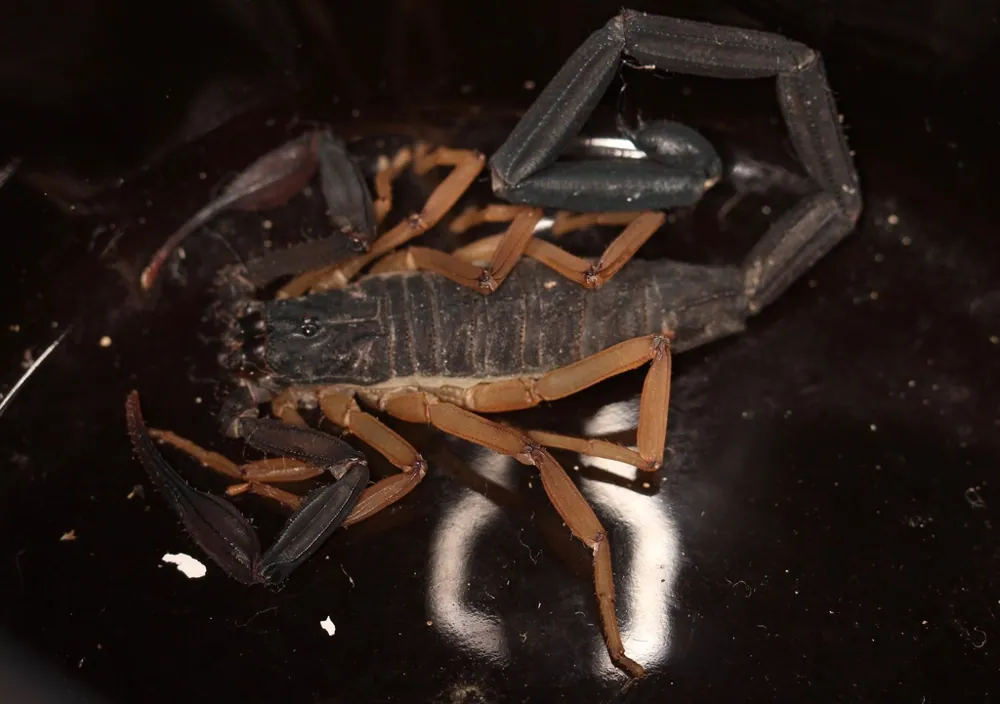
 Mmene ungaizindikirire
- Its colour varies. It may be reddish, black with reddish pincers, or dark brown with yellowish legs and red pincers.1
- Some individuals are dark brown with reddish and black tail sections.1
- Females reach up to 10 cm long. Males can grow over 15 cm long.1
Nthawi zambiri imasokonezedwa ndi: In Florida it lives alongside two native scorpions, the Hentz striped scorpion and the Guiana striped scorpion.1
Mphamvu ya ululu
Ululu umatuluka kudzera mu mbola.
Ululu wake umachita chiyani?
This scorpion is venomous, but much less toxic than others in its genus. Its venom is neurotoxic (it attacks the nerves) and cardiotoxic (it affects the heart), and it causes the release of catecholamines, hormones that speed up the body. Local effects include pain, redness, itching and swelling. Possible symptoms include irregular or fast heartbeat, fluid in the lungs, nausea, vomiting, sweating, diarrhoea, shock, convulsions and coma.1
Ndi yoopsa bwanji kwa anthu?
Ngozi kwa anthu: YopwetekaIngathe kupweteka kwambiri, koma pafupifupi nthawi zonse si vuto lalikulu.It is much less toxic than other scorpions in its genus. Serious symptoms can still occur, and death is possible.1
 Ikalasa
- Ziziritsa pamene walasidwa ndi paketi ya ayezi ndipo munthuyo akhale chete osasuntha. Peza thandizo la dokotala mwachangu, makamaka kwa ana: zinkhanira zina zimapha ana.
Nthawi zonse yamba wayimbira nambala yadzidzidzi (112, 000, 911). Awa ndi malangizo wamba a chithandizo choyamba, osati malangizo a dokotala. Zoyambira za chithandizo choyamba
 Khala wotetezeka
- Usakhudze, kugwira kapena kuseweretsa nyama yakuthengo, ngakhale yaing'ono, ndipo ngakhale ikuoneka ngati yagona kapena yafa.
- Ipatse malo. Ukakumana nayo, khala chete, bwerera m'mbuyo pang'onopang'ono ndipo uilole ipite njira yake.
- Ikakulasa: khala chete, usasunthe, imbira nambala yadzidzidzi (112, 000, 911) kapena pita kuchipatala mwachangu. Kumbukira m'mene inkaonekera, chithunzi chimathandiza.
Sikufuna kukuvulaza. Imagwiritsa ntchito ululu wake kugwira chakudya kapena kudziteteza, ndipo imakonda kwambiri kubisala. Zambiri za kukhala wotetezeka
Kuti padziko lapansi?
Ndi yaikulu bwanji?
Ndi yaitali bwanji?
 yaitali ngati zidutswa zomangira zoseweretsa 5 pamzere
 ingathamange mamita 100 m'masekondi 180 (munthu wothamanga kwambiri amafunika 9.6)
Florida bark scorpion ndi yaikulu bwanji poyerekeza ndi IWE?
Ndi masamu chabe mu msakatuli wako. Palibe chomwe chimasungidwa kapena kutumizidwa kwina.
Imathamanga bwanji?


Mfundo
Females can reproduce without a male, through a process called parthenogenesis.1
Newborn young ride on their mother's back.1
Tarantulas such as Tliltocatl vagans prey on it, and a tarantula may kill it even if the scorpion strikes first.1
In a laboratory study, males lived about 33 months on average and females about 38 months.1
Despite its name, it is native to northern Middle America, not Florida.1
Kuthetsa nthano zabodza
Nthano yabodza: It is a Florida native scorpion, as its name suggests.
Zoona: It is not native to Florida. It comes from northern Middle America and was introduced to Florida and other places.1
Za akatswiri a ululu
- Dzina la sayansi
- Centruroides gracilis
- Gulu
- Zinkhanira
- Banja
- Buthidae2
- Dongosolo
- Scorpiones
- Makontinenti
- Amereka ya Kumpoto, Amereka ya Kumwera
- Ana akhanda
- The female gives birth to a litter of 25 to 35 young, and litters of 91 have been recorded. The young ride on the female's back.1
- Ngozi kwa anthu
- 2 / 5: Yopweteka3
Kumene mfundo zimachokera
- Centruroides gracilis (Wikipedia (CC BY-SA 4.0))
- Centruroides gracilis (iNaturalist): mayina ndi magulu a sayansi.
- Venom Wiki: mlingo wa ngozi, kukula wamba ndi kuyerekeza kwa liwiro ndi zathu. Ona mmene timazipezera: Mmene timayezera ngozi.
Mfundo iliyonse patsamba lino ili ndi nambala yosonyeza kochokera. Ngati talakwitsa, pepani, ndife okonda nyama, osati magazini a sayansi. Tiuze pa [email protected] ndipo tikonza.
 Chinkhanira chili ndi njala! Venom Wiki ndi ntchito ya munthu mmodzi: yaulere, yopanda zotsatsa ndi zokutsatira. Mphatso yaing'ono imathandiza kuti ikhalebe pa intaneti.Dyetsa chinkhanira
Zina za gulu lomwelo: Zinkhanira
 Arizona bark scorpion
 Brazilian yellow scorpion
 Cuban blue scorpion
 Striped bark scorpion
 Giant desert hairy scorpion
 Amazonian black scorpion
Imakhalanso ku: Amereka ya Kumpoto
 TerciopeloNjoka za pit viperYakupha
 Eastern coral snakeNjoka za coralIngathe kupha
 Eastern diamondback rattlesnakeNjoka za rattlesnakeIngathe kupha
 Eyelash viperNjoka za pit viperIngathe kupha
 Timber rattlesnakeNjoka za rattlesnakeIngathe kupha
 Western diamondback rattlesnakeNjoka za rattlesnakeIngathe kupha