
 Africa
 Asia
Asia Ulaya
Ulaya Amereka ya Kumwera
 Australia ndi Oceania
 Antarctica
 Nyanja ya Pacific
 Nyanja ya Atlantic
 Nyanja ya Indian
 Nyanja ya Arctic
 Nyanja ya Mediterranean
 Nyanja Yofiira
 Nyanja ya Caribbean
 Nyanja ya Coral
 Nyanja ya South China
 Nyanja ya Philippine
 Nyanja ya Andaman
 Nyanja ya Kumpoto (North Sea)
 Nyanja ya Timor ndi Arafura
 Nyanja ya Bengal
 Gulf ya California
Lehmann's poison frog
 Poizoni pakhungu lakeImadya: TizilomboYa poizoni, si yaululu
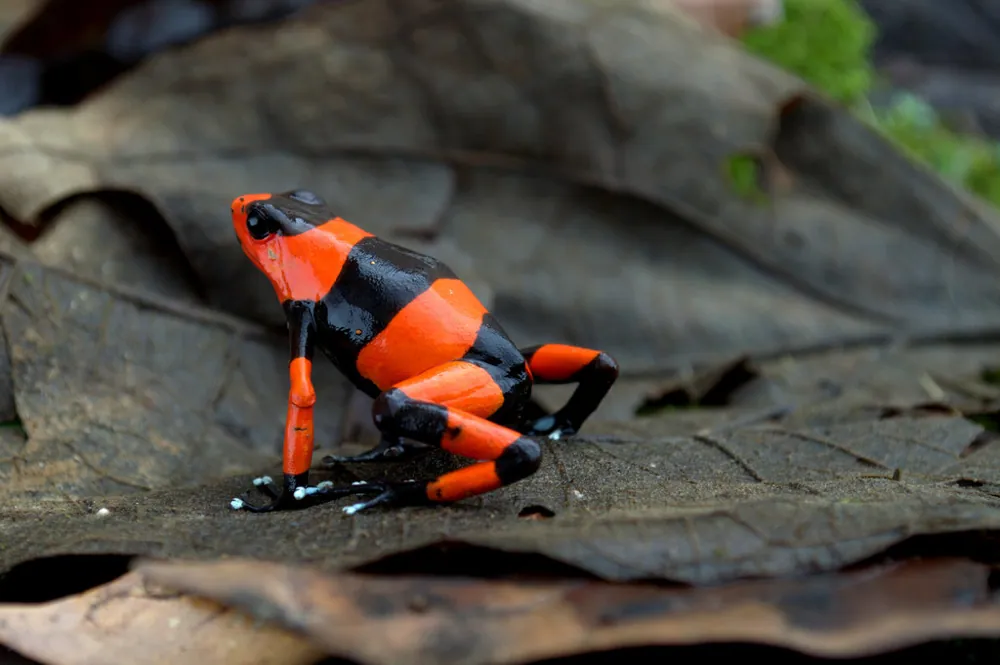
Lehmann's poison frog is a small, brightly marked frog that lives only in a small part of western Colombia. Its skin produces strong toxins, and its bright colours warn predators to leave it alone. It is critically endangered, so it matters for conservation as well as for safety.1


 Mmene ungaizindikirire
- Black or dark brown background with two bright, broad bands of colour round the body1
- Coloured bands on the arms and legs, and on the belly1
- Red, orange or yellow colour forms; each frog has its own unique pattern1
- Males have silver-tipped toes1
- Adults measure 31 to 36 mm from snout to vent1
Nthawi zambiri imasokonezedwa ndi: The harlequin poison frog (Oophaga histrionicus) looks very similar and can interbreed with it. Scientists still debate whether Lehmann's poison frog is a separate species. The main difference is that Lehmann's frog lacks histrionicotoxins, a type of toxin found in the harlequin frog. Males also have calls that differ between northern and southern populations.1
Mphamvu ya poizoni
Khungu lake lili ndi poizoni. Ndi yoopsa kuikhudza, kuinyambita kapena kuidya.
Poizoni wake umachita chiyani?
It is not venomous. Its skin produces toxins, including alkaloids such as pumiliotoxins, that can be very poisonous. Frogs bred in captivity are not poisonous, because their diet lacks the chemicals needed to make the toxins.1
Ndi yoopsa bwanji kwa anthu?
Ngozi kwa anthu: YoopsaMunthu akaikhudza kapena kuidya, pita kwa dokotala. Imfa ndi zosowa kwambiri.The skin toxins can be very poisonous to predators, and some native tribes of Colombia used them to coat their darts. Frogs in captivity are not poisonous.1
Imachita chiyani ikachita mantha?
Its bright, vivid colours act as a warning to predators that it is inedible.1
 Ngati munthu waikhudza kapena waidya
- Ngati munthu wakhudza imodzi: sambitsa m'manja bwino ndipo usakhudze maso kapena pakamwa. Ngati mwana kapena chiweto chanyambita kapena chadya imodzi: imbira malo othandiza pa za poizoni kapena nambala yadzidzidzi.
Nthawi zonse yamba wayimbira nambala yadzidzidzi (112, 000, 911). Awa ndi malangizo wamba a chithandizo choyamba, osati malangizo a dokotala. Zoyambira za chithandizo choyamba
 Khala wotetezeka
- Usakhudze, kugwira kapena kuseweretsa nyama yakuthengo, ngakhale yaing'ono, ndipo ngakhale ikuoneka ngati yagona kapena yafa.
- Ipatse malo. Ukakumana nayo, khala chete, bwerera m'mbuyo pang'onopang'ono ndipo uilole ipite njira yake.
- Ngati unaikhudza kapena kuidya: usasisite maso kapena pakamwa, sambitsa m'manja ndipo peza thandizo la dokotala.
Sikufuna kukuvulaza. Poizoni wake ulipo kuti pasapezeke choidya. Zambiri za kukhala wotetezeka
Kuti padziko lapansi?
Ndi yaikulu bwanji?
Ndi yaitali bwanji?
 yaitali pafupifupi ngati kachitsulo komangira mapepala
 ingathamange mamita 100 m'masekondi 97 (munthu wothamanga kwambiri amafunika 9.6)
Lehmann's poison frog ndi yaikulu bwanji poyerekeza ndi IWE?
Ndi masamu chabe mu msakatuli wako. Palibe chomwe chimasungidwa kapena kutumizidwa kwina.
Imathamanga bwanji?


Mfundo
In the wild, this frog is toxic, but frogs kept in captivity lose their toxicity because the toxins come from their diet.1
Tadpoles in the same pool may eat each other, so the male carries them to separate water pools.1
The male is the one who guards the eggs and carries the tadpoles on his back for two to four weeks.1
Its skin toxins are being studied for possible medicinal uses.1
Its bright colours are a warning, a strategy called aposematism.1
Kuthetsa nthano zabodza
Nthano yabodza: Lehmann's poison frog is always poisonous.
Zoona: Wild frogs are toxic, but frogs bred in captivity are not, because their diet lacks the chemicals needed to make the poison.1
Za akatswiri a ululu
- Dzina la sayansi
- Oophaga lehmanni
- Gulu
- Achule a poizoni, achule a mphini (toads) ndi ma newt
- Banja
- Dendrobatidae2
- Dongosolo
- Anura
- Makontinenti
- Amereka ya Kumwera
- Ana akhanda
- The female lays a small number of large eggs on leaves about 1.2 metres above the forest floor. The male fertilises them, keeps them moist, then carries the tadpoles on his back to small water pools such as tree hollows and bromeliad rosettes.1
- Mmene ilili kuthengo
- Critically endangered (IUCN); listed on CITES Appendix II1
- Ngozi kwa anthu
- 3 / 5: Yoopsa3
Kumene mfundo zimachokera
- Lehmann's poison frog (Wikipedia (CC BY-SA 4.0))
- Oophaga lehmanni (iNaturalist): mayina ndi magulu a sayansi.
- Venom Wiki: mlingo wa ngozi, kukula wamba ndi kuyerekeza kwa liwiro ndi zathu. Ona mmene timazipezera: Mmene timayezera ngozi.
Mfundo iliyonse patsamba lino ili ndi nambala yosonyeza kochokera. Ngati talakwitsa, pepani, ndife okonda nyama, osati magazini a sayansi. Tiuze pa [email protected] ndipo tikonza.
 Chinkhanira chili ndi njala! Venom Wiki ndi ntchito ya munthu mmodzi: yaulere, yopanda zotsatsa ndi zokutsatira. Mphatso yaing'ono imathandiza kuti ikhalebe pa intaneti.Dyetsa chinkhanira
Zina za gulu lomwelo: Achule a poizoni, achule a mphini (toads) ndi ma newt
 Golden poison frogAchule a poizoni, achule a mphini (toads) ndi ma newtYakuphaUsakhudze
 Cane toadAchule a poizoni, achule a mphini (toads) ndi ma newtIkufuna dokotalaUsakhudze
 Dyeing poison dart frogAchule a poizoni, achule a mphini (toads) ndi ma newtImangopwetekaUsakhudze
 Black-legged poison frogAchule a poizoni, achule a mphini (toads) ndi ma newtIngathe kuphaUsakhudze
 Bruno's casque-headed frogAchule a poizoni, achule a mphini (toads) ndi ma newtIkufuna dokotalaUsakhudze
 Harlequin poison frogAchule a poizoni, achule a mphini (toads) ndi ma newtIkufuna dokotalaUsakhudze
 Terciopelo
 Brazilian wandering spider
 Eyelash viper
 Golden lancehead
 South American bushmaster
 Peruvian giant centipede