
 Africa
 Asia
Asia Ulaya
Ulaya Amereka ya Kumwera
 Australia ndi Oceania
 Antarctica
 Nyanja ya Pacific
 Nyanja ya Atlantic
 Nyanja ya Indian
 Nyanja ya Arctic
 Nyanja ya Mediterranean
 Nyanja Yofiira
 Nyanja ya Caribbean
 Nyanja ya Coral
 Nyanja ya South China
 Nyanja ya Philippine
 Nyanja ya Andaman
 Nyanja ya Kumpoto (North Sea)
 Nyanja ya Timor ndi Arafura
 Nyanja ya Bengal
 Gulf ya California
South American rattlesnake
 Imaluma
The South American rattlesnake is a large, highly venomous pit viper. It lives across much of South America, except the Andes Mountains, and also on some Caribbean islands. It is the most widely spread member of its genus, which is why it matters to people in so many places.1


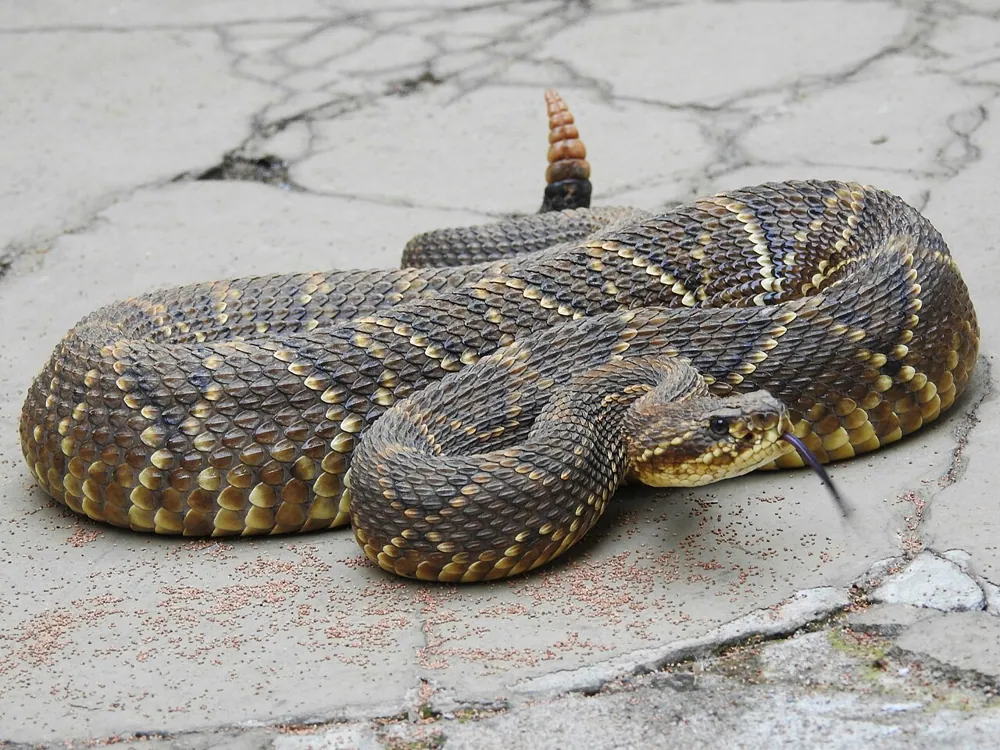
 Mmene ungaizindikirire
- Two distinct stripes start at the base of the head, and the colour between the lines is lighter than the stripes.1
- Body colour and pattern vary, but most have 18 to 32 dark diamond or rhombic spots along the back.1
- The head has a dark brown bar at the top and a dark band behind the eye.1
- The tail is usually grey, with dark, faint crossed bands.1
- The belly is white or yellowish with light grey spots, getting darker towards the tail.1
Mphamvu ya ululu
Ululu umatuluka kudzera m'mano ake ikaluma.
Ululu wake umachita chiyani?
Its venom contains neurotoxins, which attack the nerves, and myotoxins, which damage muscle. These cause progressive paralysis, including impaired or lost vision, hearing problems, drooping eyelids and weakness in the neck muscles, which can become so limp that the head appears broken. Breathing can eventually be stopped by paralysis, and the muscle damage can cause dark urine.1
Ndi yoopsa bwanji kwa anthu?
Ngozi kwa anthu: Yoopsa kwambiriIngathe kupha munthu amene sanalandire chithandizo.It is a highly venomous snake. The mortality rate is 72% for bite cases without specific serum treatment, and 11% for cases with it. Acute kidney failure is considered the main cause of death.1
 Nkhani yabwino: madokotala ali ndi mankhwala (antivenom) kapena chithandizo cha ichi.1
Imachita chiyani ikachita mantha?
It is highly alert and gives little warning before it strikes, but it is seldom aggressive towards people.1
 Ikaluma
- Specific serum treatment (antivenom) greatly lowers the death rate, so a bite needs urgent hospital care to give it.1
- Munthuyo akhale chete ndi wodekha, chiwalo cholumidwacho chikhale pamlingo wa mtima, chotsa mphete ndi zinthu zothina, ndipo mufikitse kuchipatala mwachangu.
Nthawi zonse yamba wayimbira nambala yadzidzidzi (112, 000, 911). Awa ndi malangizo wamba a chithandizo choyamba, osati malangizo a dokotala. Zoyambira za chithandizo choyamba
 Khala wotetezeka
- Usakhudze, kugwira kapena kuseweretsa nyama yakuthengo, ngakhale yaing'ono, ndipo ngakhale ikuoneka ngati yagona kapena yafa.
- Ipatse malo. Ukakumana nayo, khala chete, bwerera m'mbuyo pang'onopang'ono ndipo uilole ipite njira yake.
- Ikakuluma: khala chete, usasunthe, imbira nambala yadzidzidzi (112, 000, 911) kapena pita kuchipatala mwachangu. Kumbukira m'mene inkaonekera, chithunzi chimathandiza.
Sikufuna kukuvulaza. Imagwiritsa ntchito ululu wake kugwira chakudya kapena kudziteteza, ndipo imakonda kwambiri kubisala. Zambiri za kukhala wotetezeka
Kuti padziko lapansi?
Ndi yaikulu bwanji?
Ndi yaitali bwanji?
 yaitali ngati amphaka apakhomo 4 mphuno ndi mchira motsatizana
 yaitali ngati nthochi 11 zoyalidwa motsatizana
 ingathamange mamita 100 m'masekondi 90 (munthu wothamanga kwambiri amafunika 9.6)
South American rattlesnake ndi yaikulu bwanji poyerekeza ndi IWE?
Ndi masamu chabe mu msakatuli wako. Palibe chomwe chimasungidwa kapena kutumizidwa kwina.
Imathamanga bwanji?


Mfundo
The lethal dose for a 60 kg human is possibly 18 mg, while a snake's venom yield is 20 to 100 mg.1
Crotoxin, a neurotoxin, makes up about 48.5% to 89.4% of the venom proteins in one subspecies, though it is typically 60% to 70%.1
It is the most widely distributed member of its genus, and seven subspecies are currently recognised.1
It is more active at dusk and in the early hours of the morning.1
Males compete for access to females from the end of summer, with mating in autumn and the young born the following spring or summer.1
Kuthetsa nthano zabodza
Nthano yabodza: Yellow venom means the bite damages blood and tissue, and white venom means it attacks the nerves.
Zoona: Venom colour does not determine the type. Colour depends on pigments in the venom, not on whether it is haemorrhagic or neurotoxic.1
Za akatswiri a ululu
- Dzina la sayansi
- Crotalus durissus
- Gulu
- Njoka za rattlesnake
- Banja
- Viperidae2
- Dongosolo
- Squamata
- Makontinenti
- Amereka ya Kumwera
- Ana akhanda
- It gives birth to live young (ovoviviparous), usually four to eight at a time. In Roraima, Brazil, gestation has been reported to last five months, with up to 14 young.1
- Ngozi kwa anthu
- 4 / 5: Yoopsa kwambiri3
Kumene mfundo zimachokera
- Crotalus durissus (Wikipedia (CC BY-SA 4.0))
- Crotalus durissus (iNaturalist): mayina ndi magulu a sayansi.
- Venom Wiki: mlingo wa ngozi, kukula wamba ndi kuyerekeza kwa liwiro ndi zathu. Ona mmene timazipezera: Mmene timayezera ngozi.
Mfundo iliyonse patsamba lino ili ndi nambala yosonyeza kochokera. Ngati talakwitsa, pepani, ndife okonda nyama, osati magazini a sayansi. Tiuze pa [email protected] ndipo tikonza.
 Chinkhanira chili ndi njala! Venom Wiki ndi ntchito ya munthu mmodzi: yaulere, yopanda zotsatsa ndi zokutsatira. Mphatso yaing'ono imathandiza kuti ikhalebe pa intaneti.Dyetsa chinkhanira
Zina za gulu lomwelo: Njoka za rattlesnake
 Uracoan rattlesnakeNjoka za rattlesnakeIkufuna dokotala
 Eastern diamondback rattlesnakeNjoka za rattlesnakeIngathe kupha
 Timber rattlesnakeNjoka za rattlesnakeIngathe kupha
 Western diamondback rattlesnakeNjoka za rattlesnakeIngathe kupha
 SidewinderNjoka za rattlesnakeIkufuna dokotala
 Mojave rattlesnakeNjoka za rattlesnakeIngathe kupha
Imakhalanso ku: Amereka ya Kumwera
 Golden poison frogAchule a poizoni, achule a mphini (toads) ndi ma newtYakuphaUsakhudze
 TerciopeloNjoka za pit viperYakupha
 Brazilian wandering spiderAkangaudeIngathe kupha
 Eyelash viperNjoka za pit viperIngathe kupha
 Golden lanceheadNjoka za pit viperIngathe kupha
 South American bushmasterNjoka za pit viperIngathe kupha